
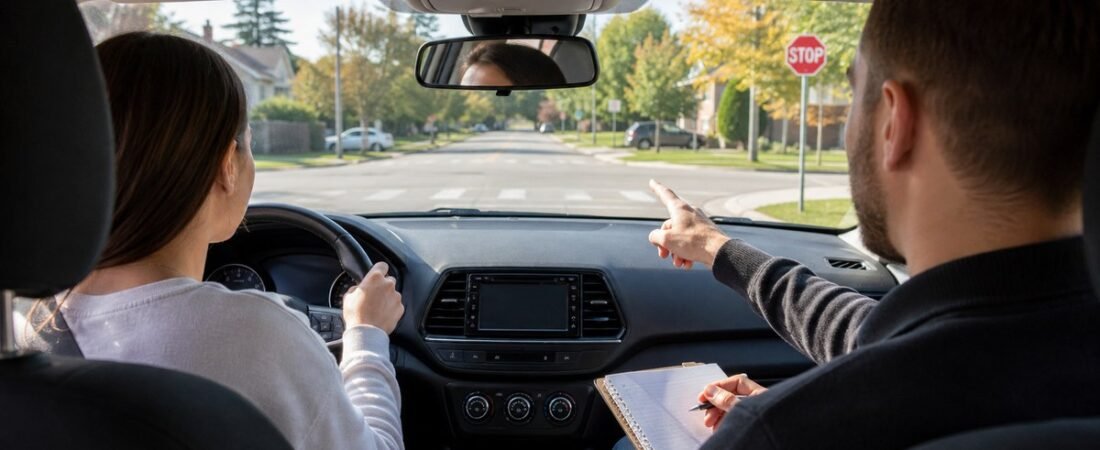
Missed observation checks, incomplete stops, right-of-way errors and poor vehicle control can undermine a G2 road test. This guide explains ten mistakes to practise correcting before test day. These are practical preparation topics, not an official ranking of Ontario test failures.
1. Missed observation checks (mirrors and blind spots)
Examiners need to see that you know what is around the vehicle before you move. That means checking mirrors, checking blind spots where needed, and scanning ahead before turns, lane changes, parking and pulling away.
A common mistake is checking after the vehicle has already started moving into another road user’s space. Observation needs to inform the manoeuvre.
How to fix it: Practise checking your surroundings before steering or changing position, while continuing to watch the road ahead.
2. Rolling or incomplete stops
Slowing almost to a stop is not a complete stop. Another mistake is stopping beyond the stop line or entering the crosswalk before checking for pedestrians and traffic.
When visibility is limited, the initial stop and the movement needed to see approaching traffic are separate decisions.
How to fix it: Stop fully at the required position. If your view is blocked, move forward cautiously only when safe, then check again before proceeding.
3. Right-of-way mistakes at intersections
Turning left without a safe gap, misunderstanding who should proceed at an intersection, or assuming another driver will yield can create an unsafe situation. Hesitating after a clearly safe opportunity can also show uncertainty.
A green light does not remove the need to check for pedestrians, cyclists or vehicles already in the intersection.
How to fix it: Practise identifying traffic controls, other road users and potential conflicts before deciding whether to proceed.
4. Wrong speed — too fast or too slow for conditions
Driving at the posted limit can still be too fast when visibility, weather or traffic conditions require a lower speed. Driving unnecessarily slowly in clear conditions can also disrupt traffic and lead to poor decisions.
School zones, curves, construction and parked vehicles require attention early enough to adjust smoothly.
How to fix it: Check your speed regularly and adjust early for the posted limit, visibility, traffic and road conditions.
5. Poor lane position and drifting
Drifting toward parked cars, hugging the centre line or wandering within the lane makes your driving less predictable. Looking too close to the front of the vehicle can lead to repeated steering corrections.
Good lane position also includes leaving appropriate space from parked vehicles and other hazards.
How to fix it: Look farther ahead, make small steering adjustments and practise maintaining a steady position with safe clearance.
6. Unsafe lane changes
Signalling does not make a lane change safe. Moving without checking a blind spot, choosing a gap that is too small or steering abruptly can put other road users at risk.
A lane change should be a planned decision, not a rushed response to an instruction or a missed turn.
How to fix it: Check mirrors, signal, check the relevant blind spot and confirm a safe gap before moving smoothly into the lane. If the gap is unsafe, wait.
7. Parking errors (parallel, reverse, and three-point turns)
Parking and turning manoeuvres can go wrong when you rush, use inconsistent reference points or stop checking your surroundings while reversing.
Concentrating only on where the vehicle will finish can cause you to miss pedestrians, approaching vehicles or changes in the space around you.
How to fix it: Practise slowly, observe throughout the manoeuvre and stop to reassess when necessary. Build consistent control before trying to complete the manoeuvre faster.
8. Following too closely
A short following distance leaves less time to react when traffic slows or stops. Watching only the vehicle immediately ahead can also prevent you from noticing developing hazards farther along the road.
Rain, snow, poor visibility and other difficult conditions can require additional space.
How to fix it: Maintain a safe following gap, look beyond the vehicle ahead and increase your space when conditions reduce visibility or traction.
9. Not yielding to pedestrians and cyclists
Pedestrians and cyclists can be easy to miss when your attention is fixed on vehicle traffic. Turning across a pedestrian’s path or crossing a cyclist’s path without checking can create an immediate conflict.
Pay particular attention when approaching intersections, crosswalks, driveways and turns across cycling facilities.
How to fix it: Scan for pedestrians and cyclists before and during turns, check blind spots where needed and yield as required before proceeding.
10. Test nerves creating new mistakes
Some students drive well in lessons but become tense during the test. They may rush familiar manoeuvres, forget checks or keep thinking about a small mistake instead of the road ahead.
A mock test with minimal coaching can show which habits change under pressure.
How to fix it: Practise driving without continuous prompts, ask for clarification if an instruction is unclear and return your attention to the next safe decision after a mistake.
How should you turn road-test feedback into a practice plan?
Group feedback by driving habit instead of trying to fix every mark at once. Start with safety-critical observation and right-of-way decisions, then work on speed and lane position, and finish with parking or manoeuvre consistency.
- Identify the habits that appear repeatedly in feedback.
- Practise difficult manoeuvres slowly before adding complexity.
- Drive on different roads and in different traffic conditions.
- Complete a mock test with minimal coaching.
- Review whether improvements remain consistent when you feel under pressure.
When should you book the G2 road test?
Book when the required skills are consistent across several drives and you can make safe decisions without continuous coaching.
No lesson or mock test can guarantee a pass, but a realistic assessment can show which habits still need work before your appointment.
Need help getting road-test ready?
SparkOn Driving Academy helps students in Scarborough and nearby GTA areas prepare with patient lessons, mock tests and road-test car support.