
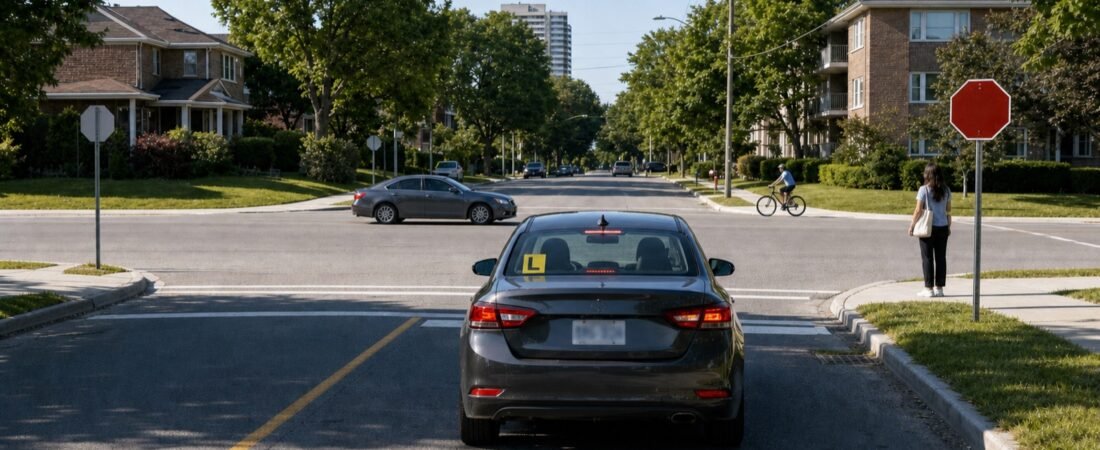
Four-way stops look simple until several drivers arrive together, someone rolls past the line, a pedestrian steps toward the crossing and nobody seems sure who should move. For learner drivers in Scarborough, the safest solution is a repeatable routine: stop in the correct place, identify the order, scan every path and proceed only when the intersection is clear.
The Ontario Four-Way Stop Rules
The Official MTO Driver’s Handbook gives two core rules for an intersection with stop signs at every corner:
- First stopped, first to go: yield to the vehicle that came to a complete stop before you.
- Same-time arrival: if two vehicles stop at the same time, the driver on the left yields to the driver on the right.
These rules organize the vehicles, but they are not permission to move blindly. The same handbook says turning drivers must yield to pedestrians in or approaching their path. A left-turning driver must also wait for approaching traffic to pass or turn. Signalling does not create right-of-way; the way still has to be clear.
Before applying any of that, confirm that the intersection really is an all-way stop. Look for a stop sign controlling every approach. At a two-way stop, traffic on the through road does not stop, so taking turns by arrival order would be dangerous.
Where to Stop—Before You Decide Who Goes First
A rolling stop makes the arrival order harder for everyone to read. Ontario’s stopping guidance requires a complete stop at every stop sign and gives a clear priority for stop position:
- Stop at the marked stop line.
- If there is no stop line, stop at the crosswalk, whether it is marked or not.
- If there is no crosswalk, stop at the edge of the sidewalk.
- If there is no sidewalk, stop at the edge of the intersection.
Approach smoothly, check the mirror before braking and stop with the vehicle settled—not still creeping. If a hedge, snowbank, parked van or building blocks your view, make the required stop first. Then inch forward only as much as needed to see, stopping again if necessary. Do not drive straight through the first stopping position to get a better view.
A Five-Step Routine for Scarborough All-Way Stops
- Recognize the control. Scan all corners early and confirm whether every approach has a stop sign.
- Brake early and stop correctly. Check behind, signal if turning and come to a full stop at the proper line or boundary.
- Track complete stops. Notice which vehicle became stationary before you—not which one reached the general area first.
- Scan left, ahead and right. Recheck sidewalks, crosswalks, cyclists and the path of every turning vehicle.
- Proceed decisively when safe. Move smoothly through the correct lane without racing another driver or changing your plan mid-intersection.
This routine works well on quieter residential streets in Agincourt, Malvern and Woburn, where parked vehicles, mature trees and busy sidewalks can limit sightlines. It also helps during school pickup periods, when several road users may arrive in quick succession. For a deeper pedestrian review, use SparkOn’s guide to school zones and pedestrian crossovers in Ontario.
Common Four-Way Stop Scenarios
You Stop Before the Vehicle on Your Right
You are first to a complete stop, so you normally go first once the intersection and your path are clear. Do not surrender the turn just because the other driver is on your right; the right-side rule is the tie-breaker for simultaneous stops, not a replacement for first stopped, first to go.
You and a Driver on Your Right Stop Together
Yield and let the driver on your right proceed. Keep watching the whole intersection while waiting. The vehicle may turn instead of travelling straight, and a pedestrian may enter a crossing that affects both of you.
You Face an Opposing Vehicle and Want to Turn Left
If the opposing vehicle is going straight or turning right and the movements conflict, the left-turning driver waits. This is the ordinary left-turn duty to yield to approaching traffic. SparkOn’s unprotected left-turn guide explains how to judge the path without rushing.
Three or Four Vehicles Arrive Close Together
Use the order of complete stops, one movement at a time. If two stops were simultaneous, apply the left-yields-to-right rule between those drivers. Avoid relying on a vague wave through a tinted windshield. If the order has become genuinely uncertain, pause, make eye contact when possible and yield rather than forcing the issue. A brief delay is safer than two vehicles entering together.
A Pedestrian or Cyclist Enters Your Path
Wait even if it was your turn among the vehicles. Look for people approaching from both sidewalks, and check the relevant blind spot before turning. A cyclist can approach from behind or from a path that was outside your first forward scan. Your place in the vehicle sequence does not override a road user already crossing your path.
Mistakes That Create Confusion
- Rolling through: other drivers cannot tell when your stop occurred, and the stop is incomplete.
- Watching only one car: a pedestrian, cyclist or third vehicle can change the safe order.
- Treating the right-side rule as universal: it applies when vehicles stop at the same time; the first complete stop otherwise comes first.
- Assuming a signal guarantees the movement: drivers forget signals or change their minds. Wait for a clear path.
- Following the vehicle ahead through: every vehicle must make its own stop and reassess the intersection.
- Entering a blocked intersection: do not move merely because it is your turn if you cannot clear the crossing.
What Road-Test Candidates Should Practise
Ontario’s official Level Two road-test guidance describes the stop-intersection task in practical terms. It says to check traffic before slowing, reduce speed steadily, come to a complete stop without rolling forward or backward, use the correct stop position, and keep checking while waiting. Just before entering, look left, ahead and right to confirm the way is clear.
The goal is not an exaggerated head movement or a memorized local route. It is visible, timely observation connected to a safe decision. During practice, have your accompanying driver note whether you:
- identified the all-way stop early;
- checked the mirror before braking;
- stopped fully behind the correct boundary;
- remembered the arrival order;
- rescanned sidewalks and traffic before moving; and
- accelerated smoothly into the proper lane.
These habits fit naturally into structured road-test preparation and help on everyday neighbourhood drives long after the test.
One More Use for the All-Way-Stop Routine
If traffic lights are dark during a power failure, the MTO’s traffic-light guidance says to yield to vehicles already in the intersection and to vehicles entering from your right, then proceed cautiously as you would at an all-way stop. A dark signal can be harder to recognize than a stop sign, so reduce speed early and expect another driver to misunderstand the situation.
Practise Four-Way Stops With a Scarborough Instructor
SparkOn’s one-on-one driving lessons in Scarborough help G1, G2 and G drivers build a calm routine for all-way stops, pedestrian checks, turns and busy neighbourhood intersections.
Book a Scarborough driving lesson and tell us which intersection situations make you hesitate.