
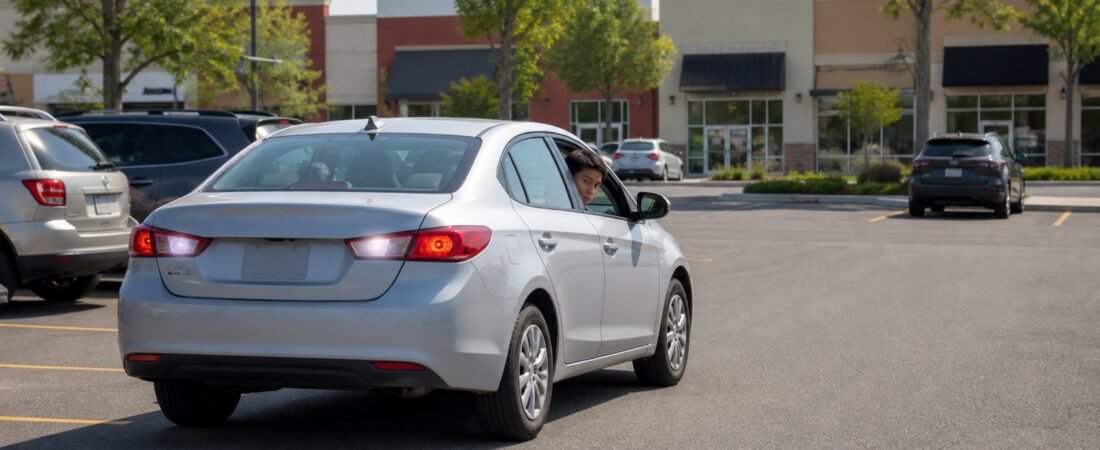
Backing out of a parking space can feel harder than driving forward because your view is limited, the steering response feels reversed, and the scene can change quickly. In a busy Scarborough plaza, a pedestrian, shopping cart or another vehicle may appear after you have already checked. The answer is not to rush—it is to use a repeatable routine, move at walking pace and be ready to stop.
Start by making the next exit easier
Safe reversing begins when you choose the space. Look for a spot with good visibility rather than squeezing beside a large SUV, van or pickup that blocks your view of the driving aisle. Park centred between the lines so you have room to turn without bringing the front corner of your car too close to the vehicle beside you.
When it is permitted and practical, a pull-through space lets you leave going forward. If you must reverse out later, notice fixed objects while you approach: curbs, concrete posts, cart corrals, light standards and the direction vehicles normally travel through the aisle. This quick mental map is useful because some objects disappear below the windows once you are seated.
Before moving, use the same basic cabin setup every time. SparkOn’s guide to adjusting your seat and mirrors explains how a consistent position improves your view and control.
Use a complete pre-reverse check
The Official MTO Driver’s Handbook backing guidance, updated March 31, 2026, says to move slowly, make sure the way is clear before beginning, and pay special attention to children and cyclists. A useful parking-lot routine is:
- Walk up looking: As you return to the car, scan behind it and beside it for people, carts, low objects and vehicles with illuminated reverse lights.
- Settle before shifting: Close the doors, remove distractions, fasten your seatbelt, start the vehicle and confirm that your mirrors are still correctly positioned.
- Check all around: Look through the windshield, both front side windows, both mirrors and over both shoulders. Do not focus only on the rear.
- Select reverse and pause: A short pause gives other road users time to notice your reverse lights. Recheck the driving aisle before releasing the brake.
- Move slowly enough to stop immediately: Cover the brake and use minimal accelerator input. If the view changes, stop and check again.
Look in the direction the car is moving
For straight backing or a reverse movement toward the right, the MTO tells drivers to turn their body and head to the right and look back over the right shoulder. For reversing toward the left, turn and look over the left shoulder. The handbook also says to check the opposite shoulder.
That last check matters in parking lots. Your rear may be travelling one way while the front of the car swings the other way. If you turn the wheel left while reversing, for example, the rear moves left but the front corner swings right. Keep checking both the path behind the vehicle and the clearance beside its front bumper.
Use the mirrors to update your side clearance, then return your eyes to the direction of travel. Do not lock your gaze on one mirror. A steady scan is more useful than one long look.
Treat the rear camera as an extra view
A rear-view camera can reveal pavement directly behind the bumper, but its screen is only one part of the scene. It may not show a person or vehicle approaching from the side soon enough, and dirt, rain or glare can reduce the image. Parking sensors can also miss some low, narrow or moving hazards.
Use the camera to support your direct observations, not replace them. Check the screen briefly for the close area behind the vehicle, then continue looking through the windows, mirrors and over your shoulders. The same principle applies to blind-spot technology: driver-assist alerts do not replace shoulder checks.
Back out in stages instead of one continuous sweep
New drivers often try to complete the whole manoeuvre without stopping. A safer approach is to divide it into small stages.
Begin with the steering wheel straight and reverse slowly until the rear of your car clears the vehicles beside you. Stop if your view into the aisle is blocked. Once you can see farther in both directions, scan again for traffic and pedestrians. Continue only when the aisle is clear, then begin turning the wheel so the car lines up with the aisle.
As the vehicle straightens, unwind the steering smoothly. Stop completely before shifting from reverse to drive. This deliberate pause protects the transmission and gives you one more chance to check the new forward path.
Know when another road user has changed the plan
If a pedestrian walks behind your car, stop and wait until the person is completely clear—not merely outside the camera image. If another vehicle enters the aisle, stop and establish what it is doing. Do not compete for the same space or assume the other driver has seen you.
If two vehicles begin reversing toward each other, both drivers should stop. Make eye contact when possible, communicate clearly, and let one vehicle finish before the other continues. If a horn sounds, treat it as new information: stop immediately, secure the car with the brake and rescan the entire area.
Never let a waiting driver pressure you into moving before you can see. A calm five-second recheck is better than a hurried guess.
Practise steering control somewhere quiet first
Choose a quiet, legal practice area during a low-traffic period and work with a qualified accompanying driver or instructor. Start by reversing straight between two visible reference lines. Keep the steering wheel nearly centred and make small corrections. Next, practise stopping, checking both directions and backing through a gentle curve.
Use fixed visual references, but do not memorize a single wheel-turn formula. Every parking space, vehicle and starting angle is different. The goal is to understand where the rear wheels are going, how the front swings, and when to pause for another observation check. SparkOn’s parking-manoeuvre practice guide provides a useful next step after basic straight-line control.
Reversing is a tested driving skill—not a shortcut
Ontario’s driver-licence handbook overview lists reversing among the skills assessed on road tests. Examiners are looking for safe observation and control, not speed. Build the habit of checking before the car moves, looking in the direction of travel and stopping whenever the path becomes uncertain.
Reversing should also never be used to recover from a missed highway exit. The MTO handbook states that driving in reverse is illegal on the travelled section or shoulder of a divided road with a speed limit above 80 km/h, except when helping someone in trouble. On Highway 401, continue forward and take the next safe exit.
Your Scarborough parking-lot reversing checklist
- Choose a space with the clearest available sight lines.
- Scan behind and around the vehicle as you approach it.
- Check windows, mirrors and both shoulders before shifting.
- Pause in reverse, then move at walking pace with the brake covered.
- Look mainly in the direction of travel and keep checking the opposite side.
- Watch the front corners as the rear changes direction.
- Use cameras and sensors as support, not as your only view.
- Stop immediately if a person, vehicle or horn changes the situation.
- Straighten fully and stop before selecting drive.
Build confident low-speed control with a Scarborough instructor
Parking-lot reversing becomes easier when observation and steering are practised together. A SparkOn instructor can help you slow the routine down, understand front-end swing and build the all-around checks needed for everyday driving and road-test preparation.
Explore driving lessons in Scarborough or contact SparkOn Driving Academy to book focused practice in a calm, progressive lesson.