
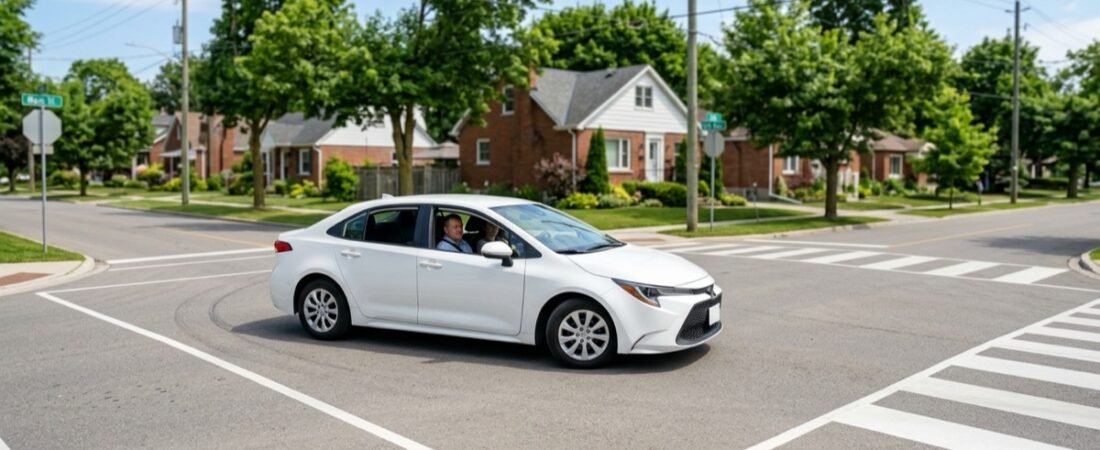
Making a U-turn can be one of the most confusing manoeuvres for new drivers in Scarborough and the Greater Toronto Area. While it might seem like a simple way to change directions when you’ve missed a turn or taken a wrong route, executing a U-turn legally and safely requires a solid understanding of Ontario’s traffic laws and excellent observation skills.
At SparkOn Driving Academy, we often get asked by our G1 and G2 students: “Are U-turns actually legal in Ontario?” The short answer is yes—but with several critical exceptions. While you won’t be explicitly asked to perform a U-turn on your G2 road test (examiners typically test the three-point turn instead), knowing when and how to make a U-turn safely is a crucial daily driving skill.
Quick Answer for Ontario Drivers
U-turns are legal in Ontario only when no sign prohibits them, the road is clear, and you can see at least 150 metres in both directions. Do not make a U-turn on a curve, near a railway crossing, near a hilltop, or anywhere a bridge, tunnel, traffic, weather, or road layout blocks your view.
Are U-Turns Legal in Ontario?
Yes, U-turns are generally permitted in Ontario at intersections and on roads unless there is a specific sign prohibiting them or if the road conditions make it unsafe. Unlike some jurisdictions where U-turns are strictly banned at all traffic lights, Ontario allows them provided you follow the rules laid out in the Official MTO Driver’s Handbook and the Highway Traffic Act.
Where Are U-Turns Illegal in Ontario?
The law is very clear about where U-turns pose a significant danger to yourself and other road users. According to the MTO, you must never make a U-turn in the following situations:
- Where a “No U-Turn” sign is posted: This is the most obvious restriction. Always scan the intersection or median for this regulatory sign before attempting the turn.
- On a curve in the road: Approaching vehicles will not be able to see you in time to stop.
- On or near a railway crossing: Stalling or getting stuck on train tracks while turning is a catastrophic risk.
- Near a hilltop or on a bridge or tunnel: Any terrain that obstructs your line of sight or the sightline of oncoming drivers makes a U-turn strictly illegal.
- When you cannot see 150 metres in both directions: This is the golden rule of U-turns in Ontario. If your visibility is blocked by weather, obstacles, or road layout such that you cannot clearly see 150 metres (about 1.5 football fields) down the road in both directions, do not attempt the turn.
Navigating U-Turns at Traffic Lights in Scarborough
Making a U-turn at a signalized intersection adds another layer of complexity. If you are stopped at a red light, you cannot make a U-turn. You must wait for a solid green light or an advanced green left-turn arrow. When you have an advanced green arrow, you have the right-of-way over oncoming traffic, but you must still watch out for pedestrians who might be crossing illegally, or opposing vehicles attempting a right turn on red without stopping.
Always ensure your vehicle can clear the median or traffic island without reversing. Many major intersections in Scarborough, such as those along Sheppard Avenue or Markham Road, have wide medians that are suitable for U-turns, but always double-check for specific “No U-Turn” signs mounted on the traffic light poles.
Step-by-Step: How to Make a Safe U-Turn
If you find yourself on a wide residential street in Scarborough, such as near Malvern or Agincourt, and you need to turn around, follow these steps to ensure you execute the manoeuvre safely:
- Scan for Signs: Double-check the intersection and the right side of the road for any “No U-Turn” signs.
- Check Visibility: Ensure you have a clear view of at least 150 metres in front of you and behind you. If you are near a hill, curve, or in heavy fog, proceed to the next intersection or find a safe driveway to use instead.
- Signal and Position: For the roadside method taught in the MTO handbook, signal right, check your mirrors and blind spot, and pull over to the right side of the road before starting the turn. If you are already in a marked left-turn lane at a controlled intersection, wait until the signal permits the movement and confirm there is no “No U-Turn” sign.
- Check Mirrors and Blind Spots: Check your rearview mirror, both side mirrors, and shoulder check before moving. Watch for vehicles, cyclists, and pedestrians beside you, behind you, or approaching from either direction.
- Yield the Right-of-Way: This is where many new drivers make mistakes. You must yield to all oncoming traffic. You must also yield to pedestrians crossing the street you are turning into, and yield to vehicles turning right on a red light from the opposing direction.
- Execute the Turn Smoothly: Turn your steering wheel sharply to the left and proceed at a slow, controlled speed. Aim to finish your turn in the correct lane (usually the right-most available lane) to avoid interfering with faster-moving traffic.
- Accelerate Safely: Once you have completed the turn and your wheels are straight, accelerate smoothly to match the speed of traffic.
U-Turn Safety Checklist for Ontario Drivers
- ✅ Is there a “No U-Turn” sign?
- ✅ Am I on a straight section of road, not a curve?
- ✅ Am I far away from bridges, tunnels, and railway crossings?
- ✅ Can I clearly see 150 metres in both directions?
- ✅ Is the road wide enough for my vehicle’s turning radius?
- ✅ Have I signaled my intention?
- ✅ Is the path clear of oncoming traffic, cyclists, and pedestrians?
Common U-Turn Mistakes to Avoid
When our instructors evaluate experienced drivers during refresher lessons, we frequently see these common U-turn errors:
- Misjudging the Turning Radius: Not all cars can make a tight U-turn in one continuous motion. If the road is too narrow, you will get stuck horizontally across the lanes, creating a dangerous situation. If the road is narrow, opt for a three-point turn instead.
- Assuming Other Drivers See Your U-Turn: Even when your signal is green, another driver may turn right, roll forward, or misjudge your path. Slow down, make eye contact where possible, and only turn when the receiving lane is clearly open.
- Rushing the Turn: Making a U-turn out of frustration because you missed a turn can lead to aggressive steering, tire squealing, or failing to notice pedestrians. Stay calm and take your time.
What Happens if You Make an Illegal U-Turn in Ontario?
Making an illegal U-turn is a violation of the Ontario Highway Traffic Act. Depending on the exact charge, a prohibited turn can result in a set fine plus surcharge and court costs, and prohibited turns are listed under Ontario’s 2-point demerit category. For G1 and G2 drivers, accumulating demerit points can lead to warning letters or even licence suspension much faster than fully licensed G drivers. It’s simply not worth the risk to rush a turn.
Official Ontario Sources Used
- Official MTO Driver’s Handbook: Changing directions
- Ontario Highway Traffic Act, section 143: U-turns prohibited
- Ontario demerit points overview
When Should You Use a Three-Point Turn Instead?
If you are driving on a narrow residential street in Scarborough where a U-turn is physically impossible without hitting the opposite curb, you should use a three-point turn. The three-point turn is a mandatory skill evaluated on the G2 road test because it allows you to turn around safely in tight spaces.
Unlike a U-turn which requires a wide continuous sweep, a three-point turn involves pulling over to the right, checking traffic, turning sharply left across the road, reversing to the right, and then driving forward. If you are unsure if your vehicle can clear a U-turn, a three-point turn is always the safer and more controlled option.
Learn Defensive Driving with SparkOn Driving Academy
Understanding when and how to execute manoeuvres like U-turns safely is what separates an average driver from an excellent, defensive driver. At SparkOn Driving Academy, we focus on building confidence and situational awareness for all our students in Scarborough and the surrounding areas.
Whether you are preparing for your upcoming G2 test, upgrading to your Full G, or simply looking to improve your daily driving skills, our MTO-approved instructors are here to help.
Contact us today to book a lesson and start your journey towards becoming a safe, confident driver in Ontario!