
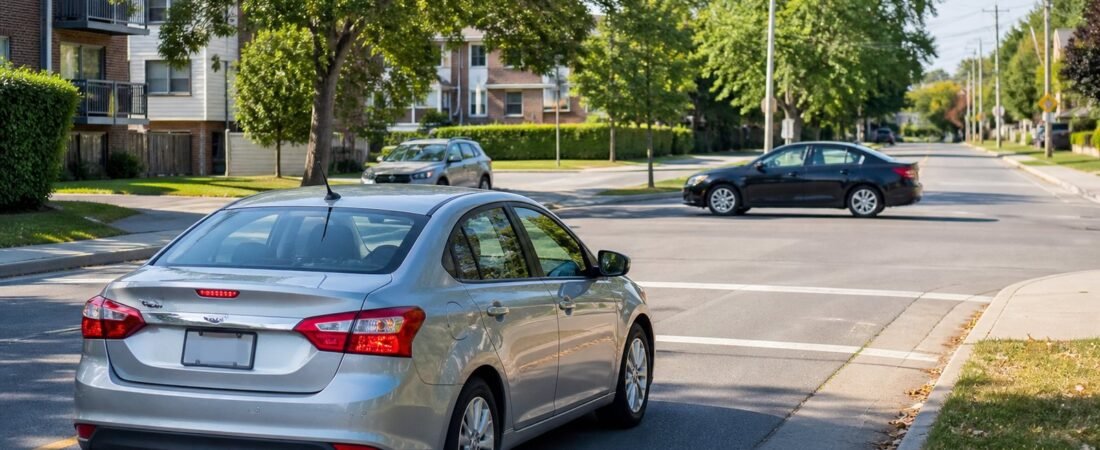
Not every intersection in Scarborough is a four-way stop or traffic light. Many side streets, neighbourhood crossings, plaza exits and quiet residential roads use two-way stops, yield signs or no signs at all. That is where new drivers often hesitate: “Do I go first, or do I wait?”
This guide explains a practical Ontario routine for two-way stops and uncontrolled intersections. It is written for G1, G2 and G drivers who want calmer decision-making on Scarborough roads without guessing, rushing or forcing other drivers to brake.
First, identify what controls your direction
Before thinking about who goes first, identify what controls your lane. Are you facing a stop sign? A yield sign? A traffic light? No sign at all? Is the cross street controlled, or does it move freely? Many mistakes happen because a learner sees another driver stop and assumes every direction has the same sign.
The Official MTO Driver’s Handbook section on signs explains that a stop sign means you must come to a complete stop and wait until the way is clear. It also explains that a yield sign means you must let traffic in or near the intersection go first, stopping if necessary. Those two signs feel similar when traffic is busy, but they are not the same instruction.
In Scarborough neighbourhood practice, train your eyes to scan both sides of the intersection before you arrive. Look for signs facing you, signs facing the cross street, stop lines, crosswalks, pedestrians, cyclists and parked vehicles that may block sightlines.
At a stop sign, stop completely and stop in the right place
Rolling slowly through a stop is not enough. The MTO Driver’s Handbook guidance on stopping says drivers must come to a complete stop for stop signs and red lights. If a stop line is marked, stop at the line. If there is no stop line, stop at the crosswalk, marked or unmarked. If there is no crosswalk, stop at the edge of the sidewalk, and if there is no sidewalk, stop at the edge of the intersection.
That order matters on residential Scarborough streets because parked cars, hedges and wide sidewalks can make visibility uneven. Stop where the rule requires, then edge forward only if your view is blocked and it is safe to do so. Creeping for visibility is not the same as rolling through the stop.
Two-way stops: cross traffic usually has priority
A two-way stop means only some directions are required to stop. If you are on the stopped side street and the cross street has no stop sign, you must wait until the cross traffic is clear. This is the part that catches many new drivers: the other vehicle may not be “taking your turn.” It may not have a stop sign at all.
Use this simple Scarborough side-street routine:
- Stop completely at the correct place.
- Check left, centre, right, then left again before moving.
- Confirm whether cross traffic is actually slowing or simply continuing through.
- Yield to pedestrians and cyclists crossing your path.
- Move only when your turn will not make another road user brake, swerve or guess.
If you are turning from a side street onto a busier road, add extra patience. Gaps can close quickly on roads such as Lawrence Avenue East, Ellesmere Road, Markham Road, Morningside Avenue or Kingston Road. This article targets Scarborough driving situations; the Markham Road example refers to the Scarborough roadway, not Markham city targeting.
Uncontrolled intersections: no signs does not mean no rules
An uncontrolled intersection has no stop signs or traffic lights. According to the MTO Driver’s Handbook section on driving through intersections, uncontrolled intersections are usually found where there is not much traffic, and drivers must be extra careful. If two vehicles arrive from different roads at the same time, the driver on the left must let the driver on the right go first.
For new drivers, the key is to slow early enough to understand the scene. Do not assume the other driver sees you. Look for wheel movement, eye direction, signals and speed. If your view is blocked by parked cars or snowbanks, slow more and be ready to stop.
Turning left adds another yielding decision
Left turns create extra judgment at both two-way stops and uncontrolled intersections. The MTO’s intersection guidance says that at any intersection where you want to turn left or right, you must yield to pedestrians crossing your path. For left turns, the MTO Driver’s Handbook section on changing directions also emphasizes yielding to pedestrians and oncoming traffic before turning.
At a two-way stop, imagine you and an oncoming driver are both stopped on opposite side streets. If you are turning left and the other driver is going straight, your safest habit is to wait unless you clearly have a protected, safe gap and the other driver’s intention is obvious. Do not turn across the front of a vehicle simply because you stopped first.
For more turning practice, review SparkOn’s guide to unprotected left turns in Scarborough.
Pedestrians and cyclists change the order
Drivers often focus so hard on cars that they miss people crossing. At any stop or uncontrolled intersection, scan the sidewalks and corners before moving. A pedestrian stepping off the curb, a cyclist approaching from the side, or a child near a driveway can change your decision immediately.
This connects directly with SparkOn’s guide to school zones and pedestrian crossovers and the article on driving near cyclists in Scarborough. Even when you know the vehicle order, you still need a clean path for vulnerable road users.
Common mistakes at side-street intersections
Watch for these habits during practice:
- Copying another driver: stopping only because someone else stopped, without checking your own sign.
- Rolling the stop: slowing down but never fully settling the vehicle.
- Stopping too far forward: blocking the crosswalk or entering the cross street before the way is clear.
- Looking only left: missing pedestrians, cyclists or a right-side vehicle at an uncontrolled intersection.
- Trusting a signal too much: moving because another vehicle signals, before confirming it actually turns.
- Rushing under pressure: letting a honk from behind push you into an unsafe gap.
If pressure from behind is a problem, SparkOn’s guide to responding safely to tailgaters is worth reviewing.
Scarborough practice checklist
Use this checklist during your next lesson or supervised practice:
- Name the control: stop, yield, light or no sign.
- Stop completely at the correct position when required.
- Look left, centre, right, then left again before entering.
- Check whether cross traffic has a stop sign or is moving freely.
- Yield to pedestrians and cyclists before vehicle priority decisions.
- At uncontrolled intersections, yield to the right if vehicles arrive together.
- When turning left, wait for pedestrians and oncoming traffic to clear.
- Ignore pressure from behind; move only when the gap is safe.
Practise with a structured Scarborough lesson
Two-way stops and uncontrolled intersections reward patience, observation and clear decisions. You do not need to memorize every side street in Scarborough. You need a repeatable routine that works whether you are near a plaza exit, a residential T-intersection or a quiet local road with no signs.
If these intersections still feel confusing, book a focused lesson with SparkOn Driving Academy. We can practise stop position, right-of-way judgment, pedestrian scanning, left-turn timing and calm side-street decisions in real Scarborough conditions.
Book Scarborough driving lessons or review SparkOn’s road-test preparation options to build a safer plan for your next drive.