
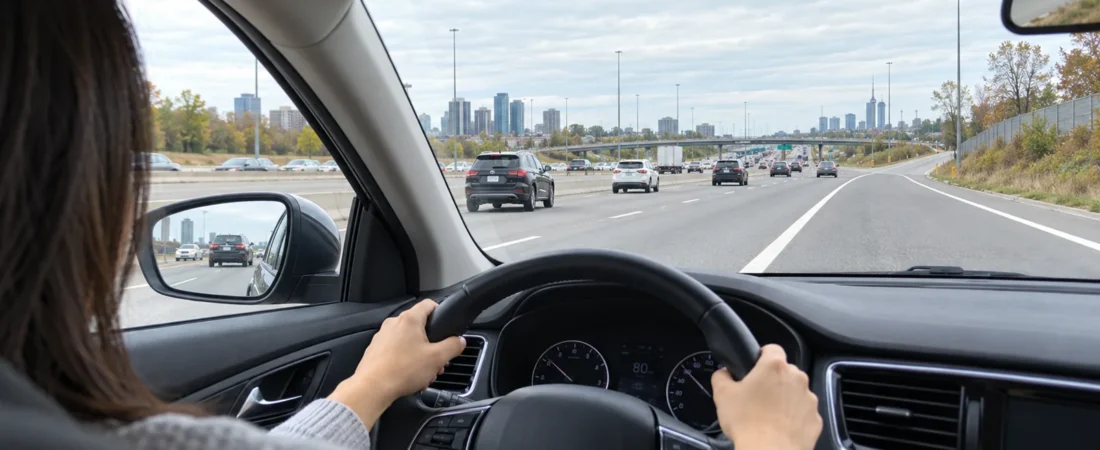
The Ontario G test is where many drivers discover that being comfortable on the highway is not the same as being consistent. A driver may merge successfully in everyday traffic yet still rely on luck: late checks, weak acceleration, rushed gaps or unnecessary braking.
DriveTest says the G test assesses advanced skills, includes a highway component and usually takes about 30 minutes. At full-time centres, the modified test continues to assess major roads and expressways, including merging on and off, appropriate speed and space, signalling, turns, curves, lane changes, intersections and business areas.
Mistake 1: entering the acceleration lane too slowly
The ramp and acceleration lane are there to help you build a speed that fits the traffic you are joining. Crawling toward Highway 401 creates a larger speed difference and makes every available gap harder to use.
Look far ahead, follow the ramp safely and accelerate positively when the lane and conditions allow. The correct speed is not one fixed number; it depends on traffic, weather, the ramp and the posted limit. The practical goal is to arrive at the merge point with options, not with the accelerator still unused.
Mistake 2: searching for a gap only at the end
A safe merge begins before the lane ends. Check the highway early, use mirrors to track vehicles and complete a blind-spot check before moving laterally. Choose a space, then adjust smoothly so you arrive beside it.
Staring over your shoulder for too long can make the car wander. Use brief checks and bring your eyes forward between them. Do not assume another driver will move over. They may help, but you still need a workable plan.
Mistake 3: braking sharply on the acceleration lane
Unnecessary braking can destroy the speed you just built and surprise the driver behind. Sometimes conditions require you to slow, but the first choice should be an early speed adjustment that positions the vehicle for a gap. Never force the merge simply because the lane is ending.
During Scarborough practice, repeat the same skill on different ramps rather than memorizing one entrance. Ramp length, curve, traffic and visibility change, but the information-speed-gap sequence stays the same. SparkOn’s Highway 401 merging guide explains that routine in more detail.
Mistake 4: treating a lane change like one mirror check
A lane change is a timed decision. A quick mirror glance does not tell you whether a vehicle is beside you or closing rapidly. Use mirrors, signal, check the blind spot, confirm the gap, then move smoothly while maintaining control.
Common test-day problems include signalling without moving for a long time, drifting before the blind-spot check, changing speed abruptly, crossing two lanes in one move or failing to cancel the signal. Complete one lane at a time and re-establish space before planning another.
Mistake 5: driving below highway speed without a reason
The official standard is not “drive at the limit no matter what.” You must obey the law and adjust for traffic, weather and visibility. But when conditions are clear, a large unnecessary speed difference can make merging and lane changes less safe.
Check the speedometer briefly and often enough to know your pace. Avoid staring at it. Once established on the highway, use small accelerator changes to maintain a steady speed and adequate following space. Do not let nerves make you pump the pedal.
Mistake 6: following too closely after merging
Some learners celebrate getting into the lane and immediately close the gap ahead. That removes the space needed to respond to brake lights or changing traffic. After merging, centre the car, cancel the signal and rebuild a safe following distance before considering another move.
Space also improves your view. Around trucks, buses and heavy 401 traffic, a larger visual field helps you see congestion earlier and reduces rushed braking.
Mistake 7: preparing for the exit too late
An exit should not trigger a last-second sweep across lanes. Listen to the direction, identify the exit early, make each lane change separately and enter the deceleration lane when safe. Then reduce speed according to the ramp and signs rather than slowing sharply in the through lane.
If you miss a direction, continue safely and let the examiner redirect you. An unsafe correction is worse than a missed turn.
Do not overlook the highway-experience declaration
DriveTest currently says G-test applicants must declare highway driving in the previous three months and have driven at least five times on qualifying roads. Qualifying experience includes highways with limits of at least 80 km/h and listed expressways such as Highway 401, the DVP and Gardiner. Without sufficient experience, the appointment can be cancelled as out-of-order and 50% of the fee lost.
This is an official eligibility requirement, not a lesson recommendation. Record your real experience honestly and build it before test day.
A practical readiness check
- You can build merging speed without repeated reminders.
- You identify a gap early and keep the vehicle centred while checking.
- You complete lane changes smoothly at a stable speed.
- You maintain appropriate space after every merge.
- You prepare for exits without late braking or multi-lane moves.
- You can repeat these habits in light, moderate and busy traffic.
If highway decisions still feel rushed, book a Full G preparation lesson in Scarborough. The goal is not to memorize a test route; it is to make merging, lane changes and speed control predictable on whichever legal route and conditions you receive.