
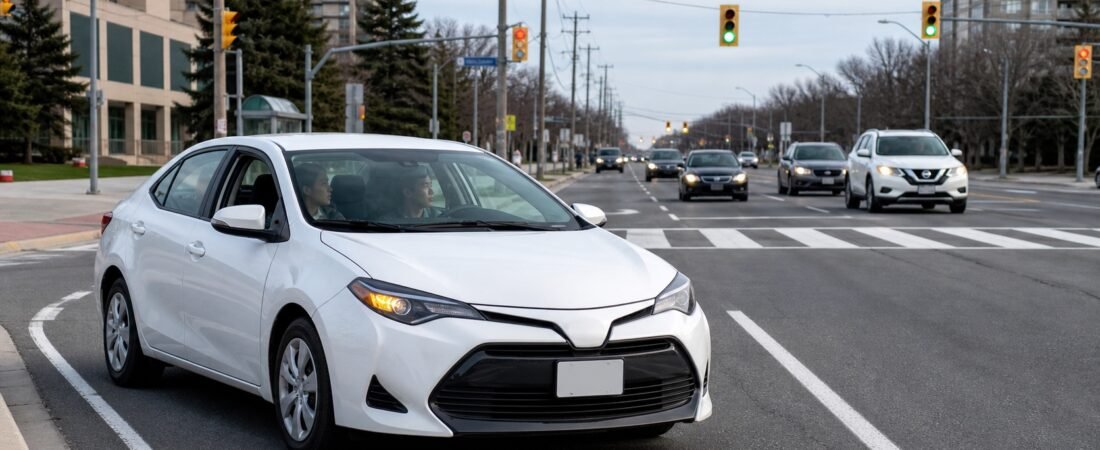
Busy Scarborough intersections can make an unprotected left turn feel intimidating. This guide breaks the manoeuvre into a calm, repeatable routine for everyday driving and Ontario road-test preparation.
What Is an Unprotected Left Turn?
An unprotected left turn is a turn where you do not have a dedicated green left-turn arrow. You may be facing a regular green light, but oncoming vehicles, motorcycles and bicycles can still travel through the intersection. Pedestrians may also be crossing the road you want to enter.
This is common on major Scarborough roads and around busy shopping areas, transit stops and neighbourhood entrances. The skill is not about forcing your way through traffic. It is about reading the intersection, waiting patiently and making one smooth decision when the path is genuinely clear.
1. Prepare Before You Reach the Intersection
Check your rearview and side mirrors before slowing. Signal early enough to communicate your plan, then move into the marked left-turn lane when it is safe. If no dedicated turn lane exists, approach in the far-left lane for your direction.
Reduce speed smoothly and identify the stop line, crosswalk, signal and lane you will enter after the turn. Planning these details early keeps you from making a last-second lane change or braking abruptly.
2. Stop in the Correct Position
If the light is red, stop completely before the marked stop line. If there is no stop line, use the crosswalk or edge of the intersection as described in the Ontario Driver’s Handbook. Do not block the crosswalk while waiting.
Keep the front wheels straight while you wait for oncoming traffic to clear. The MTO handbook warns that a vehicle with its wheels already turned left could be pushed into oncoming traffic if struck from behind.
3. Use a Consistent Scanning Pattern
When the signal permits the turn, scan the whole conflict area instead of staring only at the nearest car. A useful routine is:
- Oncoming traffic: Check vehicles travelling straight and vehicles that may turn across your path.
- Motorcycles and bicycles: They can be harder to see and their speed can be difficult to judge. Ontario guidance says left-turning drivers must wait for oncoming bicycles to pass.
- Pedestrians: Check both ends of the crosswalk and the pedestrian signal. Yield to anyone in or approaching your path.
- Your destination lane: Confirm that the lane is open and that traffic has not backed up through the intersection.
- The signal: Keep track of whether you have a regular green, an advanced green arrow, yellow or red.
After the first scan, keep your eyes moving. Conditions can change while you wait.
4. Choose a Gap Without Letting Traffic Pressure You
A safe gap gives you enough time to cross the oncoming lanes and settle into the correct lane without making another driver brake or change direction. If you are unsure, wait. A driver behind you may be impatient, but that driver cannot see every pedestrian, cyclist or approaching vehicle from your position.
Be especially careful when a large SUV, truck or bus blocks your view. Do not turn simply because the first oncoming vehicle has stopped or waved you through. Check whether another lane is still moving before committing.
5. Turn Into the Correct Lane
Begin the turn only after the path is clear. Look where you want the vehicle to go, use controlled steering and keep both hands ready to manage the wheel. Unless signs or pavement markings direct otherwise, complete the turn into the leftmost available lane in your direction, just to the right of the centre line.
Accelerate smoothly as the car straightens. Cancel the signal if it does not switch off automatically. If you later need another lane, complete a separate mirror-signal-shoulder-check routine after the turn. Do not drift across lanes inside the intersection.
What If the Light Turns Yellow?
An amber light means the red light is about to appear. Ontario’s handbook says you must stop if you can do so safely; otherwise, proceed with caution. If you are already in the intersection waiting to turn, do not panic or race the light. Continue watching oncoming traffic and complete the turn cautiously when the path clears.
Never assume oncoming drivers will stop the moment their light turns yellow. Make sure they are actually slowing before you cross their lane.
Protected Arrows Still Require Attention
A green left-turn arrow gives left-turning traffic a protected phase, but it does not remove the need to scan. Check the crosswalk, watch for anyone already in the intersection and follow the lane markings. When the arrow ends, pay attention to the next signal facing your lane; some intersections use separate lights for left-turning traffic.
Common Left-Turn Mistakes on a G2 Road Test
- Entering the turn lane too late or crossing a solid lane marking.
- Forgetting the signal or signalling only after slowing.
- Watching one oncoming vehicle and missing a pedestrian or cyclist.
- Accepting a gap that makes another road user brake.
- Turning the wheels left while waiting.
- Cutting the corner or entering the wrong lane.
- Changing lanes while still inside the intersection.
- Hesitating after a clearly safe opportunity appears.
Examiners are looking for observation, right-of-way judgment, lane control and a smooth, safe turn. They are not rewarding the fastest decision.
How to Practise Left Turns in Scarborough
Start on a quieter road with good visibility, then build toward multi-lane intersections. Practise at different times so you learn how gaps change with traffic volume, pedestrians, buses and turning lanes. Scarborough’s mix of residential streets and busy arterial roads makes gradual practice especially valuable.
During each attempt, ask yourself four questions: Is my lane position correct? Have I checked every conflict area? Is the gap large enough? Which lane will I enter? Repeating the same questions turns a stressful manoeuvre into a dependable routine.
Left turns also connect with other road-test skills. Review our guides to safe lane changes, pedestrian crossovers and school zones, and mock road tests in Scarborough.
Quick Left-Turn Checklist
- Mirror check before slowing.
- Signal early and use the correct lane.
- Stop before the line when required.
- Keep the wheels straight while waiting.
- Scan oncoming traffic, cyclists, pedestrians and the destination lane.
- Wait for a gap you can complete without affecting others.
- Turn smoothly into the correct lane.
- Recheck traffic after the turn.
Want to practise busy intersections with an instructor?
SparkOn Driving Academy provides patient, one-on-one driving lessons in Scarborough for new drivers preparing for their G2 or full G road test.