
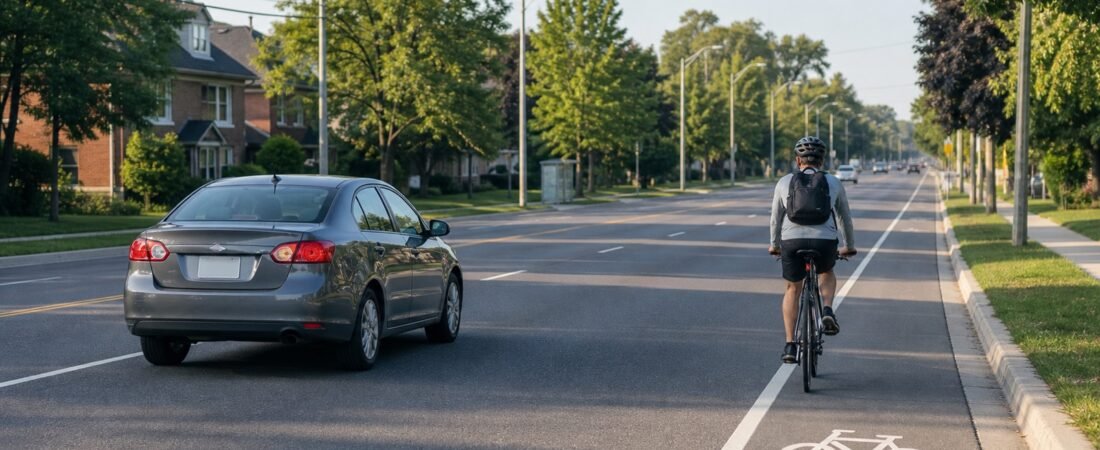
Driving beside a bicycle can feel uncertain when a Scarborough road narrows, traffic builds behind you or a bike lane reaches an intersection. The safe response is not to squeeze through. Slow down, create space, read the pavement markings and make sure the cyclist’s path is clear before you pass or turn.
What Ontario’s One-Metre Passing Rule Means
Ontario’s Highway Traffic Act, section 148(6.1), requires a motor-vehicle driver overtaking a person on a bicycle to leave at least one metre, as nearly as practicable, between the vehicle and bicycle. The measurement includes projections and attachments, so think about the widest points rather than only the tires.
The Official MTO Driver’s Handbook adds the most useful practical advice: change lanes to pass whenever possible. A full lane change creates a clearer buffer and reduces the temptation to judge a narrow gap from the driver’s seat.
One metre is a legal minimum where practicable, not a target you must pass at immediately. If the lane is too narrow, oncoming traffic blocks a safe move or you cannot see beyond a curve, stay behind. A few calm seconds behind a cyclist is safer than forcing a pass.
A Five-Step Routine for Passing a Cyclist
- See the cyclist early. Look beyond the next vehicle and scan beside parked cars, transit stops, driveways and shadows. Cyclists are smaller and can be hidden by traffic.
- Ease off the accelerator. Reduce the closing speed gradually. Leave enough following space to see the cyclist, the road surface and approaching traffic.
- Check whether the pass is truly available. Read lane markings, check mirrors and blind spots, and confirm that no vehicle is approaching in the space you need. Do not pass near a blind curve, hill crest or other place where the road ahead is not clearly visible.
- Signal and move over smoothly. Use the same mirror-signal-blind-spot process described in SparkOn’s Ontario lane-change guide. Give the cyclist more room when speed, wind, puddles or rough pavement increase uncertainty.
- Return only after you are clearly past. Do not cut back toward the cyclist’s front wheel. Check your mirror, signal and move back gradually when the space is obvious.
Why a Cyclist May Ride Farther From the Curb
A cyclist does not always stay at the extreme right edge. The MTO handbook says cyclists may use any part of the lane when needed for safety—for example, to avoid potholes, puddles, ice, sand, debris, sewer grates or a lane that is too narrow to share safely. They may also position left to prepare for a left turn.
On Scarborough streets, the usable riding line can change quickly near parked cars, catch basins, construction patches and bus stops. A cyclist moving left may be avoiding a hazard you cannot yet see. Treat that movement as information: slow down, preserve space and wait until you understand the situation.
Do not use the horn simply because you want to pass. The MTO warns that an unnecessary horn can startle a cyclist and affect control. If a warning is genuinely needed, use a brief, light tap while you are still well back.
Bike Lanes, Dashed Lines and Bike Boxes
A painted bicycle lane is reserved for cyclists. Where the bikeway is separated from traffic by a solid white line, the City of Toronto says drivers should not merge into it; yield to cyclists and turn from the vehicle lane. Where a dashed line leads toward the intersection, a driver may fully enter that lane only when it is safe and clear of cyclists. The City’s current Driving Safely Near People Cycling guidance explains both layouts.
A bike box is a marked area for bicycles at the front of an intersection. When facing a red signal, stop your vehicle behind the box, not inside it. A sharrow—chevrons above a bicycle symbol—marks a shared lane. It is a reminder that bicycle and motor-vehicle traffic may both use that lane; it is not a separate bike lane or an invitation to squeeze by.
Always follow the signs and markings at the actual location. Road designs differ, and memorizing one intersection is less useful than learning to read what is in front of you.
Right Turns: Prevent the “Right Hook” Conflict
The highest-risk moment is often where your right turn crosses a cyclist’s straight path. Use this sequence:
- signal early enough that the cyclist can understand your plan;
- check the inside mirror, right mirror and right-side blind spot;
- read whether the bike-lane boundary is solid or dashed;
- yield and let a cyclist beside or approaching from behind go through first;
- recheck the crosswalk and bikeway before steering across them; and
- complete the turn only when both paths are clear.
Do not race past a cyclist and immediately turn across their front wheel. If you cannot complete the pass and establish clear space well before the corner, stay behind and turn after the cyclist clears. The MTO’s right-turn guidance specifically tells drivers to check the right rear blind spot and let cyclists proceed through the intersection before turning.
At a red light, the same observation work still applies after the required full stop. Review SparkOn’s guide to right turns on red in Ontario if you want a complete stop-yield-wait routine.
Left Turns, Driveways and Parked Cars
Before turning left, scan for an oncoming cyclist as carefully as you scan for a car. A bicycle’s smaller profile can make its speed and distance harder to judge. Wait until the path is clearly safe rather than assuming you can finish ahead of it.
When entering or leaving a driveway, check the sidewalk, cycle track and road in both directions. A fence, parked vehicle or landscaping can hide someone approaching. Move slowly enough to stop before crossing the cyclist’s line.
After parking, check the mirror and blind spot before anyone opens a door. Ontario law prohibits opening a vehicle door unless it can be done without endangering another person or vehicle. The MTO also reminds drivers to look for a passing cyclist before opening. Passengers need the same reminder, especially when exiting on the traffic side.
Common Mistakes to Avoid
- Passing within the same narrow lane because traffic is waiting behind you.
- Accelerating hard to “beat” a cyclist to a right turn.
- Assuming the cyclist must stay beside the curb at all times.
- Checking only the right mirror and skipping the blind spot.
- Driving in a solid-line bike lane while waiting to turn.
- Stopping inside a bike box at a red light.
- Returning to the lane before the entire vehicle is safely past.
- Opening a driver or passenger door without checking behind.
Scarborough Practice Checklist
During supervised practice or a structured road-test preparation lesson, ask your accompanying driver to watch whether you:
- identify cyclists early and reduce closing speed smoothly;
- wait behind when the passing space is uncertain;
- make complete mirror and blind-spot checks before moving left or turning right;
- leave generous space for hazards beside the cyclist;
- read solid lines, dashed lines, sharrows and bike boxes correctly;
- scan again before crossing a bikeway or opening a door; and
- stay patient when another driver pressures you to pass.
Practise first on a familiar road in good visibility, then add busier traffic and more complex bikeway layouts as your observation routine becomes consistent. The goal is calm judgment that works anywhere—not memorizing a supposed test route.
Practise Sharing the Road With a Scarborough Instructor
SparkOn’s one-on-one driving lessons in Scarborough help G1, G2 and G drivers practise safe passing, bike-lane checks, right turns and patient decision-making in real local traffic.
Book a Scarborough driving lesson and tell us which traffic situations you want to handle more confidently.