
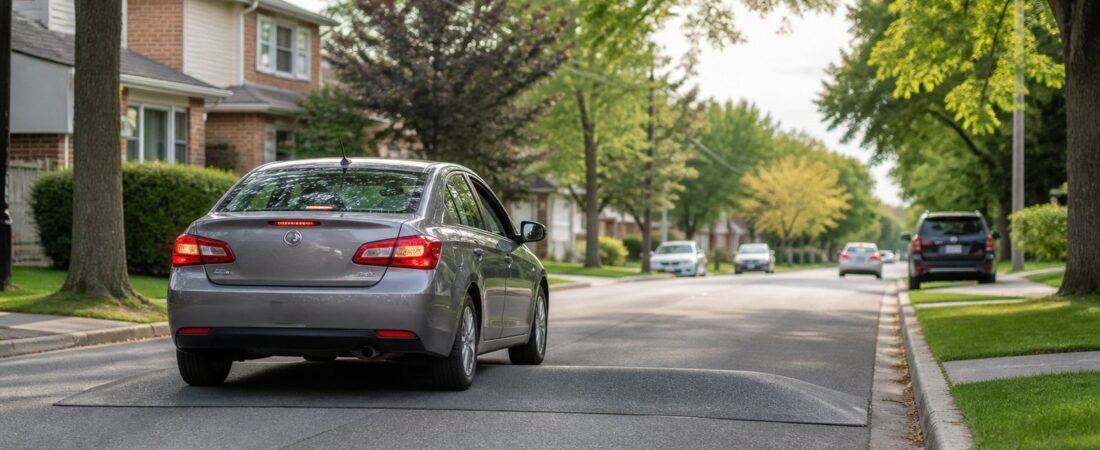
Speed humps can feel simple: slow down, go over, keep driving. In real Scarborough lessons, though, traffic-calming streets test more than your brake pedal. New drivers must manage speed early, keep space from parked cars, watch for pedestrians near schools and parks, and stay predictable when another driver is impatient behind them.
This guide explains how to handle speed humps, speed cushions, raised crossings, curb extensions, and narrowed residential streets without guessing. It is written for Ontario learner drivers and G1/G2/G drivers practising around Scarborough neighbourhood roads, school areas, and local streets.
What traffic calming means in Toronto
The City of Toronto traffic calming program describes traffic calming as measures intended to slow motor vehicles to appropriate speeds and improve safety for people walking, cycling, and rolling. In practice, that can mean speed humps, speed cushions, lane narrowings, curb extensions, raised crosswalks, centre medians, or other road-design changes.
For a learner driver, the important point is this: traffic calming is not an obstacle to “beat.” It is a warning that the street environment needs lower speed, wider scanning, and smoother control. Many Scarborough residential streets also have parked vehicles, children, buses, cyclists, driveways, delivery vehicles, and people stepping out from between sightline blockers. Treat the whole area as active, not only the raised pavement in front of you.
Speed humps, speed cushions, and speed bumps are not the same
Toronto distinguishes between different vertical traffic-calming devices. The City says speed humps are raised asphalt areas across the roadway that encourage a consistent lower travel speed. Speed cushions have spaces or cut-outs that can better accommodate larger vehicles. Speed bumps are shorter, sharper devices generally used in very low-speed laneway settings, where the City says travel should be no more than about 10 to 15 km/h.
That difference matters behind the wheel. A speed hump on a local road is usually broader and smoother than a laneway speed bump, but you still should not brake late or accelerate hard over it. A speed cushion may look like separate raised pads. A raised crosswalk may include pedestrian priority and needs an even stronger scan for people approaching the crossing. If you are unsure what the device is, default to an early, smooth slowdown and a full scan of both sides of the street.
How to approach a speed hump smoothly
The best speed-hump routine starts well before the raised pavement. Check your mirror, ease off the gas, brake gently while the car is still straight, and arrive at the hump at a controlled speed. Keep both hands steady, avoid swerving around the hump, and let the vehicle roll over evenly. After the rear wheels clear the hump, accelerate gradually only if the road ahead is clear.
This routine connects directly to the Official MTO Driver’s Handbook guidance on driving along, which emphasizes matching traffic without exceeding the speed limit and keeping a safe space cushion. If another driver follows too closely, do not let that pressure force you into a rough or rushed crossing. A smooth, legal, predictable action is safer than reacting to the driver behind you.
If you are practising speed control generally, pair this topic with SparkOn’s guide to curves and ramps in Scarborough. Both skills require the same habit: set the right speed before the hazard, then keep the car stable through it.
Watch for people, not just pavement
One common learner mistake is staring at the hump itself. The raised pavement matters, but the people around it matter more. The MTO Driver’s Handbook section on sharing the road reminds drivers to use due care around pedestrians and to drive slowly and cautiously in places such as school and residential areas.
Before reaching a traffic-calmed area, scan sidewalks, parked cars, bus stops, driveways, and side streets. Look for children near school zones, pedestrians moving toward a crossing, cyclists who may need extra space, and drivers opening doors from parked vehicles. A person can appear while you are focused on the bump, so keep your eyes moving: far ahead, mirror, sides, then back to your path.
For more on pedestrian-heavy locations, review SparkOn’s article on school zones and pedestrian crossovers in Ontario. Traffic calming often appears near the same types of high-attention areas.
Road narrowings and curb extensions need lane discipline
Not every traffic-calming feature is raised. Toronto’s geometric safety improvements include curb extensions, road narrowings, centre medians, and raised crossings. These designs can change the space available for vehicles and improve sightlines for people crossing, but they require calm steering from the driver.
On Scarborough streets with parked cars and narrow lanes, avoid drifting away from the curb so far that you surprise oncoming traffic. At the same time, do not squeeze too close to parked vehicles. Reduce speed first, choose a clear lane position, and move through the narrowed area without sudden correction. If an oncoming vehicle is already committed through a narrow point, wait where safe instead of forcing a tight squeeze.
This is also where your two-way stop and uncontrolled-intersection habits help. Slow streets often include short blocks and side streets where another road user may enter your path quickly.
Raised crossings and school-area traffic calming
The City of Toronto notes that raised crosswalks and raised intersections can improve visibility between road users and are used around school areas. For a driver, that means you should expect pedestrian activity and prepare to stop. Slow early, check both sidewalks, and do not accelerate just because the front wheels have crossed the raised section. Keep scanning until the whole crossing area is clear.
The MTO Driver’s Handbook section on signs explains that warning signs alert drivers to dangerous or unusual conditions ahead. If you see signs for school areas, pavement changes, narrowing roads, pedestrian crossings, or traffic calming, respond before the situation reaches your bumper. Late braking makes the ride uncomfortable and can make your driving look reactive during a lesson or road-test preparation session.
Rain, snow, and darkness change the routine
A speed hump that feels easy on a dry afternoon can feel different in rain, snow, slush, or darkness. Wet pavement can reduce traction. Snow can hide road edges and make raised areas harder to judge. Darkness can reduce the time you have to identify pedestrians, cyclists, and curb extensions.
The MTO Driver’s Handbook guidance on night and bad-weather driving advises drivers to reduce speed gradually and leave more braking distance when visibility or road conditions are poor. Apply that directly to traffic calming: slow earlier, avoid abrupt steering, and leave extra room from the vehicle ahead so you can cross the hump smoothly without sudden braking.
If you want related practice topics, SparkOn has guides on heavy rain driving in Scarborough and night driving in Scarborough.
Scarborough practice checklist
Use this checklist when practising with an instructor, parent, or supervising driver:
- Read the road early: look for signs, raised pavement, curb extensions, parked cars, and pedestrians.
- Check your mirror before slowing so you know what is happening behind you.
- Brake gently before the hump, not while your wheels are already climbing it.
- Keep steering straight and avoid driving around the hump or into the oncoming lane.
- Scan both sidewalks near raised crossings, parks, schools, plazas, and bus stops.
- Leave extra space from the vehicle ahead so you are not forced into sudden braking.
- Accelerate gradually after the traffic-calmed area only when the road ahead is clear.
- In rain, snow, or darkness, slow earlier and widen your scanning pattern.
These habits also support broader residential street driving in Scarborough. Traffic calming usually appears where the road is asking drivers to pay closer attention to local life around the car.
Practise traffic-calming streets with SparkOn
Reading the rule is useful; feeling the timing in the car is what builds confidence. In a SparkOn lesson, a Scarborough instructor can help you practise early braking, smooth speed-hump crossings, school-area scanning, narrow-street lane position, and calm decision-making when another driver is impatient.
If you are preparing for G2, G, or everyday independent driving, book Scarborough driving lessons with SparkOn Driving Academy. You can also combine local street practice with structured road-test preparation so speed control, observation, and lane discipline become consistent before test day.