
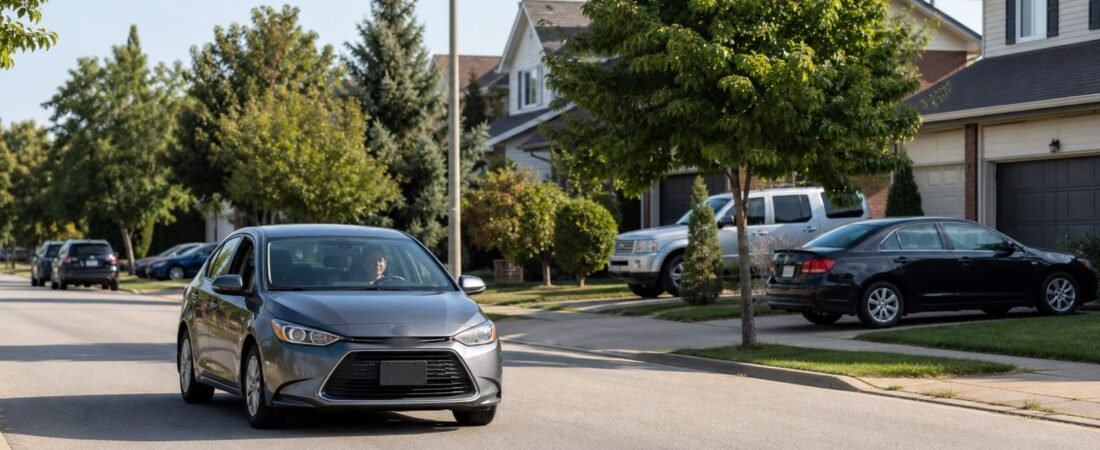
Residential streets can feel easier than major Scarborough roads because the speeds are lower. In reality, they ask for a different kind of attention: parked cars, driveways, children, cyclists, delivery vehicles, pets and narrow passing space can all change the situation quickly.
For new Ontario drivers, quiet neighbourhood practice should not become “autopilot” driving. The goal is to build a calm scanning routine that keeps you ready without making sudden moves. This guide explains how to handle residential streets in Scarborough with practical habits, not special shortcuts or unsupported claims. It is based on current guidance from the Official MTO Driver’s Handbook on driving along, the MTO’s advice for sharing the road with pedestrians and other road users, and the City of Toronto’s explanation of traffic calming on neighbourhood streets.
Why residential streets are not automatically easy
A wide arterial road usually gives you signals, lane markings and more open sightlines. A residential street often gives you the opposite: parked cars close to the lane, shrubs beside driveways, garbage bins near the curb, school pickup activity, and pedestrians who may be hidden until the last moment.
The MTO tells drivers to keep a cushion of space around the vehicle and watch for people in parked vehicles because they may pull out or open a door. That matters in Scarborough neighbourhoods where curbside parking, apartment entrances, plazas, parks and side streets can sit very close together. Your speed, lane position and eye movement have to match that environment.
Use a “near, middle, far” scan
A useful routine is to divide your vision into three zones. The far zone is where you look down the block for intersections, curves, school signs, stopped vehicles or narrowing space. The middle zone is where you check parked cars, driveways and cyclists ahead. The near zone is where you confirm your lane position and watch the closest doors, wheels and curbs.
Do not stare at one hazard. If you fix your eyes on a parked van, you may miss a pedestrian stepping from the opposite side. If you only look at the road directly in front of your hood, you will react late to a car backing out two driveways ahead. A good residential scan is steady: ahead, mirrors, sides, then ahead again.
Parked cars: read the clues early
Parked cars are not dead objects. Treat each one as a possible moving hazard until you have passed it safely. Look for brake lights, reverse lights, front wheels turned out, exhaust, a driver inside, a door gap, or someone walking toward the vehicle with keys or bags.
When you have enough room, leave safe lateral space from parked vehicles. If the street is narrow and an oncoming vehicle appears, slow early instead of squeezing through. The safer choice may be to ease off, hold your lane position and let the situation become clear. This connects directly with the broader spacing habit in SparkOn’s guide to following distance in Ontario: space is not only front-to-back, it is also side-to-side.
Driveways and laneways need a slower approach
Driveways are easy to underestimate because many are partly blocked by hedges, fences, parked SUVs or snowbanks in winter. A vehicle backing out may appear slowly at first and then enter the lane before the driver has a full view. Children, scooters, pets and bicycles can also come from private driveways.
When sightlines are blocked, cover the brake lightly and reduce speed before the hazard, not after it appears. Avoid drifting left suddenly unless you have checked for oncoming traffic and cyclists. If a vehicle is reversing from a driveway, make your response simple and predictable: slow, communicate with your brake lights, and stop if needed.
Children and pedestrians require extra patience
The MTO specifically warns drivers to drive slowly and cautiously through school zones, residential areas and places where children may be walking or playing. It also warns not to rely on a child’s knowledge of traffic laws. That is not just a school-zone point; it applies on local streets near parks, townhomes, playgrounds, apartment buildings and bus stops.
If a ball rolls into the road, a child may follow. If a group is walking near parked cars, one person may step out before looking. If a pedestrian is already crossing at an intersection, wait until the path is safe and clear. For a deeper pedestrian-focused review, use SparkOn’s article on school zones and pedestrian crossovers in Ontario.
Speed control matters more than speed confidence
Ontario drivers must obey posted speed limits, but the MTO also states that drivers should always travel at a speed that lets them stop safely. On a residential street, the correct practical speed may be below the posted limit when visibility is reduced, the road is narrow, children are present, parked vehicles are active, or there is heavy curbside activity.
Toronto’s traffic-calming guidance explains that neighbourhood streets are meant to support people walking, rolling, playing and living alongside motor vehicles, not just vehicle movement. Speed humps, cushions and bumps are reminders that the street design itself may expect drivers to slow down. Roll over traffic-calming features smoothly, avoid braking hard at the last second, and accelerate gently after.
Signals still matter on quiet streets
Some new drivers stop signalling in neighbourhoods because “nobody is around.” That habit is risky. A pedestrian, cyclist, parked driver or oncoming vehicle may be making a decision based on your movement. Signal before turning, moving out from a parked position, leaving the road, or changing position around an obstacle.
Signalling does not give permission to move. It only communicates your intention. The routine is the same as on busier roads: mirrors, signal, shoulder check, then move only when the way is clear. SparkOn’s turn-signal guide for Ontario drivers breaks that habit down in more detail.
Common residential-street mistakes to avoid
- Driving too close to parked cars when there is room to leave more side space.
- Speeding up between speed humps or stop signs instead of keeping a smooth pace.
- Looking only at the centre of the lane and missing driveways or sidewalks.
- Passing a stopped vehicle without asking why it stopped.
- Following another car too closely because the road feels “low speed.”
- Forgetting shoulder checks before moving around parked vehicles.
- Practising in neighbourhoods that are too busy for the student’s current skill level.
A Scarborough residential-street practice checklist
Use this checklist on calm streets before adding heavier traffic:
- Look far enough ahead to notice narrowing space early.
- Check parked cars for wheels, lights, drivers and door movement.
- Slow before blocked driveways, parked vans and curved sections.
- Keep a safe cushion from parked vehicles and oncoming traffic.
- Scan sidewalks, crosswalks and intersections for pedestrians.
- Use signals before turns, stops, lane-position changes and pull-outs.
- Pause behind stopped vehicles until you understand what they are yielding to.
- Keep steering smooth and avoid sudden swerves around small hazards.
When to practise this with an instructor
If you are a G1 or early G2 driver, residential streets are a strong place to build judgment before busier Scarborough routes. But they should still be chosen carefully. A good instructor can start with low-pressure blocks, then add parked-car spacing, four-way stops, hill parking, reversing, left turns and busier intersections as your control improves.
For route-planning context, read SparkOn’s guide on where to practise driving in Scarborough. If you still feel rushed around parked cars, driveways or pedestrians, book a focused neighbourhood-control lesson with SparkOn Driving Academy in Scarborough. We can work on slow-speed control, hazard scanning and calm decision-making before moving into heavier traffic.