
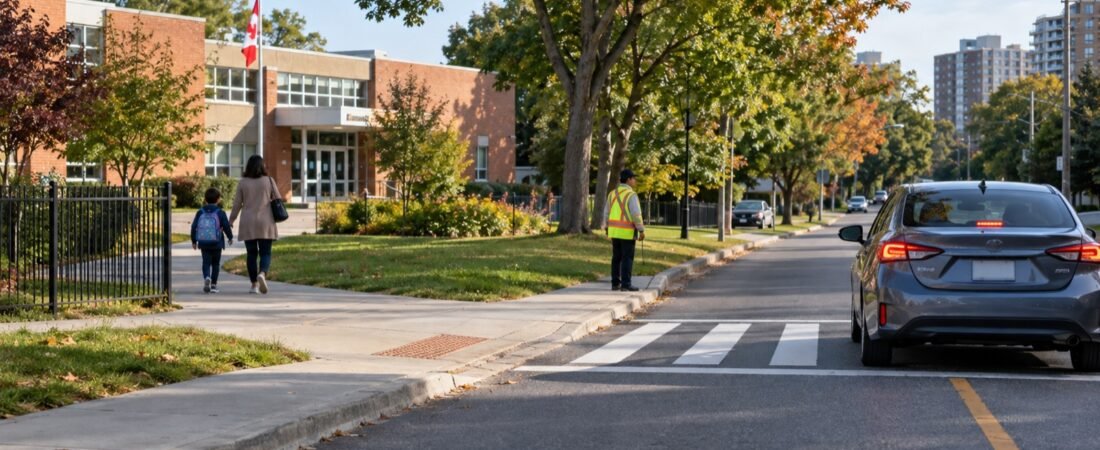
September changes the rhythm of Scarborough roads. A street that feels quiet in July can fill with turning cars, crossing families, school buses and hurried drop-offs before 8:30 a.m. If you are a new G1, G2 or full-G driver, school arrival is a good place to practise patience and observation—but it is not a good place to copy what the car ahead is doing.
This guide separates the official rules from the habits I recommend in lessons. The goal is simple: get a child to the curb without blocking a crosswalk, surprising a cyclist or forcing another driver into a risky move.
Start with the City’s back-to-school reminders
The City of Toronto back-to-school safety guidance tells people driving to stay alert, obey the speed limit and watch for children in school zones. The City also points to pedestrian crossovers, school-zone markings, flashing beacons, crossing guards and other safety features that may appear near schools.
Those features are a cue to scan earlier, not a reason to stare at one sign. Around Scarborough schools, the first decision often happens a block before the entrance: can you reduce speed, choose the correct lane and leave a clear path for someone walking or cycling?
Know the difference between stopping and parking
The MTO Driver’s Handbook parking guidance says to obey signs that limit stopping, standing or parking and reminds drivers that some municipal restrictions are not posted on every block. It also says not to block a sidewalk, crosswalk, pedestrian crossing, road entrance or another parked vehicle.
For a learner, “I am only here for thirty seconds” is not a reliable rule. A quick child drop-off can still block a crossing or reduce another driver’s view. If the curb is signed “no stopping,” keep moving and use the school’s designated area or a legal space farther away. Never double-park and ask a child to walk between vehicles.
Plan the approach before the school entrance
My practical routine is to plan one block early. Check the mirror, ease off the accelerator, and look for pedestrians stepping out from between parked cars. Keep scanning the sidewalk, the curb and the vehicles ahead—not just the school gate.
On a street feeding into Lawrence Avenue East, Finch Avenue East or Kingston Road, a queue can stretch farther than you expect. Do not follow the queue through an intersection if your exit will be blocked. Leave the intersection clear, even when the driver behind is impatient. If the line is stopped on a hill, keep a proper gap so you can see around the vehicle ahead.
Use designated drop-off areas correctly
A school’s cones, staff directions or curb markings may change the flow from day to day. Treat those instructions as temporary traffic guidance, but still obey the signs and provincial rules that apply to the road. If staff wave you forward, move slowly and check for children before opening a door.
Pull in close to the curb only where stopping is permitted. Put the vehicle in Park, secure it and make sure the child exits on the sidewalk side. Do not stop in a bicycle lane, at the mouth of a driveway or across a neighbour’s entrance just because the designated lane is busy.
Give crossing guards the complete roadway
When a school crossing guard displays a red-and-white stop sign, the City’s School Crossing Guard Program guidance says drivers must stop before the crossing and remain stopped until everyone—including the guard—has cleared the roadway and it is safe to proceed.
Do not start rolling when the last child reaches the far curb if the guard is still in the road. That is a common learner mistake because the car behind begins to move. Keep your foot on the brake, watch the guard, and wait for a clear release. The City also recommends reducing speed near school zones and staying attentive to pedestrians, especially when turning.
Expect pedestrians to change direction
Children may stop to tie a shoe, turn back for a backpack or step toward a friend without looking over a shoulder. You cannot predict every movement, so create time instead. Cover the brake as you pass a parked-vehicle gap, keep your eyes moving and be ready to stop smoothly.
At a marked pedestrian crossover, follow the MTO guidance for pedestrian crossovers and school crossings. Scan for the person approaching the crossing, stop as required, and remain stopped until the crossing is clear. A child standing near the curb deserves your attention even before they step out.
Do not let a drop-off queue erase your lane discipline
When cars stack up, learners sometimes drift across a centre line, stop diagonally or swing around a stopped vehicle without a full view. Those shortcuts create conflicts with oncoming traffic and people walking around the queue. Stay in your lane, signal every intended lane change, and wait until you have a legal, visible path.
If you are picking up after school, the same rule applies in reverse. A vehicle leaving a driveway or parking lot must yield to sidewalk users and road traffic. Review SparkOn’s parking-lot and driveway exit routine if you are not yet comfortable finding a safe gap.
Common learner mistakes I would correct
- Stopping wherever the queue stops: Check the curb, signs, crosswalk and driveway before you commit.
- Watching only the car ahead: Scan sidewalks, mirrors and the gaps between parked vehicles.
- Rolling behind a crossing guard: Wait until the guard and every pedestrian have cleared the roadway.
- Opening a door into traffic: Use the sidewalk side and look for cyclists before opening.
- Rushing because another driver is close: Keep your decision safe and predictable; their impatience is not your instruction.
A five-minute school-zone practice plan
- Drive past the school outside arrival time and identify legal stopping signs, crosswalks, driveways and bus stops.
- Return at a quieter time and practise reducing speed one block before the entrance.
- Approach a pedestrian crossing, scan left-right-left and practise a smooth, complete stop.
- Practise leaving a queue without blocking an intersection or cutting across a centre line.
- Review the drive afterward: what did you see early, and what would have surprised you?
Make the calm choice in Scarborough traffic
School drop-off is not a speed challenge. It is a short lesson in reading people, signs, gaps and changing plans. If you are still tense around busy school streets, book a Scarborough lesson with SparkOn Driving Academy. We can practise the approach, stopping decisions and re-entry into traffic at a pace that fits your experience. For scheduling, contact SparkOn.
School-zone checklist
- Did I read the signs before stopping?
- Is the crosswalk, sidewalk and driveway completely clear?
- Can I see around the vehicle ahead?
- Did I give the crossing guard and pedestrians the entire roadway?
- Is the child exiting on the sidewalk side?
- Am I leaving the intersection and nearby lane clear?
A few extra seconds usually make the whole school street easier to read. That is the habit I want every Scarborough learner to carry into the rest of Ontario driving.