
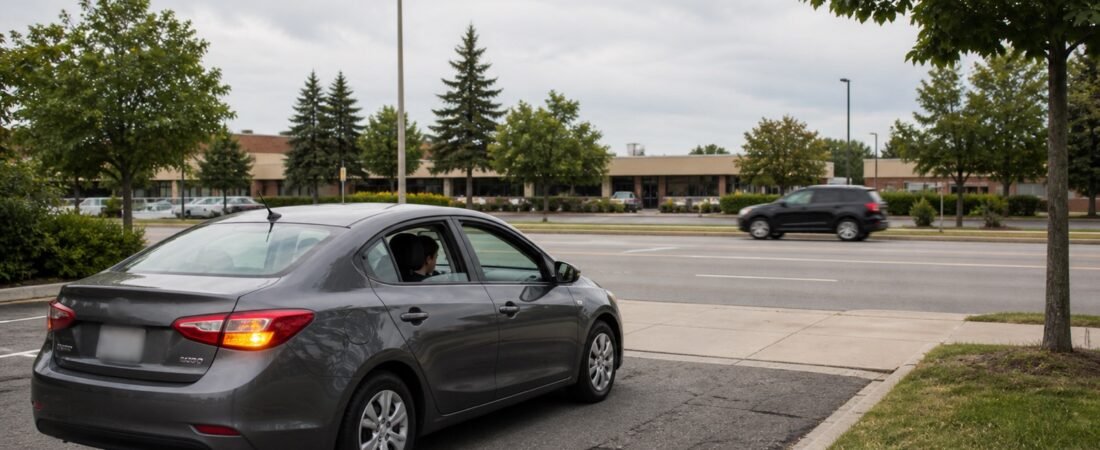
Leaving a plaza, condo driveway, gas station or school parking lot looks simple until you are the new driver judging Scarborough traffic, a sidewalk, parked cars, pedestrians and a driver behind you who wants you to hurry up.
The goal is not to “jump in” quickly. The goal is to enter the road only when you have enough space, enough visibility and full control of the car. In Scarborough, this comes up all the time around busy plazas on Lawrence, Eglinton, Kingston Road, Sheppard, Morningside and Markham Road. The exact location changes, but the routine should stay the same.
Official rule: traffic and pedestrians already there have priority
The Official MTO Driver’s Handbook says that when entering a road from a private road or driveway, drivers must yield to vehicles on the road and pedestrians on the sidewalk. Ontario’s Highway Traffic Act also covers that duty to yield.
That is the official side. In plain driving language: if you are coming out of private property, you are joining traffic. You do not get priority just because your front bumper is pointed toward the road. The sidewalk matters too. If someone is walking, using a mobility device, pushing a stroller or cycling across the driveway area, wait.
My instructor recommendation is simple: treat the driveway exit like a mini-intersection, but with less visibility. You need a complete pause, a sidewalk check, a traffic check, a signal when you are ready, and a smooth entry only when the gap is safe.
Start before the curb: do not roll onto the sidewalk blindly
A common student mistake is rolling forward while looking only at road traffic. The driver is thinking, “Can I fit into that lane?” but the car is already creeping across the sidewalk. That is backwards. First, clear the sidewalk area. Then deal with the roadway.
On many Scarborough plaza exits, your view is blocked by parked vehicles, signs, landscaping, bus stops, delivery trucks or cars waiting beside you. If you cannot see well, move slowly enough that you can stop immediately.
A practical routine:
- Ease up to the driveway exit slowly.
- Stop before the sidewalk or pedestrian path if visibility is limited.
- Check left, right and left again for pedestrians and cyclists.
- Move forward only as much as needed to improve your view.
- Stop again before entering the road if traffic is not clear.
The same scanning habit from residential street driving in Scarborough helps here. Look for clues: shadows, feet behind parked vehicles, a cyclist approaching from the side, or reverse lights in the lot.
Use your signal, but do not let it pressure you
The MTO Driver’s Handbook guidance on changing positions reminds drivers to communicate before moving and to check that the move can be made safely. When you are leaving a driveway or parking lot, your signal tells traffic which way you intend to go.
A common mistake is signalling and then feeling committed. Your signal is communication, not permission. If the gap closes, a pedestrian appears, or the driver behind you honks, you still wait.
Use the signal once you have chosen your direction and are getting ready to enter. Keep your wheels straight while waiting, especially if you are turning left across traffic.
Judging the gap: look for time, not just distance
Another common mistake is judging only by how far away the nearest vehicle looks. Distance is not enough. A faster car can close the gap quickly, and a bus, truck or large SUV can hide another vehicle in the next lane.
When leaving a Scarborough plaza onto a busier road, ask yourself three questions before moving:
- Can I enter without making another driver brake hard or swerve?
- Can I complete the turn and straighten the car before traffic reaches me?
- Is the next lane also clear if I am crossing or turning left?
If the answer is not clearly yes, wait. New drivers often choose gaps that are too small because they feel embarrassed about waiting. Do not let that decide for you.
Right turn, left turn or crossing: each one has a different risk
A right turn from a driveway is usually the simplest because you are joining the nearest lane in the direction of travel. Still, you must check the sidewalk first, then traffic from the left, then the lane you are entering. Watch for cyclists, buses and vehicles turning into the driveway at the same time.
A left turn out of a plaza is harder. You may need a clear gap from both directions and across more than one lane. On a busy Scarborough road, turning right first and finding a safer legal way around can be better than forcing a difficult left.
Crossing a road from one driveway to another needs even more caution. Do not assume drivers understand what you are doing. If traffic is heavy, choose a simpler legal route.
Check mirrors and blind spots before the car moves
The MTO’s driving-along guidance tells drivers to keep checking around the vehicle and use mirrors and blind-spot checks. At a driveway exit, your attention can get stuck straight ahead.
Before moving, do one more mirror and shoulder check in the direction you are turning. This matters when another vehicle pulls up beside you at a wide exit, or when a cyclist is coming along the curb lane.
This connects with SparkOn’s guide to mirror, signal and shoulder checks. Mirrors help, but they do not show everything.
Common mistakes I want Scarborough learners to fix
Here are the mistakes that make this situation harder than it needs to be:
- Stopping too far forward: the car blocks the sidewalk or sticks into the traffic lane before the driver has decided.
- Only looking left: traffic may come from the left, but pedestrians and cyclists can approach from either side.
- Following another car out: the first car’s gap is not automatically your gap.
- Turning the wheel while waiting: this makes the car less stable and can create an awkward entry angle.
- Rushing because someone honked: pressure from behind does not change your duty to yield.
- Entering too slowly after choosing a safe gap: once the decision is safe, move smoothly so you join traffic without hesitation.
Waiting is good when the gap is not safe. Once the gap is safe and you commit, do not crawl halfway into the lane and freeze.
A simple driveway-exit checklist
Use this routine until it becomes automatic:
- Approach the exit slowly and position the car straight.
- Stop before the sidewalk or pedestrian path when visibility is limited.
- Check both sides for pedestrians, cyclists and mobility-device users.
- Choose your direction and signal.
- Check traffic from all relevant directions, including the far lane if turning left or crossing.
- Do a final mirror and shoulder check.
- Enter only when the gap is safe, then accelerate smoothly and settle into your lane.
- Cancel the signal and continue scanning ahead.
If you are preparing for your G2, connect this with parking-lot control from reversing safely in Scarborough parking lots and side-street judgement from two-way stops and uncontrolled intersections.
Practice this with a calm instructor beside you
Parking-lot and driveway exits are not glamorous driving skills, but they reveal a lot about a new driver’s judgement. You need patience, observation, steering control, signalling, gap selection and confidence all at once.
If you are learning in Scarborough, SparkOn Driving Academy can help you practise these situations safely: quiet plaza exits first, then busier roads, then left turns only when your timing is ready. Book a Scarborough driving lesson through our driving lessons page or contact SparkOn.