
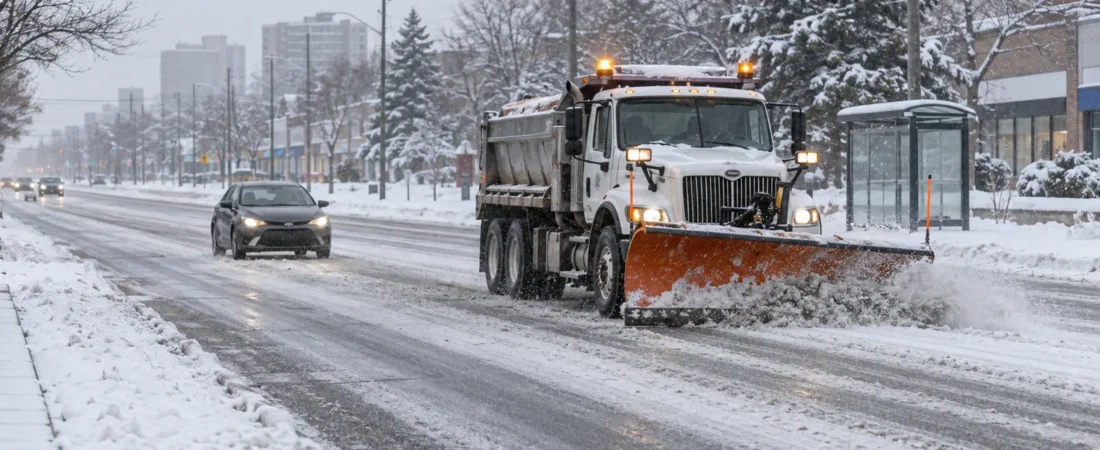
Snowplows make winter roads safer, but driving near one can feel uncomfortable when you are still building confidence. The truck is large, snow can spray behind it, and the lane may look different on each side of the blade. The safest response is not complicated: slow down smoothly, stay well back and give the operator room to work.
This guide explains the official winter-driving advice and the practical habits I recommend for learners around Scarborough.
Why a working snowplow needs extra space
A plow is doing several jobs at once. It may be pushing snow toward the curb, spreading salt or brine, and moving more slowly than normal traffic. Its blade can extend beyond the truck body, while the snow cloud behind it can briefly hide lane markings, brake lights, pedestrians or a vehicle entering from a side street.
Ontario’s winter-driving guidance tells drivers to stay well back from working snowplows and not to pass them. The MTO Driver’s Handbook also advises drivers to reduce speed, increase following distance, use low-beam headlights in blowing snow and avoid passing or changing lanes when visibility is poor.
Those are the official principles. My practical advice is to treat the clear space behind a plow as a safety buffer, not as an invitation to close the gap. If spray or blowing snow is reaching your windshield, you are probably making the drive harder than it needs to be. Ease off the accelerator and rebuild your view.
A simple routine when you meet a plow
When you see amber warning lights ahead, use this sequence:
- Look well ahead. Check the traffic behind you, the lane markings and any nearby intersections before you adjust speed.
- Slow down gradually. Come off the accelerator early. Avoid a sharp brake application on a surface that may have packed snow or ice.
- Increase the gap. Leave enough room to see around the snow cloud and react without rushing. There is no single distance that fits every storm; visibility, grip, speed and traffic all matter.
- Turn on the full lighting system. Daytime running lights may not turn on your tail lights. Ontario requires headlights in poor light conditions when people or vehicles cannot be clearly seen at 150 metres, and the handbook recommends low beams in blowing snow.
- Stay patient. Do not weave around the plow or force a pass. The road behind the equipment is usually the part that has just been treated or cleared.
One common learner mistake is watching the plow blade instead of the whole traffic picture. Keep scanning. A pedestrian may be waiting at a crosswalk, a bus may stop ahead, or a driver may pull out from a plaza entrance.
What this looks like on Scarborough roads
Scarborough has wide arterial roads, TTC routes, hills and quieter residential streets, and they are not all cleared at the same time. The City of Toronto says expressways, major roads, transit routes and streets with hills are treated before lower-volume residential streets. Its salting and plowing service page explains that the expected result also varies by road type: a residential street described as “safe and passable” may still have snow on it.
That matters when you turn from a main road such as a broad Scarborough arterial onto a side street. Do not carry the main-road speed into a narrower, snow-covered street. Finish your braking before the turn, steer smoothly and expect snowbanks to reduce the space near the curb.
At the same time, do not assume a dark strip of pavement is dry. Bridges, shaded areas and sections near intersections can freeze sooner or remain slippery. The safe choice is to read the surface continuously rather than trust how it looked one block earlier.
Passing is the wrong goal
New drivers sometimes feel pressure when another vehicle follows closely. Around a snowplow, that pressure can lead to a rushed lane change. Let the impatient driver make their own decision; you still need to protect your space and visibility.
Do not drive beside a working plow. The blade may be wider than you expect, and the operator needs room to manoeuvre. On multi-lane roads, several plows can also work together. Trying to squeeze through or around that equipment puts you in the operator’s blind areas and may place you on the less-cleared portion of the road.
If traffic is moving slowly, accept the slower pace. Smooth control is more important than arriving a few minutes earlier. The City of Toronto’s winter safety advice tells drivers to plan ahead, allow extra travel time, slow down and leave more distance between vehicles.
Watch for brine and salt trucks too
Winter maintenance can begin before snow piles up. Toronto applies salt brine to expressways, hills, bridges and other critical areas in advance of snow or ice. The City specifically tells drivers to keep a safe distance behind brine trucks.
If you see a spreader ahead, avoid following closely or sitting beside it. The practical reason is simple: extra space improves your view and reduces the chance of salt or spray striking your windshield. Keep both hands steady on the wheel, leave the wipers at a useful speed and use washer fluid before the glass becomes difficult to see.
Do not make a sudden steering move because the windshield receives a burst of spray. Look where you want the car to go, hold the lane and reduce speed smoothly if your view is getting worse.
Common mistakes to correct in practice
- Following the amber lights too closely. Back off until you can see more of the road and have time to respond.
- Using high beams in blowing snow. High beams can reflect from snow and make visibility worse; use low beams.
- Braking late for a turn. Slow earlier, while the car is straight, then steer gently.
- Assuming the cleared lane has full grip. Slush, refreezing water and packed snow can remain.
- Driving with only daytime running lights. Confirm that the full lighting system, including tail lights, is on.
- Trying to keep the usual schedule. Build in time or postpone a non-essential trip when conditions are poor.
These habits connect with the same smooth-control skills used in Scarborough winter driving preparation and driving in fog and low visibility.
Before leaving: a 60-second winter check
Before you move, confirm:
- every window, mirror, light, the roof, hood and trunk are clear of snow and ice;
- the windshield washer fluid is suitable for winter and the wipers clear cleanly;
- the full lighting system is on when visibility is reduced;
- your phone is put away and the route does not depend on last-second decisions;
- you have allowed extra time and can delay the trip if conditions become unsafe.
The City publishes current winter-maintenance information, and provincial highway conditions are available through Ontario 511. Check before you leave, not while driving.
Practise the routine before the next storm
You do not need to chase a snowplow to practise this. In a regular lesson, you can work on early speed reduction, longer following distance, low-beam use, smooth lane position and safe decisions when visibility changes. Those habits make winter driving calmer even when no maintenance vehicle is nearby.
If you want guided practice on Scarborough roads, book a driving lesson with SparkOn Driving Academy. We can focus on winter observation, space management and smooth vehicle control at a pace that matches your experience.