
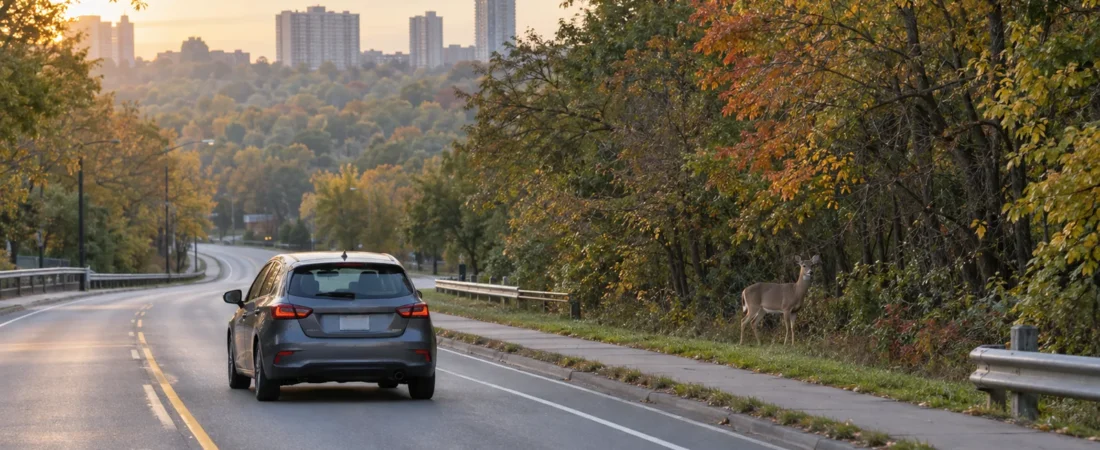
A raccoon at the curb, a deer near a wooded shoulder or a turtle moving across the road can catch a new driver completely by surprise. The danger is not only the animal. It is the sudden brake, sharp swerve or loss of attention that can follow.
Scarborough includes ravines, parks, wetlands and the Rouge Valley, so wildlife is part of the local driving environment. The goal is not to predict every animal. It is to build a response that keeps your car controlled when something moves unexpectedly.
What Ontario’s handbook tells drivers to do
The Official MTO Driver’s Handbook says animals can appear on roads anywhere in Ontario. It advises drivers to scan from shoulder to shoulder, slow down when an animal is on or near the road, and pass carefully because animals can suddenly bolt into traffic.
The handbook also says to be especially cautious around animal-crossing signs and during dusk-to-dawn hours. Darkness, rain and fog make animals harder to see, so speed should be reduced. If you see an animal, the MTO advises slowing down, sounding the horn and watching for other animals that may be nearby. It specifically warns drivers not to try to drive around an animal because its movement is unpredictable.
Those are the official recommendations. In a lesson, the practical focus is how to apply them without creating a second danger for the people behind or beside you.
The first response: eyes up, car straight
When something moves at the edge of the road, keep your eyes where you want the car to travel. Check the road ahead, mirrors and surrounding traffic instead of staring only at the animal.
Ease off the accelerator immediately. If more slowing is needed, brake firmly but progressively while keeping the steering steady. A controlled stop in your lane is usually safer than a sudden move into another lane, a curb, a cyclist or oncoming traffic.
A common learner mistake is turning the steering wheel at the same moment as pressing the brake hard. That asks the tires to manage two big changes at once. Build the habit of keeping the car straight while you reduce speed, unless a different movement is clearly necessary and you have confirmed the space is open.
This is also why your following distance matters. If the driver ahead brakes for an animal, you need enough room to react without panic. The MTO’s two-second minimum applies in ideal conditions; leave more space when it is dark, wet or visibility is limited.
Scan the places where an animal may appear
Do not search only the centre of the lane. Move your eyes between the road ahead and the edges of the driving environment:
- gaps between parked vehicles;
- bushes and wooded shoulders;
- drainage ditches and wet areas;
- the entrances to parks, trails and ravines;
- the dark edge beyond your headlight beam;
- the space underneath and beside vehicles ahead.
At night, the MTO suggests watching for shining eyes at the roadside and using high beams when it is possible and safe. Remember to return to low beams when required around other road users. A clean windshield and properly aimed headlights also matter because glare and haze can hide a small shape near the curb.
On a residential street, reduce speed before you reach the uncertain area. Do not wait until an animal is already in your path. This is the same early-planning habit used for parked cars and hidden residential hazards.
A Scarborough example near the Rouge
Rouge National Urban Park is an urban natural area with roads, trails and wildlife close together. Parks Canada notes that some Rouge trails cross busy roads, including Twyn Rivers Drive, where visibility is not ideal. It also describes road-safety work intended to help wildlife cross park roads more safely.
For a driver, the lesson is simple: a road can feel urban and still have natural edges. Near parkland or a wooded ravine, look farther into the shoulder and be ready for a slower decision. Do not assume streetlights, houses or traffic mean an animal cannot appear.
Parks Canada has also promoted slowing and stopping safely for turtles in Rouge National Urban Park. A turtle may look stationary from a distance, and another driver may not notice it at all. Slow early, keep your vehicle predictable and do not stop in a way that exposes you to traffic from behind.
If the animal stops in your lane
Slow down and be prepared to stop while checking the traffic behind you. Keep the wheels straight. If you can stop safely, leave space rather than creeping right up to the animal.
Do not get out in a live lane to move, photograph or watch wildlife. The MTO says anyone who wants to watch an animal should first find a safe place completely off the road and should remain in the vehicle. Stopping on the shoulder can distract other drivers and put you in their path.
Do not assume the animal will continue in the same direction. It may freeze, turn around or follow another animal. If one crosses, scan again before moving. The next animal may be a few seconds behind.
If a deer or moose is struck, the MTO says to report it to local police or the Ministry of Natural Resources and not to move an injured animal. For any collision, first protect people: regain control, stop in a safe place when possible and contact emergency services if anyone is injured or the situation is an immediate danger.
Common mistakes new drivers can correct
Staring at the animal. Your hands tend to follow your eyes. Keep scanning the safe path and the traffic around you.
Swerving before checking. An empty-looking lane may contain a motorcycle, cyclist or faster vehicle in your blind spot.
Following too closely at night. Your view is already limited. More space gives you time if the vehicle ahead brakes suddenly.
Speeding up as soon as one animal crosses. Pause and scan both sides. Animals may travel together.
Using the horn as the whole solution. The MTO recommends sounding the horn, but the animal’s reaction is not predictable. Slow down and stay prepared to stop.
Pulling over just to look. Wildlife can distract other drivers too. Continue safely or use a proper parking area.
A short wildlife-response checklist
When you notice an animal on or near the road:
- Lift off the accelerator and keep the car straight.
- Check mirrors and the space around your vehicle.
- Brake smoothly and be ready to stop.
- Sound the horn if appropriate, but do not rely on a predictable reaction.
- Avoid a rushed lane change or sharp swerve.
- Watch for a second animal before moving again.
- Do not stop on the roadway to watch or approach wildlife.
These steps work best when practised with good scanning and calm braking before an actual surprise. Review SparkOn’s guides to smooth emergency braking and safer night driving in Scarborough for the related vehicle-control skills.
Practise observation without waiting for a surprise
During an ordinary drive, call out the places where movement could appear: a dark driveway, a break in the bushes, a trail entrance or the space behind a parked van. This is not about being nervous. It is about noticing uncertainty early enough to make a smooth choice.
If you want help developing calmer observation, braking and space-management habits, book a Scarborough driving lesson with SparkOn Driving Academy. We can practise reading road edges and responding to unexpected hazards without rushing the steering wheel.