
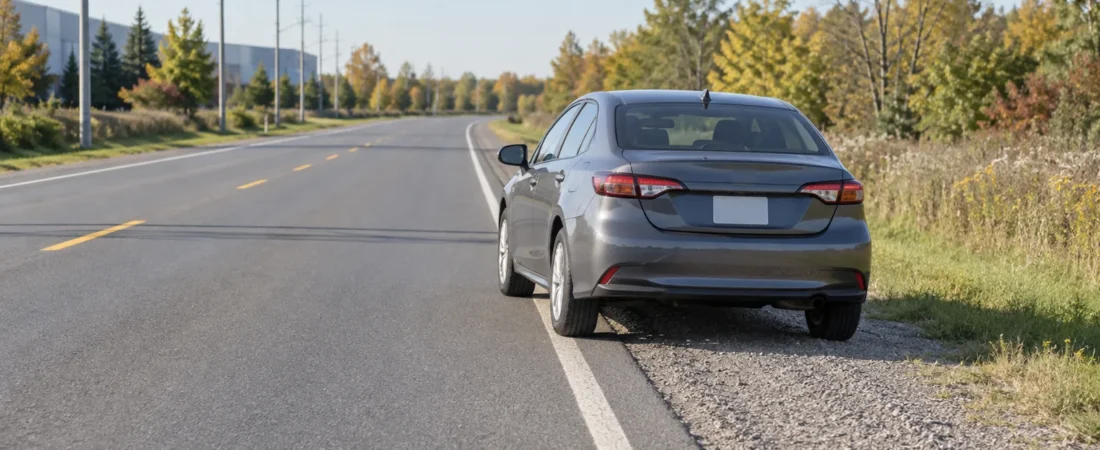
Hearing gravel under the right tires can make a new driver react instantly. The natural impulse is to pull the wheel left and get back onto the road as fast as possible. That sharp correction is often the part that creates the bigger problem.
If the shoulder is stable and there is space ahead, you usually have time to slow the car, regain control and return smoothly. This guide explains Ontario’s official advice and the practical routine I want learners to understand before the situation ever happens.
Ontario’s official recovery guidance
The Official MTO Driver’s Handbook gives a short, direct sequence for wheels leaving the pavement:
- do not panic;
- grip the steering wheel firmly;
- take your foot off the accelerator to slow down;
- avoid heavy braking;
- when the vehicle is under control, steer toward the pavement;
- be ready to correct the steering and increase speed after the wheels are fully back on the pavement.
The handbook’s driving-along section also tells drivers to steer smoothly, look well ahead and maintain a cushion of space. For freeway driving, the MTO advises scanning 15 to 20 seconds ahead, or as far as you can see, because higher speed demands more time to respond. That guidance appears in the official freeway-driving section.
Those are the official instructions. The steps below are practical instructor guidance for putting them into a calm, usable order; they are not a separate law or road-test procedure.
First, recognize what has happened
You may hear a sudden change in tire noise, feel vibration through the steering wheel or notice the car pulling slightly toward the shoulder. Keep your eyes up. Looking down at the edge of the hood will not tell you what traffic, road shape or hazards are ahead.
The situation is different from a tire blowout. If the steering becomes extremely heavy, the vehicle develops severe vibration or you suspect a tire has failed, follow the MTO blowout guidance: ease off the accelerator, steer firmly in the direction you want to travel and bring the vehicle to a stop off the road. Do not assume every vibration is simply gravel.
For a normal pavement-edge drop, your first job is to stabilize the vehicle—not to return immediately.
A five-step recovery routine
1. Hold the wheel and look ahead
Keep both hands on the wheel and hold a steady path parallel with the road. Avoid staring at the pavement edge. Look toward the open path ahead while continuing to monitor traffic.
If only the right wheels are off the pavement, the tires may experience different grip levels. A calm, firm hold stops small bumps from becoming unnecessary steering movements.
2. Ease off the accelerator
Let the vehicle slow gradually. The official handbook specifically says to take your foot off the gas and avoid heavy braking. A hard brake application can upset the car, particularly when one side is on loose gravel, soft ground or a wet shoulder.
Do not press the accelerator in panic to “power” back onto the road. Speed reduces the time available to judge the pavement edge and surrounding traffic.
3. Check the road and traffic
Use quick mirror checks while keeping most of your attention forward. Ask three questions:
- Is the shoulder stable and wide enough to continue straight briefly?
- Is there a ditch, guardrail, sign, parked vehicle or narrowing edge ahead?
- Is the lane beside you clear enough for a controlled return?
If the shoulder is disappearing or another immediate hazard is present, the situation may require a quicker response. That is why scanning ahead before anything goes wrong matters so much.
4. Return only after the car is controlled
When the speed is lower, the vehicle is stable and the lane is clear, guide the wheels toward the pavement smoothly. Use one measured steering input rather than a fast pull.
The pavement edge may resist the tire slightly, especially if there is a height difference. Do not keep adding more steering until the car jumps across the edge. A progressive input helps you avoid crossing too far into the lane or toward opposing traffic.
5. Straighten and rebuild speed
As all four wheels return to the pavement, straighten the steering so the car settles into the lane. Be ready for the vehicle to respond more quickly once both right tires regain full pavement grip.
After the car is straight and stable, return to an appropriate speed for the road and traffic. Check the mirrors again. If the impact was hard or the vehicle now pulls, vibrates or shows a tire-pressure warning, find a safe place to stop and inspect it.
Why a sharp return can go wrong
When a learner yanks the wheel left, the right tires may initially press against the pavement edge instead of climbing it. The driver then turns farther. Once the tires cross the edge, all that steering angle takes effect at once and the car can shoot across the lane.
The next reaction is often an equally sharp turn back to the right. That back-and-forth correction can become harder to control than the original drift onto the shoulder.
The better response feels slower: reduce speed, hold the path, check traffic, return with one smooth input and straighten. Calm does not mean passive. It means doing each control action in an order the tires and vehicle can handle.
Common mistakes to correct
Looking at the shoulder instead of the path. Your vision should lead toward the safe space ahead, not stay fixed on the road edge.
Braking hard immediately. Ease off the accelerator first unless an obstacle makes stronger braking unavoidable.
Turning back before checking traffic. A sudden return can put you into the path of a vehicle beside or behind you. Keep the mirror-check routine active.
Trying to return at the original speed. Give yourself time to make a controlled steering movement.
Adding too much steering. If the tire does not cross the edge instantly, avoid winding on a large steering angle.
Forgetting to straighten. Once the tires regain pavement, reduce the steering input so the car does not continue across the lane.
Assuming driver-assistance technology will fix it. Lane-keeping systems vary and may not recognize a weak, missing or construction-shifted edge line. The MTO’s vehicle-control guidance says drivers remain responsible and must be ready to take control even when assistance features are available.
Scarborough situations where edge awareness matters
Most urban Scarborough streets have curbs, but pavement-edge recovery still matters. Roadwork can temporarily change lane edges. Some ramp, industrial and less-developed roadside sections have narrow shoulders or soft edges. Snow, leaves, darkness or rain can make the edge harder to read.
On a Highway 401 ramp or another higher-speed road, prevention is especially important. Look farther ahead, keep a stable lane position and avoid following a large vehicle so closely that it blocks your view. Our guide to curves and ramps in Scarborough explains how early speed control reduces late steering corrections.
If you drifted because your seating position made the lane hard to judge, review our driver seat and mirror setup before the next practice drive.
A short recovery checklist
Remember this order:
- Eyes up and hold steady.
- Ease off the accelerator.
- Avoid heavy braking.
- Check the shoulder, lane and traffic.
- Return smoothly when controlled.
- Straighten, then rebuild speed.
- Stop safely if the vehicle feels damaged.
This is a situation to understand with an instructor, not something to deliberately recreate on a public road. A lesson can build the underlying skills—lane position, far-ahead vision, smooth steering and controlled speed—without intentionally dropping wheels onto an unsafe shoulder.
SparkOn offers driving lessons in Scarborough for learners who want steadier lane control and calmer emergency responses. Book a Scarborough lesson and ask to focus on road-edge awareness, ramp positioning and smooth recovery principles.