
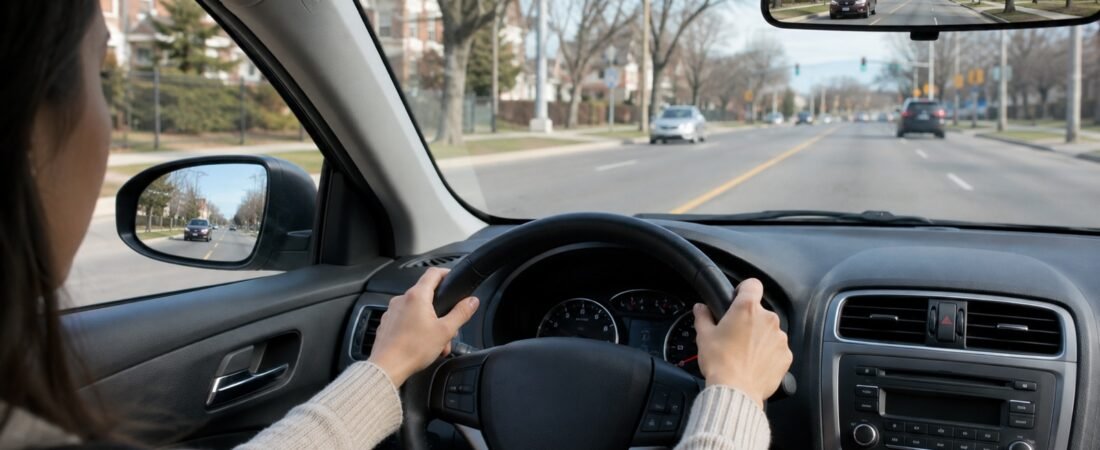
New drivers hear “check your mirrors” all the time, but many students are never sure what that actually means on a busy Scarborough road. Some learners stare at the rear-view mirror too long. Some only check after they already started braking or steering. Some check the mirror but forget the blind spot. The car may still be in the lane, but the driver’s attention is late.
A good mirror routine should feel quick, calm, and useful. You are not checking mirrors to look busy. You are checking because traffic changes behind you, beside you, and ahead of you at the same time. Once you understand what each glance is for, your driving becomes smoother and other drivers get fewer surprises from you.
The official rule side: mirrors and blind spots are part of awareness
The Official MTO Driver’s Handbook section on driving along tells drivers to stay aware of traffic around them, check mirrors about every five seconds, and check blind spots by turning the head to look over the shoulder. That is the official safety foundation: mirrors are not only for lane changes. They are part of regular driving.
The MTO’s Changing positions guidance also connects moving, passing, and changing lanes with checking that the way is clear before you move. Instructor recommendation: build the mirror habit before the manoeuvre. If your mirror check happens after the car already drifts or slows, it is late.
Rear-view mirror: what is changing behind you?
The rear-view mirror gives you the big picture behind the car. Use it before braking, before changing speed, after turning, after entering a new road, and anytime traffic flow changes. On Scarborough roads like Lawrence Avenue East, Ellesmere Road, Kingston Road, or busy plaza areas, traffic behind you can close the gap quickly even when you are driving correctly.
A common student mistake is checking the rear-view mirror only when the instructor says it. That creates a robotic habit. Instead, ask a simple question: “If I slow down now, who behind me needs time to react?” This is especially useful before stopping for traffic, approaching a yellow light, slowing near a pedestrian area, or preparing to pull over.
If following space is already a weak area, connect this habit with SparkOn’s guide to following distance in Ontario. Your mirror check tells you what is behind; your space in front gives you options.
Side mirrors: what is beside you and slightly behind?
Side mirrors help you track vehicles, cyclists, motorcycles, buses, and parked vehicles beside or slightly behind you. They are important before changing lanes, moving around a parked car, passing a cyclist, leaving the curb, or positioning for a turn. But a side mirror is still not a full blind-spot check.
Students often make one of two errors. The first is ignoring the side mirror until the last second. The second is staring at it for too long and letting the car wander. Keep the glance short. Look, understand, and bring your eyes back to the road ahead. A mirror is information, not a place to live.
For lane-change timing, SparkOn’s article on mirror-signal-shoulder-check lane changes goes deeper into the full sequence.
Blind spots: mirrors help, but they do not replace your head turn
The MTO is clear that drivers should check blind spots by turning their head to look over the shoulder. This matters because a vehicle, cyclist, or motorcycle can sit in a space your mirrors do not show clearly. That is why a shoulder check is not optional just because your car has blind-spot warning lights.
Instructor recommendation: shoulder check before your car moves sideways, not while it is already moving sideways. The check should be quick and controlled. Keep the steering wheel steady, turn your head enough to confirm the blind spot, then bring your eyes forward. If you cannot keep the car straight while shoulder checking, practise first at lower speed on a quiet street.
If you rely too much on driver-assist technology, review SparkOn’s guide on why blind-spot monitors do not replace shoulder checks.
Use a scan pattern, not random glances
A practical scan pattern keeps your eyes moving without panic. Think: far ahead, near ahead, mirrors, sides, back ahead. Far ahead helps you notice stale green lights, brake lights, lane reductions, buses, and pedestrians early. Near ahead keeps your lane position and speed smooth. Mirrors tell you what is changing around your vehicle.
On a Scarborough residential street, the pattern changes slightly. You still check mirrors, but you also scan parked cars, driveways, laneways, children, delivery vehicles, and cyclists. On a wider arterial road, mirror checks become more frequent when traffic speed, lane changes, buses, or turning vehicles create movement around you.
The point is not to count every glance perfectly. The point is to stop driving with tunnel vision. The more organized your scan is, the less surprised you feel.
When mirror checks matter most
- Before braking: know whether the driver behind has enough time and space.
- Before signalling: understand whether your planned move is realistic.
- Before changing lanes: mirror, signal, mirror again if needed, shoulder check, then move only if clear.
- Before passing parked cars: look for traffic behind, cyclists beside you, and doors or pedestrians ahead.
- Before leaving the curb: signal, check mirrors, shoulder check, and wait for a safe gap.
- After a turn: confirm what traffic is now behind you and rebuild normal speed smoothly.
The MTO guidance on sharing the road is also useful here because mirror and blind-spot checks are a big part of seeing cyclists, motorcycles, and other vulnerable road users before your vehicle changes position.
Common mirror-check mistakes new drivers make
The biggest mistake is treating mirrors like a road-test performance instead of useful information. A learner may move their eyes, but not actually understand what they saw. If you check the mirror and cannot answer “is anyone close behind me?” the check was too passive.
Another mistake is over-checking one mirror and forgetting the road ahead. This happens when students become nervous about lane changes. They keep looking left and the car starts drifting left before the decision is complete. Keep the vehicle stable first. Observation should support control, not replace it.
A third mistake is skipping the second check when the situation changes. If you checked, waited three seconds, and then moved, your information may already be old. Check again before committing.
A simple practice routine for Scarborough learners
Try this routine during a lesson or supervised practice:
- Drive on a calm road and call out what you see in the rear-view mirror every few seconds.
- Before each planned slowdown, check the rear-view mirror first.
- Before each lane-position change, check the correct side mirror and shoulder.
- After each turn, check the rear-view mirror and rebuild speed smoothly.
- On residential streets, add parked-car, driveway, and pedestrian scanning.
- On busier roads, practise short mirror glances without staring or drifting.
This routine pairs well with SparkOn’s article on residential street driving in Scarborough and the guide to pulling over and re-entering traffic.
Book a Scarborough driving lesson with SparkOn
If mirror checks feel rushed or unnatural, you do not fix that by memorizing a script. You fix it by practising the timing in real traffic until each check gives you useful information. SparkOn Driving Academy can help you work on observation, blind spots, lane changes, curbside stops, residential driving, and G2/G preparation on Scarborough roads. Book Scarborough driving lessons or contact SparkOn to practise with an instructor.