
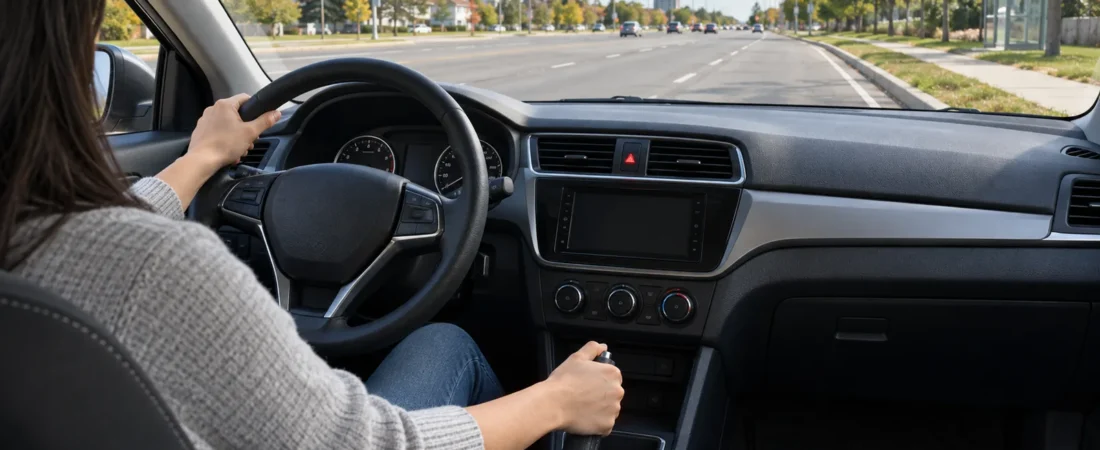
A brake pedal that suddenly does not slow the car is one of those emergencies every driver hopes never happens. Total brake failure is rare, but a new driver should still know the response before the moment arrives. On a busy Scarborough road, the priority is simple: stay calm, keep steering, warn others and reduce speed without creating a second emergency.
Ontario’s official brake-failure steps
The Official MTO Driver’s Handbook gives a short sequence for passenger-vehicle brake failure:
- Try pumping the brake pedal to temporarily restore hydraulic brake pressure.
- If that does not work, apply the parking brake gently but firmly while holding the release button.
- Once stopped, do not drive away. Call for help.
Those are the official steps. The practical guidance below explains how to carry them out while you are still sharing the road with other drivers, cyclists and pedestrians.
First, keep control of the car
The first surprise is often the pedal itself: it may feel unusually soft, sink farther than expected or fail to produce normal braking. Keep your eyes up. Hold the steering wheel firmly, take your foot off the accelerator and look for open space ahead. Turn on the hazard lights so other drivers have an early warning that your vehicle is not behaving normally.
Do not stare down at the pedals or parking-brake control. On a Scarborough arterial, the situation ahead can change quickly at an intersection, bus stop or driveway. You still need to steer, scan your mirrors and choose the safest available path.
If there is a curb lane or a wide, empty shoulder, move toward it only after checking that it is clear. Avoid a sudden lane change. If you are approaching stopped traffic, look for the open path that gives you the most time and distance rather than aiming directly at the back of the queue.
Pump the brake pedal, then use the parking brake smoothly
Pump the brake pedal several times as the MTO recommends. The purpose is to see whether temporary hydraulic pressure returns. Keep steering and looking ahead while you do it.
If pumping does not work, use the parking brake gently but firmly. With a traditional hand lever, holding the release button lets you control the force instead of locking the brake suddenly. Add pressure progressively and be ready to ease slightly if the rear of the vehicle begins to move sideways.
Some vehicles have a foot-operated or electronic parking brake rather than a hand lever. Their emergency operation can differ. The MTO also tells drivers to know their vehicle and consult information from the automaker about its systems and limitations. Read the owner’s manual before you need it, and know where the parking-brake control is without looking away from the road.
This is not the time to experiment with buttons you do not recognize. During normal lessons, I want a learner to identify the hazard switch, gear selector and parking brake while the car is safely parked. That small habit reduces hesitation in an emergency.
Choose space, not a perfect stopping place
Your stopping place may not be convenient. It only needs to be safer than continuing through traffic. Aim for a clear shoulder, empty curb lane, parking area or another open space where you can bring the vehicle to rest. Use the horn if someone ahead has not noticed your hazards and you need to warn them.
Vehicle designs differ, so do not improvise with the ignition or gear selector. If the owner’s manual gives a model-specific emergency procedure, learn it in advance rather than trying to find it while the vehicle is moving.
On a slope, a long straight road or a Highway 401 exit, distance becomes especially important. Scan far enough ahead that you can use every metre available. Avoid steering onto a sidewalk or into a space occupied by pedestrians, cyclists or parked vehicles. The safest route is the one with room, visibility and the fewest conflicts.
Once you stop, the trip is over
The MTO is clear: if your brakes fail and you manage to stop, do not drive away. Put the vehicle in Park, keep the parking brake applied, leave the hazards on and call for roadside assistance or a tow. Even if the brake pedal seems normal again, the cause has not been diagnosed.
If you are stopped on a high-speed road, use the safety principles in SparkOn’s guide to a car breakdown on Scarborough roads and Highway 401. If the vehicle is in a dangerous live lane, call 911. Be cautious about getting out beside moving traffic; where you stop determines whether remaining inside or moving to a safer location is the better option.
Warning signs you should not ignore
Brake failure is usually discussed as a sudden event, but sometimes the vehicle gives you an earlier warning. The MTO vehicle-maintenance guidance tells drivers to watch for dashboard warning lights and listen for squeaking or grinding when applying the brakes. It also says a brake pedal should feel firm and secure rather than spongy after driving through floodwater.
Before driving, pay attention to:
- a brake warning light that remains on after startup;
- a pedal that feels softer, lower or different from normal;
- grinding, scraping or unusual brake noises;
- the vehicle pulling to one side during braking;
- a parking brake that does not apply or release normally.
Do not begin a lesson, road test or regular trip hoping a brake problem will improve. Have the vehicle inspected. SparkOn’s Ontario road-test car checklist also explains the basic condition checks to complete before test day.
Common mistakes to avoid
Freezing and looking down: keep your eyes on the escape path and continue steering.
Yanking the parking brake: sudden force can make control harder. Apply it progressively while holding the release button on a traditional lever.
Swerving across several lanes: signal, check and move toward safe space gradually if traffic allows.
Continuing after the car stops: temporary braking pressure does not mean the fault is repaired. Call for help.
Practising alone on public roads: the MTO says new drivers should practise a parking-brake emergency stop only under controlled conditions with a qualified instructor.
A short routine to remember
Eyes up. Hazards on. Foot off the gas. Pump the pedal. Apply the parking brake smoothly. Steer to clear space. Stop and call for help.
You do not need to become a mechanic to handle the first few seconds well. You need to know your vehicle’s controls, keep scanning and avoid sudden decisions.
If you want to build calm emergency-control habits in a safe setting, book a driving lesson in Scarborough with SparkOn Driving Academy. We can work on controlled braking, hazard awareness and knowing the vehicle’s controls without creating a dangerous simulation on a public road.