
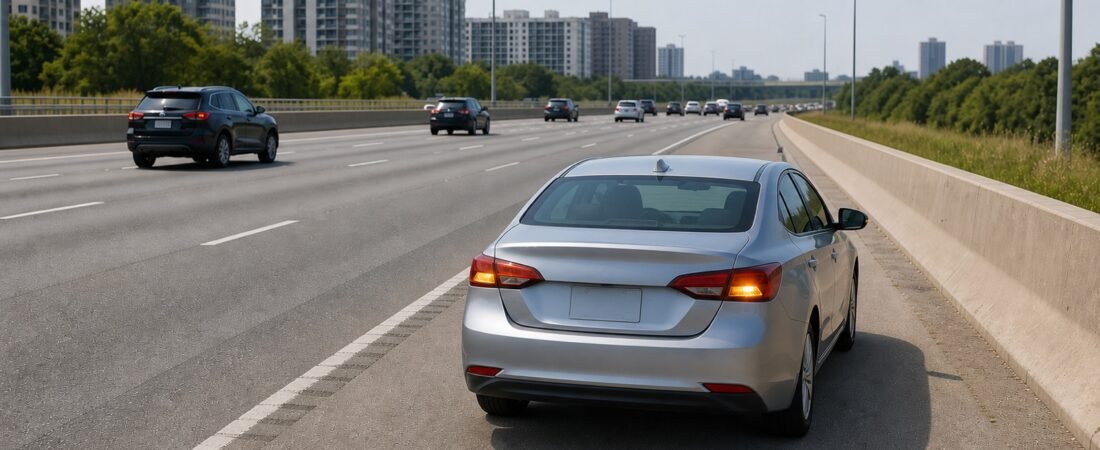
A warning light appears, the engine loses power, or a tire suddenly feels wrong. A car breakdown in Scarborough can become stressful quickly—especially on Highway 401—but a calm sequence helps you protect yourself and give responders the information they need.
This guide covers the first decisions to make, the difference between stopping on a city street and a freeway, current Ontario towing-zone instructions, and a simple emergency checklist. It is for breakdowns, not collisions; if anyone is injured or there is immediate danger, call 911.
At the first sign of trouble, act early
Do not wait for the vehicle to stop moving if you can still control it. The Official MTO Driver’s Handbook says that when trouble begins on a freeway, drivers should check their mirrors, turn on the hazard lights, take their foot off the accelerator, and move to the nearest shoulder as quickly as possible.
Keep steering smooth and predictable. Avoid a sudden lane change or hard braking unless you must respond to an immediate hazard. As you slow:
- Turn on the four-way hazard lights.
- Scan ahead for a shoulder, side street, driveway, parking area, or other place outside the travel lane.
- Check mirrors and the appropriate blind spot before changing position.
- Signal if it will make your intended movement clearer to nearby drivers.
- Stop as far out of moving traffic as the available safe area allows.
If you cannot reach a safe place and the vehicle stops in a live lane, keep the hazards on and call 911. Ontario’s current Tow Zone Program guidance specifically directs drivers to call 911 when they are in a travelled lane and cannot move the vehicle somewhere safe.
Breaking down on a Scarborough city street
On a local or arterial road, look for a location that does not block an intersection, driveway, crosswalk, bike lane, transit stop, or traffic lane. A nearby side street or parking area may provide more separation than the curb of a busy multi-lane road, but only continue that far if the vehicle remains controllable.
Once stopped, select Park, apply the parking brake, and leave the hazard lights on. Think before opening a door. Cyclists, buses and other vehicles may pass close to the driver’s side, so check mirrors and the blind spot first. If you must exit, use the door away from traffic when that is possible and safe.
Do not stand between the disabled vehicle and moving traffic. If the location feels exposed, tell the assistance provider exactly where the car is and explain the traffic risk. For a refresher on choosing a roadside position and securing a stopped vehicle, see our guide to parking on hills in Scarborough.
Breaking down on Highway 401
The priority is to get completely out of the travel lanes. The MTO handbook says never to stop in a freeway driving lane. Use the nearest shoulder; do not try to cross several lanes to reach a preferred side if doing so would be unsafe.
After stopping, keep the doors locked and generally remain inside while waiting for help. If you must leave, the handbook advises using the door away from traffic where possible. It also says not to raise the hood. Ontario’s Tow Zone Program adds that drivers on a highway should not attempt repairs or change a flat tire while waiting for responders.
That advice matters on Highway 401 because traffic speed, wind and limited clearance make the roadside different from a driveway or parking lot. A task that feels routine at home can be dangerous beside live freeway lanes.
Highway 401 towing rules around Scarborough
Ontario operates restricted towing zones on selected high-volume provincial highway sections. One current zone covers Highway 401 from Highway 404 to Morningside Avenue. Always check the official map or instructions because the program boundaries can change.
In a restricted towing zone:
- Call 911 for an emergency or when the vehicle is stuck in a travelled lane and cannot be moved safely.
- Call 511 when you are in a safe location and need a tow in the restricted zone; select the Tow Zone Program option.
- An eligible roadside-assistance provider authorized by MTO may be called directly for a light vehicle that has broken down—not collided—when it is safely on the right shoulder and the other program conditions are met.
If you are outside a restricted zone and it is not an emergency, the province says to call a towing company directly rather than 511. The safest approach is to identify your precise location before deciding which number or provider applies.
What information to give the responder
A clear location description can reduce confusion. Before calling, note:
- the road or highway name;
- your direction of travel;
- the nearest exit, cross street, bridge, kilometre marker, or visible landmark;
- whether you are on the right shoulder, left shoulder, ramp, or in a live lane;
- your vehicle’s colour, make, model, and plate number;
- what happened, such as loss of power, a flat tire, overheating, or a warning light;
- whether anyone is injured or the vehicle is creating an immediate danger.
Do not walk along the highway to search for a sign. Use information you can see safely from the vehicle, your phone’s map if available, or location details provided by emergency-call systems.
What not to do during a roadside breakdown
Do not stop in a live lane if the car can still reach a shoulder. Begin moving over at the first sign of trouble.
Do not stand beside traffic to inspect the car. Wait for trained assistance when the road environment is unsafe.
Do not raise the hood on a freeway. Follow the MTO handbook instruction and keep the vehicle closed while you wait.
Do not accept an unclear tow destination or arrangement. Ontario’s official towing-rights page explains that, unless police or another authorized official initiates the tow, your consent is required. Confirm who is towing the car and where it will go.
Do not let the breakdown distract you before the car is secure. Make the safe stop first; phone calls and troubleshooting come afterward.
A practical breakdown kit for Scarborough drivers
Keep a small kit where you can reach it without standing beside traffic:
- charged phone and in-car charging cable;
- roadside-assistance and insurance details;
- reflective vest;
- flashlight with working batteries;
- seasonal blanket, water, and basic first-aid supplies;
- warning triangles or approved safety markers, used only when it is safe to place them;
- paper note with emergency contacts and key vehicle information.
Prevention also helps. Check fuel or charge, tire condition, warning lights and fluid leaks before longer trips. Our Ontario road-test car checklist covers many useful vehicle checks, while the guides to Highway 401 merging, night driving, and heavy rain can help you prepare for the road conditions around a breakdown.
Build calm roadside decision-making in your lessons
New drivers benefit from practising the steps before an emergency happens: recognizing a problem, checking mirrors, communicating, choosing a safer stopping place, securing the vehicle, and describing the location. These are judgement skills, not just mechanical steps.
SparkOn Driving Academy offers driving lessons in Scarborough that help learners develop calm observation and decision-making on local roads and major routes. Contact SparkOn to book a Scarborough lesson and practise safer roadside stops, lane changes, Highway 401 preparation, and emergency awareness with an instructor.