
Last verified: October 2, 2026.
The Metro East G2 test is a city-driving assessment, not a route-memory exercise. Prepare to manage Lawrence Avenue-area traffic, nearby residential streets, controlled intersections, lane changes and low-speed manoeuvres safely. The exact route and examiner directions are not guaranteed and can change.
What the G2 test is designed to assess
Ontario describes the G2 road test as the G1 exit test. It covers basic driving skills such as turns, stopping, lane changes, one-way streets, residential driving, traffic lights, stop and yield signs, parallel parking and three-point turns. Highway driving belongs to the later G test, not the normal G2 assessment.
That official list is more valuable than any online route video. DriveTest uses predefined routes and tasks, but construction, traffic and operational decisions can affect what happens on a particular appointment. Treat this article as local practice guidance, not an official map or promise of where an examiner will direct you.
Why Lawrence Avenue requires active planning
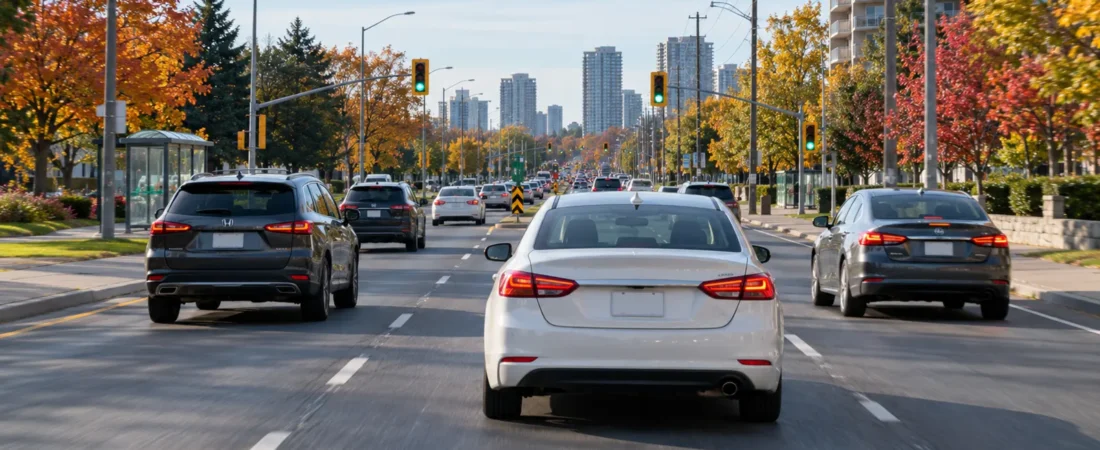
Lawrence Avenue East is a broad urban corridor with multiple lanes, signalized intersections, transit activity, commercial entrances and changing traffic volumes. For a learner, the difficulty is rarely one dramatic event. It is keeping several ordinary tasks organized at once: holding a steady lane, monitoring the speed limit, reading signs, noticing pedestrians and planning lane changes early.
Look well beyond the vehicle directly ahead. Brake lights two or three vehicles up can warn you that the flow is changing. Keep space so you can slow gradually instead of reacting late. Near driveways and plazas, expect vehicles to enter, stop suddenly or cross lanes. Do not give up your right of way blindly, but cover the brake when another driver’s intention is uncertain.
TTC buses may stop and re-enter traffic. Ontario law requires drivers in the lane next to the curb to yield to a bus displaying its signal when it is leaving a bus bay, but the bus driver must signal and must not move until it can be done safely. Our TTC bus guide explains the practical space and observation routine.
Moving between major roads and neighbourhood streets
The transition from a multi-lane road to a residential street exposes speed-control problems. A learner may carry the faster-road pace into a quieter area or focus on the turn and miss a new sign. Finish the turn, straighten the vehicle, read the road and settle promptly at an appropriate legal speed.
On streets lined with parked vehicles, keep enough side space while remaining on your side of the road. Scan through windows and under vehicles for movement. A child, cyclist, opening door or car edging from a driveway may appear with little warning. If the usable space narrows, reduce speed rather than squeezing through beside an oncoming vehicle.
At stop signs, stop before the line or crosswalk. Complete the stop, scan left-right-left and check again for pedestrians before moving. If buildings or parked vehicles block the view, make the legal stop first, then edge forward slowly for a second look.
Skills to practise around Metro East
Lane discipline
Keep the car centred without staring at the lane line. Use a far visual target and short mirror checks. When a lane ends or becomes turn-only, respond to signs and pavement arrows early. Last-second lane changes are a planning error even when another driver leaves a gap.
Lane changes
Use mirror, signal, blind-spot check and a smooth lateral move. Check the blind spot immediately before moving, not several seconds earlier. Maintain an appropriate speed and avoid turning the wheel while your head is still over your shoulder. The signal communicates your intention but does not give you priority.
Signalized intersections
Approach at a speed that gives you time to respond if the light changes. On green, scan before entering. On yellow, follow Ontario’s rule: stop if you can do so safely; otherwise proceed with caution. Do not accelerate to beat the light. Before a right turn, check the crosswalk and the right-side blind area for pedestrians and cyclists.
Left turns
Choose the correct lane early, enter the intersection only when appropriate and keep the wheels straight while waiting. Judge the entire gap, including pedestrians crossing the street you want to enter. Turn into the correct lane without cutting the corner. If the safe gap never appears, wait; another driver’s impatience does not change the risk.
Parking and three-point turns
Practise these on streets where they are legal and will not obstruct traffic. Move slowly, observe all around and yield whenever another road user approaches. A reversing camera can supplement your checks, but the MTO says road-test skills must be demonstrated without relying on driving aids. Look in the direction the car is moving.
A better practice plan than repeating a rumoured route
Divide your preparation into short goals. In session one, work on lane position, stops and turns on quieter streets. In session two, add Lawrence Avenue-style traffic, several planned lane changes and busy intersections. In session three, combine the skills while a supervising driver gives directions. End each session with two manoeuvres that need improvement.
Vary your starting point and direction so you do not drive on autopilot. Practise during moderate traffic after you are comfortable in light traffic. If rain, glare or congestion makes the task too difficult, move to a calmer area and build up gradually. Safe practice should stretch your skill without overwhelming you.
A supervising driver should name the next turn with enough notice, then allow you to plan it. If you miss the turn, continue safely. On the real test, you may ask the examiner to repeat an instruction. Never cross lanes abruptly or make an illegal movement to rescue a missed direction.
Practise decisions, not just movements
Ask why a gap was safe, why you reduced speed, or why you waited before turning. If the only answer is “because my supervisor said so,” the skill is not independent yet. Use the same observation routine on different roads until you can identify the hazard and choose the response yourself.
Keep a brief practice note after each session. Record one recurring error and the situation that triggers it. A learner who misses shoulder checks only in heavy traffic needs a different exercise from one who forgets them on quiet streets. Fix the pattern under manageable conditions, then bring it back into moderate Lawrence Avenue traffic.
Repeat the exercise on a different street so the improvement is a genuine habit, not a memorized response to one intersection.
Common Metro East test-day mistakes
- Following too closely on Lawrence: there is no room for a smooth response when traffic compresses.
- Missing lane-use signs: attention stays on the car ahead instead of looking farther forward.
- Incomplete blind-spot checks: the learner signals and moves after checking only a mirror.
- Speed carried into side streets: the new road is not reassessed after the turn.
- Blocked crosswalks: the vehicle stops too far forward or enters without enough space beyond the intersection.
- Over-coaching: the learner has practised only while someone supplies every decision.
- Chasing a route: memorized cues replace sign reading and hazard checks.
Your vehicle and arrival checklist
The MTO handbook says to bring a vehicle in good working order, applicable fees and required glasses or contact lenses, and to arrive at least 30 minutes before the appointment. Check the car several days beforehand so a repair does not become a test-morning surprise.
- Confirm the official appointment location, date and time.
- Check tires, brake lights, signals, horn, mirrors, windshield and seatbelts.
- Make sure the vehicle has fuel and the interior is clear of loose items.
- Bring your valid licence and corrective lenses, if required.
- Adjust the seat and mirrors, then locate the wipers, defroster, lights and parking brake.
Use SparkOn’s Ontario road-test car checklist and what-to-bring checklist for the final review.
Build a calm, transferable routine
A strong Metro East drive is not flashy. It is a series of ordinary decisions made early: see the sign, control the speed, check the blind spot, leave space and wait when the gap is not safe. Keep driving the road in front of you instead of trying to predict the examiner.
If you need help organizing those skills, SparkOn offers focused Scarborough road-test preparation. A lesson can target major-road lane changes, residential observation and test-day independence without claiming an official route or guaranteeing a result.
Official sources: Ontario graduated licensing; Official MTO Driver’s Handbook; DriveTest road tests for cars; MTO handbook: sharing the road.