
Last verified: October 2, 2026.
Toronto Port Union is a practical G-test choice for many Scarborough drivers, especially those who already practise on eastern Scarborough roads and Highway 401. Familiarity with the area can reduce test-day distraction, but it cannot replace adaptable driving. You still need to handle the road you are given, not a route copied from a video or forum.
This guide uses official DriveTest centre information and Ontario’s current G-test guidance. It does not provide an exact or guaranteed test route. Examiner directions, routes, construction, traffic and the test format can change.
Official Toronto Port Union centre details
The official DriveTest centre list identifies Toronto Port Union at The Village of Abbey Lane Shopping Centre, 91 Rylander Boulevard, Unit 109A, Toronto, Ontario M1B 5M5. DriveTest lists G2 and G road tests at this location.
As of the verification date above, inside services are listed Monday to Friday from 7:00 a.m. to 7:00 p.m. and Saturday from 8:30 a.m. to 5:00 p.m. Road-test appointments are listed Monday to Saturday from 8:00 a.m. to 5:00 p.m. Hours and services can change, so confirm the centre entry and your appointment confirmation before travelling.
Port Union is in a shopping-centre setting near multi-lane arterial roads and Highway 401 access. That tells you the types of environments worth practising. It does not tell you which streets or ramps an examiner will select.
What the G test asks you to demonstrate
Ontario’s Level Two road-test guide says the G test includes major roads and expressways, including merging on and off, maintaining speed and space and signalling. It also covers turns, curves, lane changes, intersections and business areas.
The current official page says that, until further notice, the G test does not include parallel parking, a roadside stop, a three-point turn or residential-neighbourhood driving. Recheck before your appointment because that temporary format can change.
Before the freeway portion, you must complete the Declaration of Highway Driving Experience. The form asks about eligible freeway or 80-km/h highway trips completed during the previous three months and their average length. Highway 401 is one of the freeways Ontario lists. Answer accurately: insufficient experience can make the test out of order.
Prepare for the shopping-plaza start
A plaza exit can look simple, but it concentrates several decisions. Pedestrians may cross between parked vehicles, drivers may reverse without much warning and traffic on the road may leave only short gaps. Start the test-day drive as you would any careful parking-lot exit: seat and mirrors set, doors secured, belt on, surroundings checked and directions heard clearly.
Move slowly enough to observe, but do not stop unnecessarily in the middle of a travel aisle. At a sidewalk or driveway edge, check both directions for pedestrians and cyclists before searching for a traffic gap. If parked vehicles block the view, creep only as far as necessary after yielding, then reassess.
A common mistake is looking only toward the nearest traffic lane. A vehicle or cyclist can approach from the other direction, and a pedestrian may enter while you are waiting. Keep the scan active until you commit to the turn.
Build major-road judgment, not route memory
The Port Union area includes roads where several lanes, commercial driveways, buses and turning traffic can compete for attention. Practise choosing the correct lane early, keeping a stable position and reading signs far enough ahead that you do not make last-second moves.
On business roads, the MTO advises checking for people or vehicles at entrances, institutions, construction sites and crossings. It also tells drivers to look 12 to 15 seconds ahead and maintain at least a two- to three-second following distance. Use more space when visibility or conditions are poor.
New G-test candidates often drive too slowly because they believe caution means staying well below the limit. That can interrupt traffic and make lane changes harder. Caution means selecting a legal speed appropriate to traffic, weather, visibility and road conditions. Accelerate smoothly after turns so the vehicle blends with the road.
Another common mistake is staying in the left lane after a left turn without considering the next instruction or normal traffic flow. Complete the turn into the corresponding lane, gain a stable speed, then change lanes only after a full safety check when it is appropriate.
Highway 401 entry: use the entire process
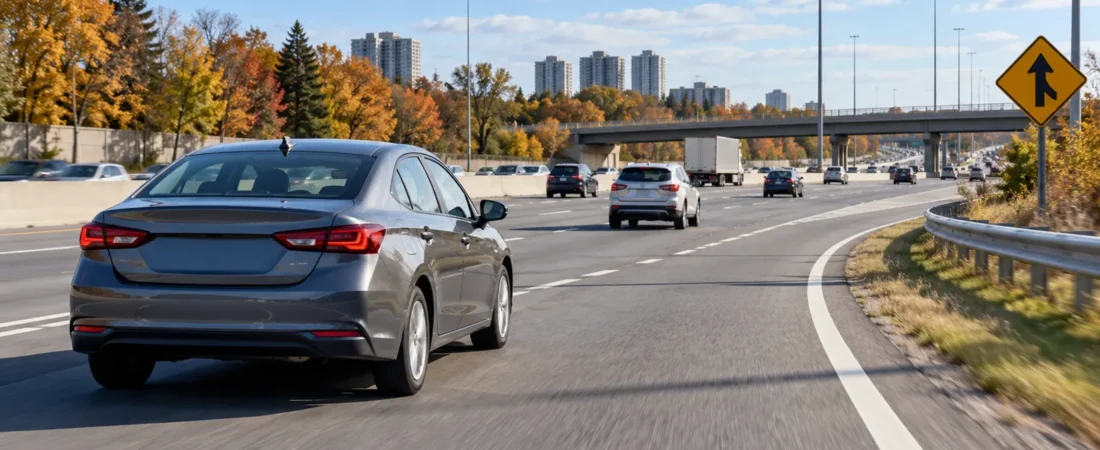
For Scarborough learners, Highway 401 can feel busy because gaps develop and disappear quickly. The official MTO freeway-driving chapter breaks entry into manageable parts. Control the ramp curve, look ahead, assess freeway traffic through mirrors and a blind-spot check, signal, build speed in the acceleration lane and merge smoothly into a safe gap.
Do not fixate on one vehicle beside you. Identify a primary gap and a backup option. Adjust speed gradually so you arrive beside open space rather than beside another vehicle. Keep enough room behind the car ahead on the ramp; it may hesitate or brake unexpectedly.
The shoulder check should be quick. Turning your head for too long can make you drift or lose track of traffic ahead. Check, return your eyes forward and check again if necessary. Our step-by-step Highway 401 merging guide gives a practice routine without claiming a test route.
Do not assume the posted maximum is always the correct immediate target. Match the flow when it is safe and legal, while adapting to congestion, weather and the usable length of the acceleration lane. Equally, do not enter fast-moving traffic at an unnecessarily low speed when conditions allow proper acceleration.
While on the highway: keep the drive settled
Once merged, centre the vehicle, cancel the signal and rebuild space. Check mirrors every five to ten seconds as the official test guide recommends, but keep most attention ahead. Look far enough forward to spot brake lights, lane changes and slowing traffic before they reach you.
A G-test drive should not feel like a series of disconnected commands. If the examiner asks for a lane change, you should already know what is beside and behind you. Use the normal sequence: mirror, signal, blind spot, smooth movement, centre and cancel. Never move solely because the signal is on.
If a gap is not safe, wait. The examiner is assessing judgment, not obedience at any cost. Avoid speeding up aggressively to beat a vehicle or braking sharply to force your way behind it. Create the space progressively.
Exit without braking in the through lane
The MTO says to signal before the exit, enter the exit lane at its beginning and avoid slowing until completely in that lane. Once inside it, slow gradually for the ramp. Check the right blind spot where another lane, acceleration lane or shoulder creates a possible conflict.
One common error is relaxing as soon as the vehicle crosses into the exit lane. The ramp still requires speed control, lane position and observation. Look through the curve rather than down at the pavement directly in front of the hood. Cancel the signal when appropriate and prepare for the road at the end of the ramp.
Local-road skills to practise near Port Union
- Lane selection: read signs and markings early, then move only after a complete check.
- Intersections: scan left, ahead and right before entering, even with a green light.
- Turns: approach at a controlled speed and finish in the corresponding lane.
- Following distance: keep at least the official two-to-three-second minimum and add space when needed.
- Commercial driveways: anticipate vehicles entering, exiting or stopping suddenly.
- Bus interaction: avoid hiding in a bus blind spot and expect stops and lane movements.
- Lane changes: preserve steering control during mirror and blind-spot checks.
- Speed control: respond to posted limits and conditions instead of guessing from surrounding traffic.
Port Union G-test day checklist
- Recheck the official DriveTest centre listing and your appointment location.
- Arrive with enough time to park, settle and complete check-in instructions.
- Bring your current licence, appointment information and required corrective lenses.
- Be prepared to complete the highway-experience declaration honestly.
- Use a clean, insured and mechanically suitable vehicle with enough fuel.
- Test lights, signals, horn, tires, seat belts, mirrors and windshield before leaving home.
- Remove loose items and ensure any recording device complies with DriveTest rules.
- Check DriveTest service disruptions before departure.
Our Ontario road-test checklist covers these practical details in one place.
Practise to adapt, not to predict
Rumoured Port Union routes can create false confidence. A construction closure, heavy traffic or examiner direction can change the drive. If you know only one entrance or street sequence, an unexpected instruction may take attention away from basic safety.
Practise a range of lawful highway entries, exits, major-road lane changes and intersection situations. The exact road is less important than your ability to read it. You are ready when observation, spacing and speed remain stable without coaching.
SparkOn offers Port Union and Scarborough G-test preparation focused on transferable skills, not route promises. If you want feedback on Highway 401 merging, major-road decisions or a complete mock-test drive, book a Scarborough driving lesson.