
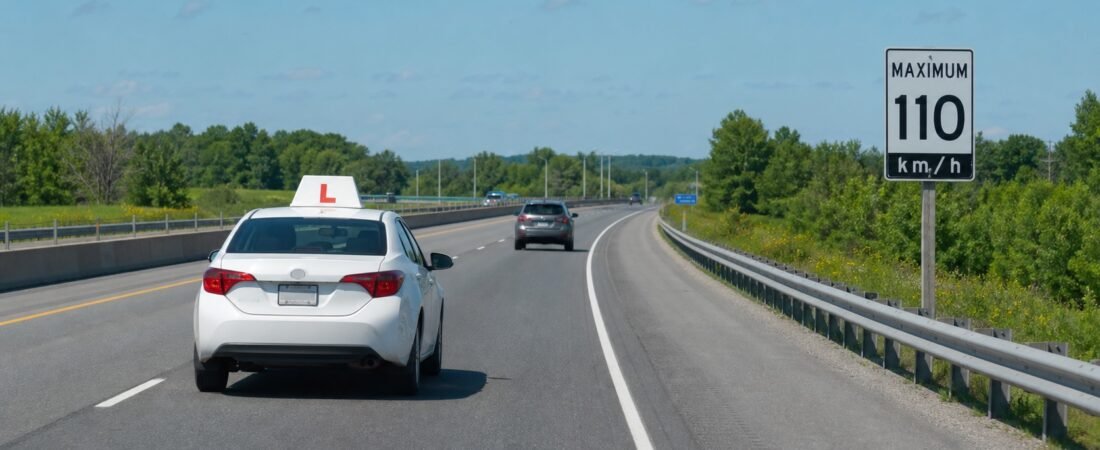
Ontario is raising speed limits from 100 to 110 km/h on more provincial highways in 2026. Here is what new drivers should know before practising highway driving.
What Is Changing?
On June 24, 2026, Ontario announced that more provincial highway sections will move from 100 km/h to 110 km/h. The first new sections started on June 26, 2026, and more sections are scheduled to change through September 30, 2026.
The key point for drivers is simple: follow the posted signs on the road you are actually driving. Do not assume every part of Highway 401, 400, 403, 404, 416, 417 or the QEW is automatically 110 km/h. Speed limits can change by section, construction zone, ramp, traffic condition and sign.
Which Sections Are Changing In 2026?
According to Ontario’s official backgrounder, these sections were scheduled first:
- June 26, 2026: Highway 401 from Highway 15 to Highway 16, and Highway 416 from Cedar Grove Road to Highway 401.
- July 31, 2026: sections of Highway 402, including Highway 401 to White Oak Drive and Waterworks to 350 metres east of Colborne Drive.
- August 21, 2026: sections of Highway 7, 115, 400, 416 and 417.
- August 31, 2026: more sections of Highway 401 and Highway 403.
- September 30, 2026: sections of Highway 403, 404, 406, 407, 412, 418 and parts of the QEW.
For the full official section-by-section list, check the Ontario backgrounder linked at the bottom of this guide. If you are planning a long highway drive, it is worth checking the route before you go.
What This Means For New Drivers
For a new driver, 110 km/h changes the feeling of the road. Traffic closes gaps faster, lane changes need more planning, and small steering or braking mistakes can feel bigger because the vehicle is travelling farther every second.
This is why a higher posted limit should not change your basic routine. You still need to scan far ahead, keep space around the car, check mirrors often, signal early, shoulder check before changing lanes and leave enough time to exit safely.
110 km/h Is A Maximum, Not A Target
A posted speed limit is the legal maximum in good conditions. In rain, fog, snow, darkness, construction, heavy traffic or poor visibility, the safe speed may be lower. Driving 110 km/h just because the sign allows it can still be unsafe if the conditions do not support it.
New drivers should also avoid copying the fastest vehicle on the highway. The safest habit is to choose a speed that fits the posted limit, traffic flow and your ability to keep smooth control.
Road-Test And Highway Lesson Habits That Matter More Now
Ontario’s driver’s handbook describes freeway driving as more demanding because traffic is moving at higher speeds. At 110 km/h, the same skills become even more important:
- Use the acceleration lane to match freeway traffic before merging.
- Keep a two- to three-second following distance, and add more space in poor conditions.
- Look 12 to 20 seconds ahead so you are not reacting late.
- Stay right when possible and use left lanes for passing.
- Do not slow down in the main lane before you are fully in the exit lane.
- Watch for speed adaptation when leaving the highway, because 60 or 70 km/h can feel slower than it really is after highway driving.
If you are preparing for your full G road test, this connects directly to highway skills: merging, maintaining speed and space, changing lanes, exiting and staying calm while traffic moves quickly.
Stunt Driving Still Starts At 150 km/h On These Sections
Ontario’s speed-limit page says stunt driving penalties continue to apply at 150 km/h on the 110 km/h sections. That means the higher limit is not a free pass to push much faster. At 110 km/h, you are already moving quickly enough that reaction time and following distance matter.
The better mindset is this: drive predictably, keep right unless passing, and leave other drivers room to make safe decisions.
How To Practise The Change Safely
If you are nervous about 110 km/h highway sections, do not make your first attempt during rush hour or bad weather. Practise with an instructor, start with calmer highway conditions and build the skill step by step.
- Begin with merging and exiting at quieter times of day.
- Practise holding steady speed without drifting in the lane.
- Count your following distance behind different types of vehicles.
- Practise lane changes only when there is a clear, patient gap.
- Review your exit plan early so you are not rushing across lanes.
Students in Scarborough and nearby GTA areas should also remember that many local practice drives include a mix of city roads, ramps and faster highways. The goal is not just reaching 110 km/h. The goal is staying calm and predictable as speed changes.
Quick Readiness Check
You are getting closer to highway confidence when you can merge without freezing, hold a steady lane position, keep safe space at higher speeds, pass and return right smoothly, and slow down for exits without surprising traffic behind you.
Need help with highway driving?
SparkOn Driving Academy helps students in Scarborough and nearby GTA areas build safe highway habits for G2, full G and everyday driving.