
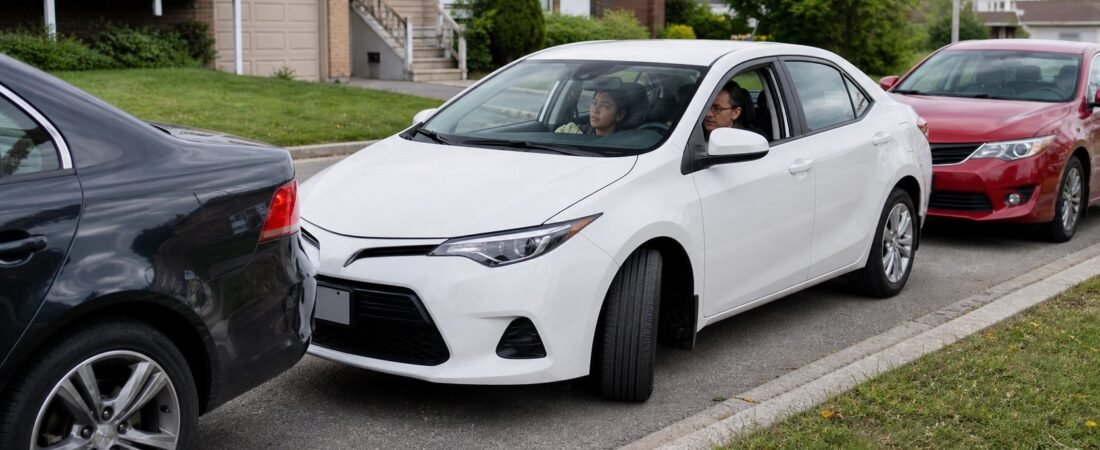
Parallel parking is one of the most intimidating parts of the G2 road test. Our straightforward 3-step method makes it easy, consistent, and stress-free.
Step 1: Signal, Check, and Line Up
Before you even begin the maneuver, safety and communication are your top priorities. Turn on your right signal to let other drivers know your intention. Check your rearview mirror, right side mirror, and your right blind spot.
Pull up next to the vehicle you are going to park behind. You should be parallel to it, leaving about 1 meter (3 feet) of space between the two cars. Align your vehicle so your rear bumper is even with the rear bumper of the target car.
Step 2: The 45-Degree Reverse
Put the car in reverse. Before taking your foot off the brake, physically turn your head and look out the rear window. Turn your steering wheel all the way to the right.
Slowly ease off the brake and begin backing up. Keep backing up until your car is at roughly a 45-degree angle to the curb. A good reference point is looking in your left side mirror: stop when you can see the entire front bumper of the car parked behind you.
Step 3: Straighten and Finish
Once at the 45-degree angle, straighten your steering wheel (usually 1.5 turns to the left) and continue reversing slowly in a straight line. Stop when your front right bumper clears the rear left bumper of the car in front of you.
Now, turn the steering wheel all the way to the left. Continue reversing slowly until your car is parallel with the curb. Finally, straighten the wheel and pull forward slightly to center your vehicle within the space. You should be about 30 cm from the curb.
The Biggest Observation Mistake
A perfectly centered car will still fail the maneuver if you do not observe traffic! Examiners deduct points heavily if you only look at your mirrors or the backup camera.
You must actively look over your shoulder and constantly check the front, back, and sides of the vehicle throughout the entire process.
How should you practise parallel parking safely?
Start in a legal, quiet practice area with an instructor or qualified accompanying driver. Use cones or a generous space before practising between vehicles. Move at walking speed, keep checking around the car, and stop whenever a pedestrian, cyclist, or vehicle enters the space.
- Practise the observation routine before focusing on steering reference points.
- Use the same slow speed through each step so you have time to correct.
- Remember that reference points change with the vehicle, seat position, and parking space.
- Finish by checking your distance from the curb and the space in front and behind.
When are you ready to use the skill on a road test?
You are getting close when you can choose a safe space, signal and check around the vehicle, reverse under control, make a correction without panic, and finish without touching the curb or creating a hazard. The goal is a safe, controlled manoeuvre, not memorizing one steering formula.
Need help getting road-test ready?
SparkOn Driving Academy helps students in Scarborough and nearby GTA areas prepare with patient lessons, mock tests and road-test car support.