
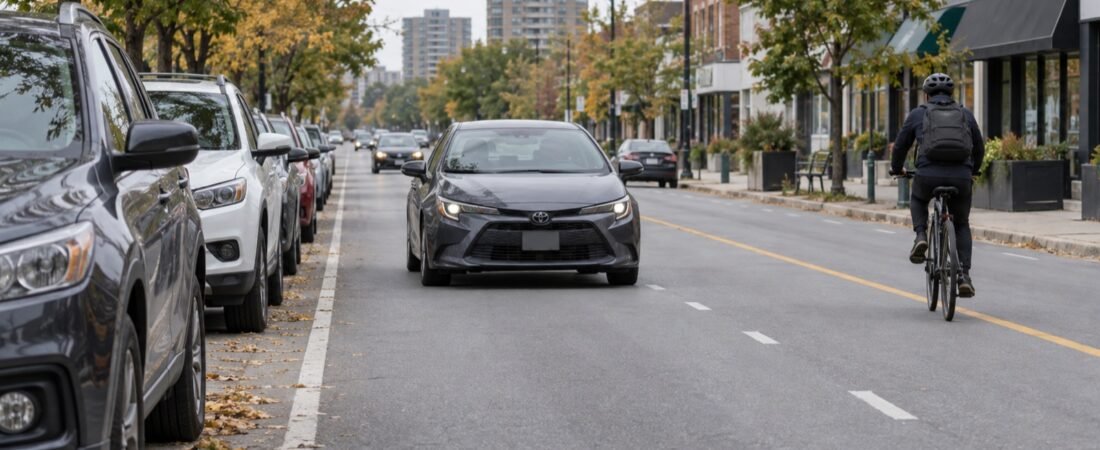
Parked cars are not empty space. A person can open a door, a driver can pull out, or a passenger can step onto the road with almost no warning. In Scarborough, where a busy commercial street can move from parked cars to a bike lane to a TTC stop in one block, new drivers need a clear plan for the “door zone.”
This guide explains the official Ontario expectations for sharing the road and the practical buffer routine I teach. The aim is not to hug the centre line or to swing around every parked car. It is to read the space early, choose a safe position and give yourself time to react.
What the official guidance says
The Official MTO Driver’s Handbook tells drivers to look well ahead for people in parked vehicles who may open a door or pull into traffic. When passing a cyclist, drivers must leave a minimum of one metre where practical and should change lanes whenever possible.
The MTO’s parking guidance also says a person must not open a vehicle door unless it can be done without endangering another person or vehicle. Toronto’s Vision Zero cycling guidance uses the same message: look before opening a door and be careful around people cycling.
Those are the rules and official safety directions. The buffer sizes and scanning steps below are instructor recommendations for managing risk in real traffic.
Spot a door zone before you reach it
Scan the parked cars for clues. A person sitting in the driver’s seat, a brake light, a front wheel turned toward the lane, a taxi with someone waiting, or a vehicle with its hazard lights on all deserve extra attention. Look through the windows of the parked cars rather than staring at only the nearest bumper.
Keep your eyes moving far enough ahead to find the next gap in the parked line. That gives you time to check mirrors, adjust position and decide whether you need to slow down. A common learner mistake is noticing an open door only after the car is beside it. By then, there is no comfortable option left.
Choose a calm lane position
On a road with a full lane beside the parked cars, hold a steady position away from the doors while staying inside your lane. Do not drift toward the centre line just because the shoulder looks clear. Keep checking oncoming traffic and vehicles behind you.
If the lane narrows, reduce speed and wait behind a cyclist or other road user rather than squeezing past. The MTO says bicycles may use any part of the lane when needed for safety, including to avoid parked-car doors or discourage a close pass. Treat the cyclist’s position as information about the road, not as an obstacle to rush around.
Passing a cyclist near parked cars
Before passing, check the mirror, signal and look over your shoulder. Move fully into the next lane only when it is clear and legal, leaving at least the required one metre where practical. If a solid line, traffic or a narrow lane prevents a comfortable pass, slow down and wait.
Do not sound the horn close behind a cyclist. The MTO recommends a quick, light tap only when you truly need to get attention and are still some distance away. In Scarborough, a cyclist may move left to avoid a door, a pothole or a storm drain. Give that movement room and expect it.
Look for people stepping out
Parked vehicles can hide pedestrians near shops, restaurants and bus stops. Check the gaps between cars, the sidewalk edge and the front of a vehicle that is about to leave. If you see a person near the curb, ease off the accelerator and cover the brake.
At a crosswalk or intersection, complete your traffic and pedestrian scan before changing position. The MTO reminds drivers to scan sidewalks and paths as well as the roadway. A clear lane is not enough if a pedestrian is about to cross into your path.
When a parked car starts moving
Watch for front wheels turning, a driver looking over a shoulder, reverse lights or a gap opening in the line. If a car begins to pull out, slow and let it finish when possible. Avoid accelerating to pass its bumper; the driver may not have seen you.
After a vehicle enters traffic, create space before returning to your normal speed. Keep your steering smooth and resist the temptation to brake sharply unless the situation requires it. Our smooth-braking guide covers the difference between a planned slowdown and an emergency stop.
Door-zone habits when you park
The safest driving habit continues after you stop. Before opening your door, check the rear-view mirror, side mirror and blind spot. A practical option is the Dutch Reach: open the driver’s door with your right hand so your shoulders turn toward the lane. That makes it easier to notice a cyclist approaching from behind.
Keep a door open only long enough to load or unload. Passengers should exit toward the curb when possible. These are simple habits, but they matter on busy streets where a cyclist can arrive silently.
Common mistakes I correct with learners
- Driving too close to parked cars: move away early and keep a steady, legal lane position.
- Passing a cyclist in the same lane: wait or change lanes when you can leave the proper space.
- Looking only at mirrors: scan the parked-car windows, wheels and gaps ahead.
- Signalling without checking: a signal communicates; it does not make a movement safe.
- Returning to speed too soon: rebuild space after a car, cyclist or pedestrian clears the hazard.
A five-step Scarborough practice routine
- See: identify the parked line, bike lane or bus stop before you reach it.
- Predict: look for occupied cars, open gaps, wheels turning and people near the curb.
- Prepare: check mirrors, ease off the accelerator and decide whether you need to change lanes.
- Protect space: keep a safe buffer and wait if the lane is too narrow to share.
- Reset: check mirrors again and return to a normal position only after the hazard is behind you.
Practise first on a quieter street with a supervising driver, then repeat the routine on a busier commercial road. Ask yourself what you saw two parked cars ahead, not just what was beside your bumper. That is how you build time and options.
Make door-zone awareness part of your road-test routine
Examiners want to see a driver who observes, communicates and leaves room for other road users. If you are preparing for a G2 or G road test, book a Scarborough driving lesson with SparkOn Driving Academy. We can practise parked-car scanning, cyclist spacing, lane positioning and calm decisions around shops and transit stops. Contact us to plan your next lesson.
Official sources: Ontario Ministry of Transportation, Sharing the road with other road users and Parking along roadways; City of Toronto, Driving safely near people cycling.