
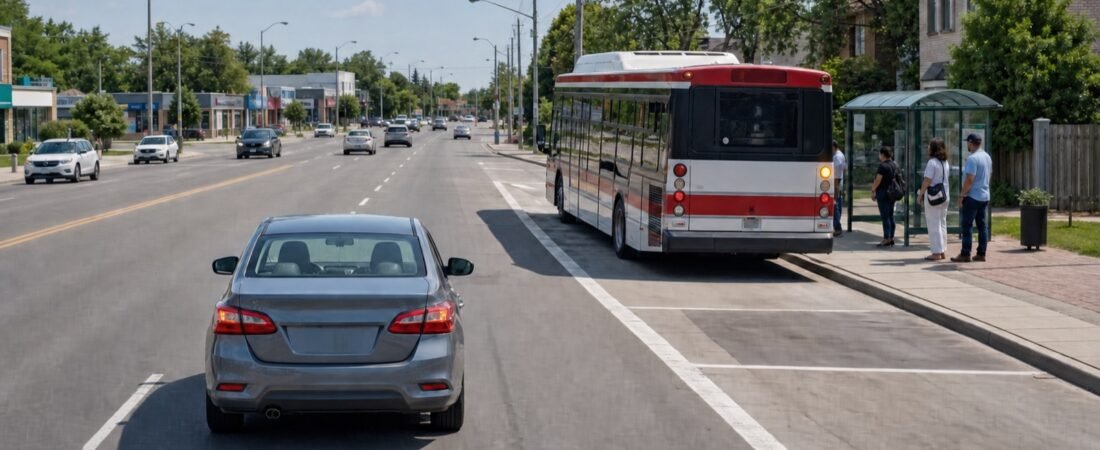
TTC buses are part of everyday driving in Scarborough. For a new driver, the difficult moment is often deciding whether to wait, change lanes or continue when a bus is stopped at the curb. This guide gives you a calm routine for sharing the road safely without guessing.
Why Scarborough Bus Stops Demand Extra Attention
Scarborough’s multi-lane roads, neighbourhood stops and shopping plazas can bring several driving tasks together: traffic slows, passengers move near the curb, the bus blocks part of your view and another driver may change lanes around it.
The answer is not to pass every stopped bus or to stop behind every bus automatically. Your job is to identify the type of stop, read the bus’s signal, check the lane beside you and choose the safest legal response. That judgment is valuable for everyday driving and for building the observation habits used during G2 and G road-test preparation.
The Ontario Rule: Yield When a Bus Signals Out of a Bus Bay
Ontario’s Highway Traffic Act, section 142.1, says that a driver in the lane beside a bus bay must yield to a bus that has indicated its intention to re-enter that lane. Ontario’s regulation defines a bus bay as the part of the road beside a bus stop that requires the bus to leave the adjacent traffic lane and then re-enter it.
Watch for a bus stopped in an indented curb area or designated bay. When its left signal begins flashing, do not accelerate to squeeze past. Ease off, create space and let the bus enter. Brake smoothly if needed, checking your mirror first.
The law also says a bus driver must not move into the path of a vehicle that is already so close that yielding is impractical. That does not make racing the bus a good strategy. An attentive driver notices the bus early enough to avoid a last-second conflict. The official MTO Bus Handbook gives the same direction: when a bus in a bay flashes its left signal, approaching drivers in the adjacent lane must allow it to re-enter.
A Bus at an Ordinary Curb Stop Is a Different Situation
Not every TTC stop is a bus bay. Sometimes the bus remains partly or fully in the travel lane. Do not apply the bus-bay rule mechanically to every stopped bus; treat the scene as a developing hazard.
Ask three questions before you act:
- Is the bus signalling? A left signal tells you the driver intends to move out or merge. A right signal may indicate that the bus is still pulling in.
- Can I see the road around it? The bus may hide a pedestrian, cyclist, driveway, turning vehicle or red traffic signal.
- Can I pass without forcing a lane change? If the next lane is occupied or your view is limited, waiting behind the bus is often the calmer choice.
A TTC bus is also not a school bus. The special rules for a school bus with overhead red lights and a stop arm are different. Never use the ordinary transit-bus routine for a stopped school bus.
Use This Five-Step Routine When You Approach a Stopped Bus
- Look well ahead. Notice the bus, shelter, waiting passengers, brake lights and any signal before you reach the stop.
- Check your mirrors. Know what is behind and beside you before slowing or considering a lane change.
- Reduce speed smoothly. A lighter accelerator gives you time to identify whether the bus is loading, signalling out or waiting at a red light.
- Scan the hidden areas. Look near the front of the bus, along the sidewalk, around the shelter and toward nearby driveways or intersections.
- Choose one clear action. Yield, wait behind the bus or make a complete safe lane change. Avoid drifting halfway into another lane while you decide.
This routine creates time. Problems begin when a driver notices the bus late, then tries to steer, signal, check a blind spot and accelerate at once.
How to Pass a Stopped Bus Safely
Pass only when lane markings permit it, the neighbouring lane has enough space and you can see far enough ahead. Use the same full sequence you would use for any safe lane change in Ontario: mirror, signal, blind-spot check and smooth movement into the new lane.
Do not swing out sharply from close behind the bus. Hanging back improves your view and makes the lane change easier for other drivers to understand. Keep a useful following gap as you approach; SparkOn’s guide to the two-second following rule explains how space gives you more time to see, think and brake.
Once beside the bus, keep a steady path without speeding. Large vehicles have substantial blind areas. Return to the right lane only when it is legal, useful and clearly safe.
Watch for People Near the Front of the Bus
A stopped bus can create a wall between you and the sidewalk. A passenger may hurry toward the stop, step around the front of the bus or cross at a nearby intersection. Someone using a mobility device may need more time near the curb. The MTO Driver’s Handbook guidance on sharing the road reminds drivers to watch all crosswalks, allow slower pedestrians time to cross and expect children to act unpredictably.
Do not assume the road is clear merely because the bus doors have closed. Scan beyond the bus before accelerating. At night, in rain or when the shelter is crowded, reduce speed further because movement near the curb is harder to read.
Be Careful With Right Turns Near Bus Stops
Many Scarborough bus stops sit close to intersections. Before turning right, check whether a bus, bicycle or pedestrian is approaching along your right side. Signal early, slow before the turn and make a direct shoulder check. Ontario’s Driver’s Handbook section on changing directions says right-turning drivers must check the right rear blind spot and let cyclists and pedestrians in their path go first.
Never cut across the front of a bus to reach a driveway or right-turn lane. If the bus blocks your view or your lane position is wrong, continue safely and choose another entrance or turn. A missed turn is inconvenient; a rushed turn beside a bus can put several road users at risk.
What This Builds for a G2 or G Road Test
You do not need to memorize a special road-test route to practise this skill. Driving around buses develops the habits that matter anywhere: early observation, mirror use, safe following distance, signalling, blind-spot checks, speed control and sound right-of-way decisions.
During practice, ask your accompanying driver or instructor to stay quiet as you approach a bus stop. Say what you see and choose your response without prompting. If you can consistently identify the bus’s signal, hidden hazards and lane options early, your decision-making is becoming more independent.
Quick Scarborough Transit-Stop Checklist
- Look beyond the bus, not only at its rear lights.
- Check mirrors before slowing.
- If a bus signals left from a bus bay, yield and leave room.
- Expect pedestrians or cyclists in areas the bus hides.
- Wait if a lane change would be rushed or incomplete.
- Use mirror, signal and blind-spot checks before moving lanes.
- Keep extra space instead of following tightly.
- Check the right side carefully before turning near a stop.
- Do not let pressure from the driver behind choose your gap.
Practise Scarborough Traffic With a Patient Instructor
Bus stops, multi-lane roads and busy intersections become easier when you learn a repeatable scanning routine. SparkOn offers one-on-one driving lessons in Scarborough for G1, G2 and G drivers who want calmer decisions and stronger road-test habits.
Book a Scarborough driving lesson and tell us which traffic situations you want to practise.