
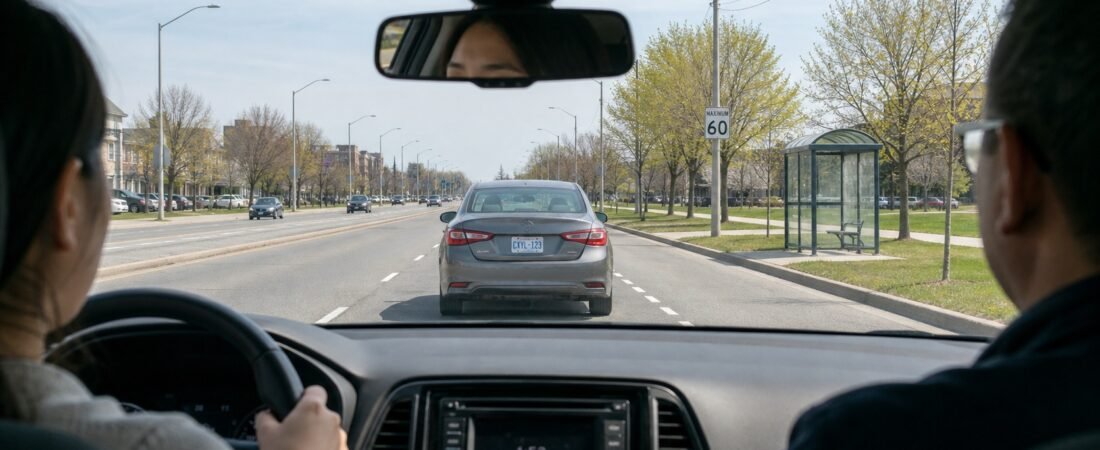
A practical Ontario following-distance guide for new drivers learning the two-second rule, safe stopping space and calm road-test habits.
Why Following Distance Matters More Than Beginners Think
Many new drivers focus on steering, speed and signs, then slowly drift too close to the vehicle ahead. It feels harmless until the car in front brakes suddenly, a pedestrian steps out, or traffic stops around a bend.
Good spacing gives you options. You can brake smoothly instead of slamming the pedal, check mirrors before slowing, avoid panic lane changes and keep the drive calm enough for a road-test examiner to feel safe.
The Two-Second Rule, Explained Simply
The Ontario driver’s handbook uses the two-second rule as a simple way to judge space in normal driving conditions. Here is the routine to practise:
- Pick a fixed marker ahead, such as a sign, pole, shadow or lane marking.
- When the rear of the vehicle ahead passes that marker, start counting.
- Count at a steady pace: one thousand and one, one thousand and two.
- If the front of your vehicle reaches the marker before you finish, you are too close.
Two seconds is a minimum for good conditions. Add more space in rain, darkness, construction, heavy traffic, behind large vehicles or any time visibility is reduced.
How Examiners Notice Following Distance
On a road test, following distance shows up everywhere: approaching turns, moving through intersections, changing lanes, merging, driving beside parked cars and slowing in traffic. The examiner is watching whether your spacing gives you enough time to react without surprising other road users.
If you follow too closely, small mistakes become bigger. You may brake late, stop harshly, lose your lane position while looking around, or feel forced into a rushed lane change. A good gap makes the whole drive look more controlled.
Common Following-Distance Mistakes
- Matching the speed of traffic but forgetting to rebuild space.
- Closing the gap before red lights instead of braking early and smoothly.
- Following large trucks or buses too closely, which blocks your view ahead.
- Leaving good space on quiet roads, then shrinking it in busier Scarborough traffic.
- Reacting to tailgaters by speeding up or braking suddenly.
These habits are fixable, but only if you practise spacing as an active skill instead of waiting for your instructor to remind you.
What To Do If Someone Tailgates You
Do not brake check. Do not speed just because the driver behind you is impatient. Keep your speed legal and predictable, increase the space in front of your own vehicle, and change lanes only when it is safe.
That extra front space protects you because it lets you brake gradually if traffic ahead slows. The driver behind you may still be too close, but you are reducing the chance that you need to stop suddenly.
Rain, Darkness And Big Vehicles Need More Space
Wet roads can reduce tire grip, and heavy rain can make it harder to see brake lights, lane markings and pedestrians. At night or in poor weather, drive slowly enough that you can stop within the distance you can see.
Behind trucks, buses and larger vehicles, leave extra space so you can see traffic signals, road signs and hazards early. If your view ahead is blocked, your reaction time is already late.
Practice Plan For Scarborough And The GTA
Start on calm roads where you can practise counting without pressure. Once the habit feels natural, move to busier multi-lane roads, commercial areas, school-zone traffic and highway-style merging practice with your instructor.
During each drive, ask yourself three questions: Can I see around the vehicle ahead? Can I stop smoothly if it brakes now? Do I have enough time to check mirrors before slowing? If the answer is no, rebuild space.
Quick Readiness Check
You are getting closer when you keep space without being reminded, brake early and smoothly, stay patient when another driver tailgates, and increase your gap automatically in rain, darkness or heavy traffic.
Need help building safer road-test habits?
SparkOn Driving Academy helps students in Scarborough and nearby GTA areas prepare with patient lessons, mock tests and real-road coaching.