
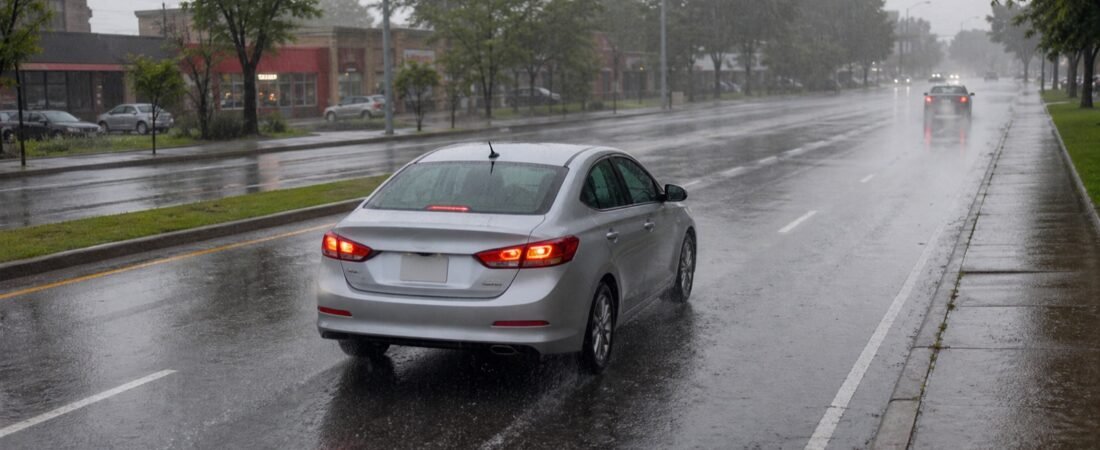
A summer downpour can turn a familiar Scarborough drive into a visibility and traction problem within minutes. The safest response is not a single trick: it is a sequence of earlier decisions about lights, speed, space, steering and whether the trip should continue at all.
Why Heavy Rain Changes a Familiar Scarborough Road
Rain affects two things every driver depends on: the view through the windshield and the grip between the tires and pavement. The Official MTO Driver’s Handbook explains that wet roads can become slippery as the first rain falls. As water builds, tires make less contact with the road and can begin to ride on top of it—a loss of grip known as hydroplaning.
In Scarborough, the challenge can change from block to block. Spray from trucks can briefly hide lane markings on a busy arterial road. Water may gather beside a curb or near a blocked catch basin. On Highway 401, higher speeds make planning and following space even more important. A low point or underpass may look passable from a distance but should never be treated as a depth test.
The right question is not “Can I keep the posted speed?” It is “Can I see, stop and steer safely in the conditions I have right now?”
Use This Six-Point Rain Checklist Before Moving
- Wipers: confirm every speed works and the blades clear water without leaving broad streaks.
- Washer fluid: top it up so road spray and grime do not stay on the glass.
- Lights: check the low beams, tail lights and brake lights rather than relying only on the dashboard indicator.
- Tires: look for visible damage or low pressure and follow the vehicle manufacturer’s pressure guidance.
- Windows: know how to use the front and rear defrosters before visibility suddenly deteriorates.
- Route: check weather and the City of Toronto’s road restrictions and closures; postpone the trip if conditions are unsafe.
Ontario’s vehicle-maintenance guidance specifically includes wipers, washer fluid, tire condition and lights among the items drivers should check. Learn the controls while parked so you are not searching for the defroster or light switch during a downpour.
Turn On the Full Lighting System
Daytime running lights are designed for good light conditions and may not switch on the tail lights. Turning on the low-beam headlights activates the other required lighting systems, helping drivers see your vehicle from both directions.
Under section 62(1) of Ontario’s Highway Traffic Act, the required lamps must be lit when unfavourable atmospheric conditions make people and vehicles unclear at 150 metres or less. The MTO handbook identifies rain, fog and snow as examples of poor light conditions. If the rain is making the road hard to read, do not wait for darkness—use the full lights.
Keep high beams off in heavy rain or fog. Bright light reflected by droplets can add glare instead of improving the view. Use low beams and reduce speed to match the distance you can actually see.
Create Time With Speed and Space
The MTO handbook does not give one universal wet-weather following number. Conditions vary, so the practical rule is to leave more space than you would on a dry road. That extra room gives you time to respond smoothly if the vehicle ahead brakes, a lane marking disappears under spray or water crosses your path.
Start with the observation method in SparkOn’s following-distance guide, then increase the gap until it fits the rain, traffic and visibility. If a vehicle cuts into the space, ease off and rebuild it instead of braking sharply.
Avoid cruise control on wet or slippery pavement. Keep direct control of acceleration and use gentle inputs. Sudden steering, hard braking and quick acceleration can demand more grip than the tires have available.
Prevent Hydroplaning—and Stay Calm if Grip Feels Light
Prevention starts before the car begins to float: reduce speed, keep tires in good condition, scan for standing water and drive on the clearer portion of the lane when it is safe. Never swerve around water without first checking mirrors, the blind spot and the space beside you.
If the steering suddenly feels light or the tires stop responding normally, avoid adding another abrupt input. Ease off the accelerator, keep looking where you want to travel and make small, smooth steering corrections while the tires regain contact. Do not stamp on the brake or jerk the wheel. If a skid develops, the MTO handbook advises releasing the brake and steering in the direction you want to go without oversteering.
After traction returns, reduce your speed further. The car has already shown that the combination of water and speed exceeded the available grip.
Treat Puddles and Flooded Roads as Unknown Hazards
A puddle can hide a pothole, damage a tire, send spray into another road user’s view or affect the vehicle’s brakes. Slow early and avoid the water when you can do so without an unsafe lane change. Review SparkOn’s mirror-signal-shoulder-check routine before practising in wet conditions.
Floodwater is different from an ordinary shallow puddle. You usually cannot judge its depth, the condition of the pavement below it or whether the water is moving. The City of Toronto’s extreme-rain and flooding guidance says not to drive in low-lying areas where flooding may occur. The City also advises drivers never to drive through flooding or ponding, especially at underpasses.
If water covers the roadway ahead, stop before entering it, keep a safe distance from other vehicles and choose another route when safe. Obey barricades and closure signs. Do not follow another driver into the water as proof that your car can make it.
Know When to Pause the Trip
Sometimes the safest driving decision is to stop driving. If the wipers cannot maintain a useful view, lane lines disappear, traffic becomes unpredictable or you cannot identify a safe path ahead, look for a legal place well away from moving traffic. Signal early, reduce speed progressively and avoid stopping on a live lane or in a location vulnerable to flooding.
Once parked safely, keep the vehicle visible, check official weather and road information without handling a phone while driving, and wait for conditions to improve. A missed appointment is easier to manage than a collision or a stranded vehicle.
Practise Rain Skills Without Taking Extra Risk
Do not make a severe storm your first wet-weather lesson. Begin in light rain with a qualified accompanying driver or instructor and practise the building blocks: switching on lights without looking down, adjusting wipers, clearing fogged windows, increasing space, braking smoothly and reading faded-looking lane markings.
These are everyday observation and control habits, not supposed road-test routes or examiner tricks. They complement the skills in SparkOn’s G2 road-test preparation. Nervous in poor weather? Structured nervous-driver lessons in Scarborough can help you build a calm routine at an appropriate pace.
Build Wet-Weather Confidence in Scarborough
SparkOn’s one-on-one driving lessons in Scarborough help G1, G2 and G drivers practise smooth control, space management and visibility decisions on local roads when conditions are suitable.
Book a Scarborough driving lesson and tell us which wet-weather situations make you least comfortable.