
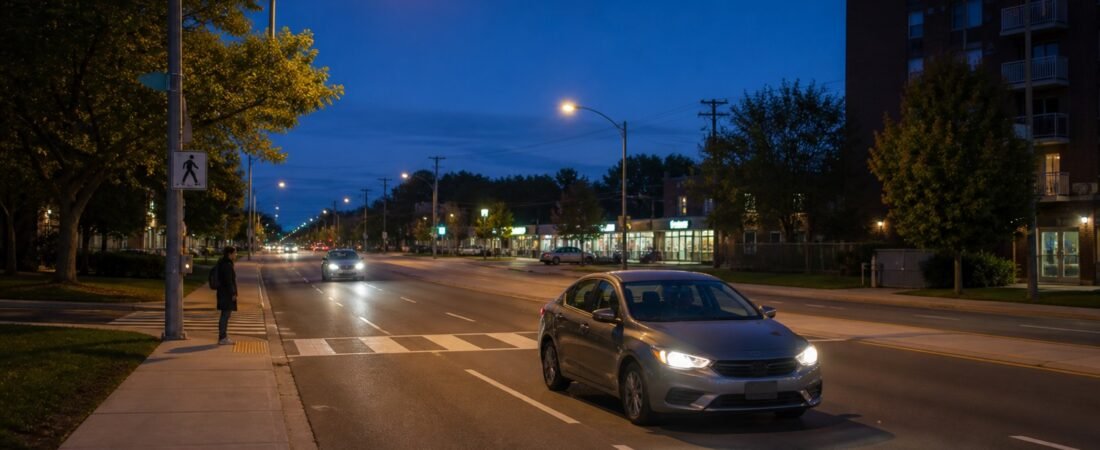
Night driving changes what you can see, how quickly you notice hazards and how accurately you judge distance. On Scarborough roads, bright storefronts, dark residential blocks, bus stops and multi-lane intersections can appear within the same short trip. A good night-driving routine helps you stay calm, use your lights correctly and keep enough space to respond.
When Ontario Drivers Must Use Headlights
Ontario’s Highway Traffic Act, section 62, requires vehicle lights from one-half hour before sunset until one-half hour after sunrise. Lights are also required whenever poor light or weather makes people and vehicles unclear at a distance of 150 metres or less.
The practical lesson is simple: do not wait until the road looks fully dark. Turn on your vehicle’s complete lighting system during dusk, dawn, rain, fog or any other reduced-visibility condition. The Official MTO Driver’s Handbook recommends using the automatic full-light setting when the vehicle has one, while still monitoring whether the correct lights are actually on.
Daytime running lights are not a substitute for headlights in poor light. Depending on the vehicle, they may not activate the tail lights or the other lights you need to be visible from behind. Learn the dashboard indicator and headlight switch in the vehicle you drive rather than assuming “auto” has handled everything.
Low Beams, High Beams and the Distance Rules
High beams can help on a dark, open road, but they must not blind other drivers. Ontario’s handbook says to switch to low beams when you are within 150 metres of an oncoming vehicle or following another vehicle within 60 metres. These rules apply on all roads, including divided roads.
Most Scarborough night driving happens around traffic, homes, shops and street lighting, so low beams are usually the sensible choice. If you use high beams on a genuinely dark stretch, dim them early for an approaching vehicle, a vehicle ahead, or before a curve or hilltop where another driver may suddenly appear.
Before leaving, walk around the vehicle and confirm that both headlights, tail lights, brake lights and turn signals work. Clean grime from the lenses and windshield. A burned-out bulb, dirty glass or badly aimed light reduces what you see and can make it harder for others to read your position.
Do Not Overdrive Your Headlights
The MTO describes “overdriving your headlights” as travelling so fast that your stopping distance is longer than the roadway you can see. A reflective sign far ahead does not prove that the pavement, a pedestrian or a stopped vehicle is visible all the way to that sign.
Use a moving visibility test: ask yourself whether you could stop smoothly before the farthest point you can clearly identify. If the answer is uncertain, ease off the accelerator and increase your space. This matters when leaving a brightly lit intersection for a darker block, approaching the crest of a hill, or entering a curve where your headlights do not yet reveal the full path.
Keep a generous following distance as well. Headlight glare, shadows and changing pavement contrast can delay recognition. SparkOn’s Ontario following-distance guide explains how to build a basic time gap and why you should add more space when visibility or conditions are worse.
How to Handle Oncoming Headlight Glare
Staring at bright headlights makes it harder to see the rest of the road. The MTO recommends looking up and beyond the lights and slightly to the right. Keep the right edge of your lane in your wider field of view, reduce speed gradually if needed and avoid making a sudden steering correction.
Glare can also come from mirrors. Use the night setting on a manual rear-view mirror or make sure an automatic dimming feature is working. Adjust side mirrors properly before moving, and keep interior screens only as bright as needed to read them. A very bright dashboard can make the dark roadway outside feel even less visible.
If glare, fatigue or poor visibility makes you unable to continue safely, choose a legal, well-lit place to pull off the road. Do not stop in a live traffic lane.
Scan for Pedestrians, Cyclists and Transit Stops
At night, the easiest objects to notice are not always the most important ones. Headlights and illuminated signs attract attention, while a person in dark clothing, a cyclist beside parked cars or someone stepping away from a bus stop may have little contrast with the background.
Build a two-stage scan at every intersection. First, read the signal, lane and vehicle movement. Then deliberately check both sidewalks, crosswalks and the area beside your vehicle before turning. When turning right, include the right mirror and blind spot so you do not cross the path of a cyclist. SparkOn’s guides to pedestrian crossovers and driving near cyclists in Scarborough offer more detailed routines.
Never assume a pedestrian has seen you because your headlights are on. Slow down early, yield as required and wait until the entire path is clear. Near TTC stops, expect people to emerge from behind a shelter or bus and leave extra time to recognize what is happening.
Night Lane Changes and Turns
Darkness can make another vehicle’s speed and distance harder to judge. A pair of headlights may look far away even when the vehicle is closing quickly. Before changing lanes, use the full mirror-signal-blind-spot sequence, then move only when the gap is clearly adequate. Do not rely only on a blind-spot warning light.
For turns, slow enough to keep the crosswalk, curb and destination lane visible. Scan through the turn rather than fixing your eyes on the headlights facing you. If wet pavement adds reflections, reduce speed and separate the important signals—traffic lights, lane markings, brake lights and pedestrian movement—instead of reacting to every bright patch.
Review SparkOn’s calm lane-change routine before practising after dark. The sequence should remain the same in daylight and at night; you are simply giving yourself more time to collect the information.
A Safe Scarborough Night-Practice Plan
Night driving is easier to learn in stages. Start with a licensed accompanying driver or instructor and a familiar, lower-complexity area. Add busier conditions only after the basic routine feels consistent.
- Before moving: identify the headlight, high-beam, dimmer, defroster and wiper controls without looking down for long.
- Begin at dusk: practise recognizing when the full lights are on and how the dashboard indicators change.
- Use familiar streets: rehearse smooth speed changes, generous following space and accurate lane position.
- Add intersections: make a deliberate left-right-left sidewalk scan and recheck the blind spot before right turns.
- Add a busier arterial: practise judging gaps from headlights, changing lanes without rushing and ignoring pressure from impatient drivers.
- Finish before fatigue: stop while attention is still good and record one or two habits to improve next time.
Quick Checklist Before Every Night Drive
- Windshield, mirrors and light lenses are clean.
- Full headlights and tail lights are on; you are not relying on daytime running lights.
- High beams are dimmed early for other road users.
- Your speed lets you stop within the distance you can clearly see.
- You leave extra space when glare, rain or darkness reduces information.
- You scan sidewalks, crosswalks, bus stops and bike-lane areas deliberately.
- Your mirrors, signals and blind-spot checks stay complete.
- You pull over safely if visibility or fatigue makes continuing unsafe.
Build Night-Driving Confidence With a Scarborough Instructor
SparkOn’s one-on-one driving lessons in Scarborough help G1, G2 and G drivers practise light controls, visibility checks, lane changes, turns and calm decision-making after dark.
Book a Scarborough driving lesson and tell us which night-driving situations you want to handle more confidently.
Official Sources Checked
- Ontario Highway Traffic Act, section 62: vehicle lighting requirements
- Official MTO Driver’s Handbook: headlights, daytime running lights and lighting controls
- Official MTO Driver’s Handbook: night driving, glare and overdriving headlights
- Official MTO Driver’s Handbook: visibility, scanning and space management