
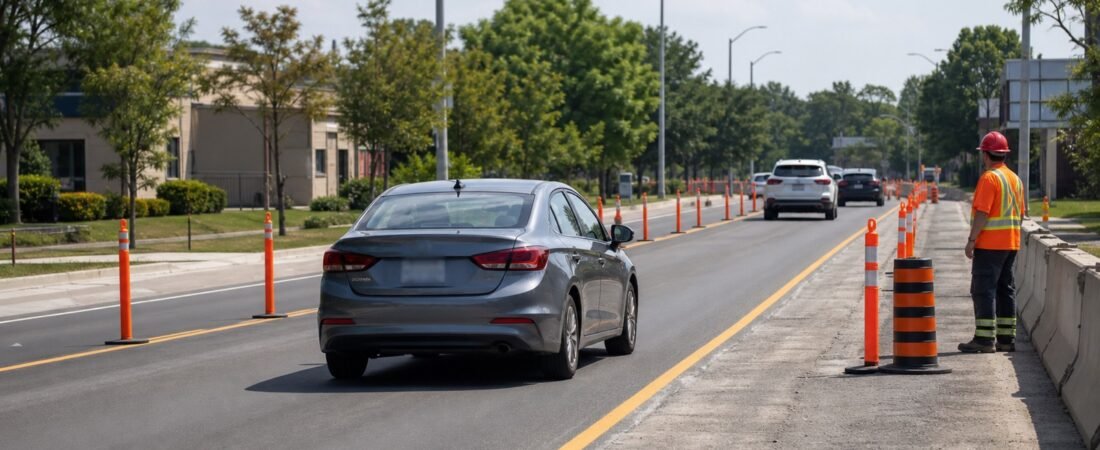
Road work can turn a familiar Scarborough trip into a sequence of narrowed lanes, temporary signs, changed pavement markings and unexpected stops. For a learner driver, the safest response is not a last-second lane change. It is an early scan, a smooth speed adjustment and a clear plan before reaching the work area.
Read Temporary Signs Before You Reach the Work Zone
Ontario temporary-condition signs are usually orange with black letters or symbols. They warn about road work, lane closures, detours, traffic-control workers, rough pavement and other unusual conditions. The Official MTO Driver’s Handbook guide to signs shows the common designs and explains the action each one requires.
Look beyond the vehicle directly ahead. Your first useful clue may be an orange sign, an arrow board, cones beginning to taper or brake lights forming farther up the road. Check your mirrors as soon as you recognize the change. That gives you time to decide whether your lane continues and where a safe gap may develop.
Do not follow an outdated painted line when cones, temporary markings or a traffic-control person clearly direct traffic elsewhere. In a changing work area, the current signs and devices show the intended path.
Slow Down Before the Lane Narrows
A posted speed limit is a maximum under favourable conditions, not a promise that the limit is safe at every moment. The MTO handbook tells drivers to choose a speed that still allows a safe stop and notes that construction zones often have lower limits because of workers and added hazards. Ontario’s Highway Traffic Act, section 128, provides doubled speeding fines in a designated construction zone when a worker is present.
Ease off the accelerator early instead of braking hard at the taper. A gradual reduction gives the driver behind more time to react. It also helps you notice a stopped queue, a construction vehicle entering the road or a worker standing near the live lane.
Keep enough following space to see the surface and the vehicle ahead. Dust, cones and large equipment can block your view. SparkOn’s Ontario following-distance guide explains the basic time-gap method; add more space when traffic is uneven or visibility is limited.
Merge Into the Open Lane Without Rushing
When an orange sign shows that your lane ends, begin planning the merge. Check the rear-view mirror, the appropriate side mirror and the blind spot. Signal, adjust speed gently and move only when the gap is clearly safe. The MTO sign guidance says to obey the speed limit and merge with traffic in the open lane.
Avoid two common mistakes:
- Stopping beside the cones to demand a gap: this surprises following drivers and leaves you with very little room to match the open lane.
- Crossing several lanes at once: one deliberate lane change is easier for everyone to read and gives you time to reassess.
Once you are established in the lane that travels through the active work area, hold your position unless signs or a traffic-control worker direct another movement. The MTO guidance for workers on the road specifically advises drivers not to change lanes in a construction zone. If lane-change timing still feels rushed, review SparkOn’s mirror-signal-shoulder-check routine before practising around road work.
Obey Traffic-Control Workers and Be Ready to Stop
Traffic-control workers manage conflicts between moving vehicles and construction activity. Watch for the warning sign showing a traffic-control person ahead, reduce speed and be ready to obey a STOP or SLOW paddle. Their direction takes priority over your assumption about whose turn it should be.
On a two-way road narrowed to one usable lane, traffic may alternate by direction. Stop where directed and wait without creeping forward. Leave the intersection, driveway or work entrance in front of you clear. When released, move slowly through the narrow section and stay behind any pilot or pace vehicle.
If your lane is blocked and nobody is directing traffic, the MTO handbook says to yield to traffic coming from the opposite direction. Proceed slowly only after the way is clear. Do not copy another vehicle blindly; conditions may change before you reach the obstruction.
Watch the Surface, Cones and Construction Vehicles
Milled pavement, gravel, steel plates, uneven lane edges and temporary ramps can change steering feel and stopping ability. Keep both hands ready, reduce speed before the rough section and avoid abrupt braking or steering. Give motorcycles and cyclists room because surface changes can affect their balance and path more noticeably.
Construction trucks may enter or leave through openings that look like ordinary driveways. Their size can hide workers, pedestrians or a traffic queue. Do not drive beside a large vehicle longer than necessary, and never use a closed lane or shoulder to pass slow traffic.
Cones are boundaries, not suggestions. Centre the vehicle within the available lane and look toward the open path rather than staring at the cone nearest your bumper. If the lane shifts, guide the car with small, smooth steering inputs.
Check Again for Pedestrians and Cyclists
Road work can move a sidewalk, bike lane or bus-stop waiting area from its usual location. A pedestrian may be guided through a temporary walkway, while a cyclist may need to merge into the same narrow lane as vehicles. Scan both sides of the roadway and expect people to appear from behind fencing, equipment or a stopped bus.
Before turning across a temporary path, slow down and check mirrors and blind spots again. Do not squeeze past a cyclist where cones remove the normal passing room. Wait until there is enough legal, visible space to pass safely. SparkOn’s guide to driving near cyclists in Scarborough covers the one-metre passing rule and safer turn checks in more detail.
A Scarborough Construction-Zone Practice Routine
- Plan the trip: check the City of Toronto’s road restrictions and closures map before leaving, especially when you have an appointment or road test.
- Name the first warning: say what the orange sign or arrow board means and which lane remains open.
- Mirror check early: identify traffic beside and behind you before reaching the taper.
- Adjust smoothly: signal, match an available gap and complete one controlled lane change.
- Hold the lane: follow cones and temporary markings without unnecessary weaving.
- Create space: keep a larger gap and cover the brake when the view ahead is limited.
- Scan the edges: look for workers, pedestrians, cyclists and equipment entering the live lane.
- Debrief afterward: identify the earliest clue you noticed and one decision you could make sooner next time.
Quick Construction-Zone Checklist
- Orange signs and arrow boards are read early.
- Speed is reduced before the narrowing or rough surface.
- Mirrors, signal and blind spot are checked before merging.
- The vehicle stays centred in the temporary lane.
- Following space is increased for sudden stops.
- Traffic-control workers’ directions are obeyed.
- Closed lanes and shoulders are never used to pass.
- Pedestrian and cyclist paths are checked before turning.
Practise Busy Scarborough Roads With a Calm Instructor
SparkOn’s one-on-one driving lessons in Scarborough help G1, G2 and G drivers build smooth lane-change timing, safer following space and confident decisions when familiar roads suddenly change.
Book a Scarborough driving lesson and tell us which construction-zone or lane-closure situations you want to handle more comfortably.