
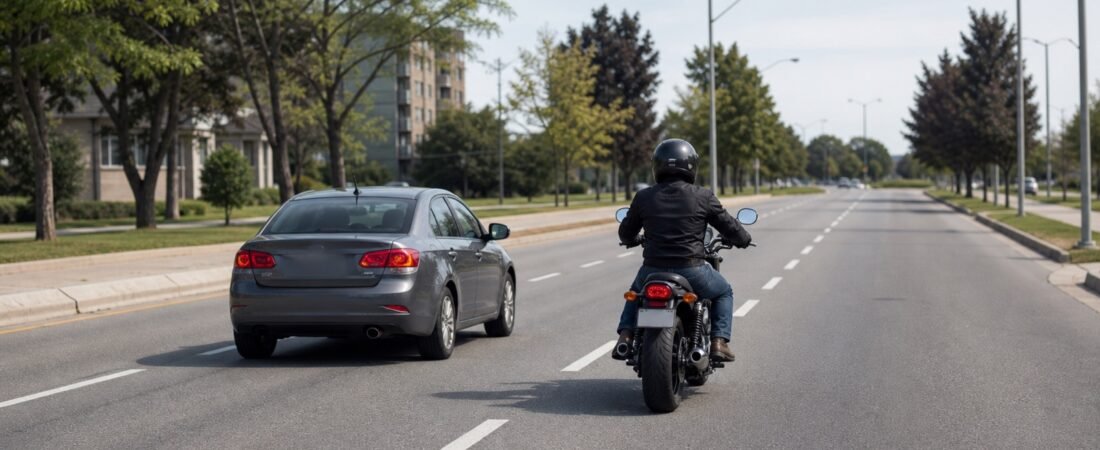
Motorcycles can seem to appear suddenly in mirrors or at intersections, especially on busy Scarborough roads with several lanes, frequent driveways and changing traffic speeds. The safest response is not a last-second correction. It is a steady routine: search early, judge the rider’s path carefully and leave a full, predictable space around the motorcycle.
This guide shows G1, G2 and experienced drivers how to share the road calmly with motorcycles. It focuses on habits you can practise during everyday drives and driving lessons in Scarborough.
Start with one rule: a motorcycle gets a full lane
The Official MTO Driver’s Handbook says motorcycles use a full lane and should be treated like other vehicles. Do not try to squeeze beside a rider within the same lane, even when the motorcycle looks narrow or traffic is moving slowly.
A rider may also change position within the lane. That movement can create visibility, increase space from another vehicle or avoid a pothole, loose material, a sunken maintenance cover or water. The handbook notes that riders may make sudden moves because of uneven road surfaces or poor weather. Give the rider room to choose the safest part of the lane instead of assuming they will stay on one tire track.
Why motorcycles are easy to miss
A motorcycle has a smaller visual profile than a car. It can disappear behind a windshield pillar, sit in a side-mirror blind spot or be hidden by another vehicle for a moment. Its speed and distance can also be harder to judge when you see only one headlight approaching.
On Scarborough arterials, build a wider search pattern:
- Look ahead through gaps in traffic, not only at the vehicle directly in front.
- Check the rear-view and side mirrors regularly so a motorcycle does not become a surprise.
- Before moving sideways, signal, check the correct mirror and perform a deliberate shoulder check.
- At intersections and driveways, look twice in the direction a motorcycle could approach.
A shoulder check remains essential even when your vehicle has blind-spot monitoring. Review SparkOn’s guide to mirror-signal-shoulder-check lane changes and the limits of driver-assistance technology.
Leave useful following space
Following too closely pressures the rider and removes your time to respond. A motorcycle can slow quickly, and its brake light may be smaller than the brake-light area on a car. The rider may also need to adjust position around damaged pavement before you notice the hazard.
Choose a fixed object ahead, watch the motorcycle pass it and count your gap. If traffic, visibility or traction gets worse, increase the space. Do not move closer because another driver might fill the gap; rebuild it smoothly if that happens. SparkOn’s Ontario following-distance guide explains how to practise a time-based gap and when to add more room.
At a red light, stop far enough back that you can see the motorcycle’s rear tire meeting the pavement. Avoid creeping forward repeatedly. A stable stop is clearer and less stressful for the rider.
Be especially patient when turning left
Before turning left across oncoming traffic, identify every road user—not just the largest vehicle. A motorcycle may be partly hidden behind an approaching car or blend into a busy background. Wait until you can judge its path and confirm there is a genuinely safe gap.
Never treat an illuminated motorcycle turn signal as proof that the rider will turn. The MTO handbook warns that many motorcycle signals do not shut off automatically. The province’s motorcycle handbook likewise tells riders to cancel the signal manually. Confirm the motorcycle is slowing and beginning the turn before you cross its path.
For learners, a useful decision script is: search, identify, judge, then go. If the view is blocked or the decision feels rushed, wait. The same patient judgement supports safer left turns in Scarborough.
Change lanes without trapping a rider
Motorcycles can sit in the blind area beside your rear door or quarter panel. Before changing lanes, check well ahead, check mirrors, signal, shoulder-check and move only when the whole lane is clear. Do not begin drifting and expect the rider to create the gap.
Also watch for two drivers moving toward the same open lane from opposite sides. Your first check may show an empty lane, but a motorcycle one lane farther over could be entering it at the same time. Keep scanning throughout the manoeuvre and make one smooth lane change.
When passing, use a separate lane, leave generous lateral space and wait until you can return without cutting in. A quick acceleration followed by a close merge creates avoidable pressure and reduces the rider’s escape space.
Expect surface and weather adjustments
A shallow pothole or patch of gravel that feels minor in a car can matter much more to a two-wheeled vehicle. Expect riders to adjust around rough pavement, standing water, debris, painted markings, construction plates and broken road edges. Do not accelerate into the space beside them when a hazard is visible ahead.
Rain and darkness reduce contrast and make every search more demanding. Slow to a speed that lets you process the whole scene, keep windows and mirrors clear, and increase your space. Avoid high beams when they would glare into a rider’s mirrors. For more practice ideas, see SparkOn’s night-driving guide for Scarborough.
Common mistakes to replace
- “The lane is wide enough for both of us.” Give the motorcycle the full lane.
- “The signal is on, so I can turn.” Confirm the rider’s actual movement.
- “My mirror is clear.” Add a shoulder check before moving sideways.
- “I will pass quickly and tuck back in.” Return only when you have a safe, generous gap.
- “The rider is weaving.” Look for a surface hazard or a visibility reason and maintain space.
A Scarborough practice checklist
On your next supervised drive, ask yourself:
- Am I searching far enough ahead to spot a motorcycle early?
- Can I account for the motorcycle after every mirror check?
- Have I left a full lane and a useful following gap?
- Is my left-turn view complete, or is another vehicle hiding the rider?
- Did I shoulder-check immediately before changing lanes?
- Is there rough pavement, water or debris that may change the rider’s path?
- Would waiting two more seconds make this decision calmer and clearer?
Safe driving around motorcycles is built from observation, space and patience—not guessing what the rider will do. A SparkOn instructor can help you practise those habits in real Scarborough traffic while keeping the lesson appropriate to your licence level and confidence.
Want focused, local practice? Explore road-test preparation or contact SparkOn Driving Academy to book a Scarborough driving lesson.