
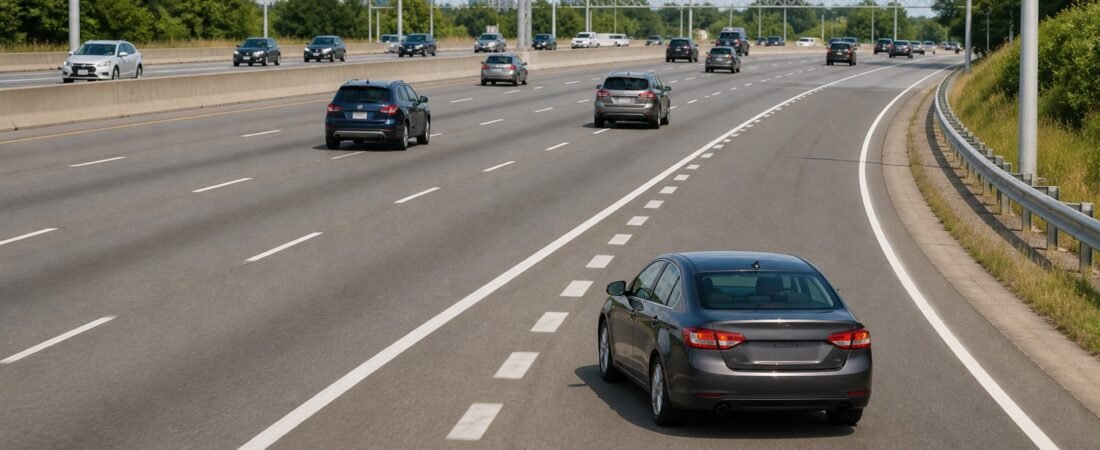
Merging onto Highway 401 can feel like several tasks happening at once: steering through the ramp, reading fast-moving traffic, building speed, choosing a gap and checking a blind spot. The solution is not to rush. It is to complete those tasks in a calm order so your car reaches the freeway ready to blend in.
This Scarborough-focused guide explains a practical routine for entering, driving on and leaving a freeway. It does not describe a road-test route. Use it to prepare for supervised highway practice or a focused Scarborough driving lesson.
First, make sure your licence allows the drive
Ontario’s G driver’s licence guidance says a G1 driver may not drive on a 400-series highway or high-speed expressway. The exception is when the G1 driver is accompanied by a driving instructor certified in Ontario. G2 drivers may drive on all Ontario roads, subject to the other conditions of their licence.
If you have never driven at freeway speed, begin when traffic and weather are manageable and work with an instructor. Highway practice should come after you can hold a steady lane, check mirrors without drifting, shoulder-check and change lanes smoothly. SparkOn’s Ontario lane-change guide is a useful refresher.
Understand the three parts of an entrance
Most freeway entrances give you three different working areas:
- The entrance ramp: the curved or connecting road leading toward the freeway.
- The acceleration lane: the lane where you increase speed and select a gap.
- The merge area: the section where the acceleration lane meets the nearest freeway lane.
Treat them as a sequence. Control the curve first, begin reading freeway traffic early, and then build speed in the acceleration lane. The Official MTO Driver’s Handbook says drivers use the acceleration lane to increase to the speed of freeway traffic before merging.
A calm step-by-step merging routine
1. Read the ramp before it straightens
Look through the curve and follow any posted signs. Keep enough space behind the vehicle ahead; it may hesitate or brake while looking for a gap. As the freeway becomes visible, begin comparing the positions of vehicles in the nearest lane.
2. Pick a gap, not just a vehicle
Identify the vehicle you plan to merge behind and the vehicle that would be behind you after the merge. A useful gap has room at both ends. Avoid aiming beside another vehicle or into its blind spot. Keep updating the plan because traffic positions change as you accelerate.
3. Build speed decisively
Once the ramp geometry and conditions allow, accelerate in the acceleration lane so your speed is close to the traffic you will join, without exceeding the posted limit. A large speed difference makes a safe gap harder to use. Staring only at the speedometer is not the answer; glance at it while keeping most of your attention on the road and traffic pattern.
4. Signal and keep checking
Signal early enough to communicate your plan. Check the nearest freeway lane in your mirror, look ahead, and make a deliberate shoulder check immediately before moving over. Do not let the shoulder check turn into a long stare. Your car is still travelling quickly and the vehicle ahead may change speed.
5. Blend in smoothly
Adjust your speed to arrive in the selected opening, then steer gradually into the centre of the nearest freeway lane. Cancel the signal and rebuild a safe following distance. The MTO’s Level Two road-test guide describes the merge as a smooth, gradual movement and warns against entering beside another vehicle or in its blind spot.
What if traffic is heavy?
Heavy Highway 401 traffic does not change the basic routine, but it makes early planning more important. Use the length of the acceleration lane to adjust your speed and line up with the most workable opening. Sometimes easing off slightly lets a vehicle pass so you can merge behind it. At other times, positive acceleration keeps you ahead of a vehicle that is already behind your chosen gap.
Do not assume a freeway driver will change lanes for you. A courteous driver may create space, but your plan still needs to work if that driver stays in place. Avoid forcing another driver to brake sharply, racing to the end of the lane or crossing the painted gore area. If traffic compresses, keep steering predictable and choose the best available spacing rather than making repeated, abrupt speed changes.
Once you are on Highway 401
After merging, settle into a steady, legal speed and look far ahead. Keep checking mirrors so you know when vehicles enter your blind spots. Leave a time-based gap behind the vehicle ahead, and add space when visibility or traction is reduced. SparkOn’s following-distance guide explains how to measure and adjust that cushion.
Avoid an immediate lane change unless it is needed. Give yourself a moment to understand the traffic flow. When you do change lanes, repeat the complete mirror-signal-shoulder-check routine and watch for another driver moving toward the same lane from two lanes over.
Rain makes every part of the merge less forgiving. Use smoother inputs, increase following space and make sure you can see lane markings clearly. Review SparkOn’s guide to driving in heavy rain in Scarborough before practising in poor conditions.
How to exit without slowing traffic behind you
Prepare early by reading signs and moving to the correct lane with enough time for each lane change. Signal before the exit lane, check mirrors and the right blind spot, then enter the exit lane at its beginning. Stay within the markings.
The MTO guidance says not to slow down before you are completely in the exit lane. Once you are in it, reduce speed gradually for the ramp and the traffic control at its end. If you miss the exit, continue to the next one. Never stop or reverse on the freeway.
Common merging mistakes to replace
- Looking backward for too long: use short mirror and shoulder checks while continuing to monitor the lane ahead.
- Reaching the merge area too slowly: use the acceleration lane to reduce the speed difference.
- Choosing a vehicle instead of a gap: plan for space both ahead of and behind your car.
- Assuming a signal creates right-of-way: signal your intention, then move only when the opening is safe.
- Moving over abruptly: steer gradually into the centre of the new lane.
- Braking before the exit lane: maintain freeway flow until your vehicle is fully inside the deceleration lane.
Scarborough highway-practice checklist
Before your next supervised session, check that you can:
- Control the entrance-ramp curve without drifting.
- Identify the acceleration lane and merge area early.
- Choose a gap with space at both ends.
- Build speed while maintaining space from the vehicle ahead.
- Check mirrors and blind spots without losing lane position.
- Blend into the nearest freeway lane with one smooth movement.
- Maintain steady speed, space and an active scan after merging.
- Enter the exit lane before slowing.
- Continue safely to the next exit if you miss yours.
Highway confidence comes from correct repetition, not from one aggressive merge. If you are preparing for a full G test, SparkOn’s highway-skills preparation guide can help you plan the next stage of practice.
Ready to practise with a professional? Explore SparkOn’s road-test preparation or contact SparkOn Driving Academy to book a Scarborough lesson matched to your licence level and highway experience.