
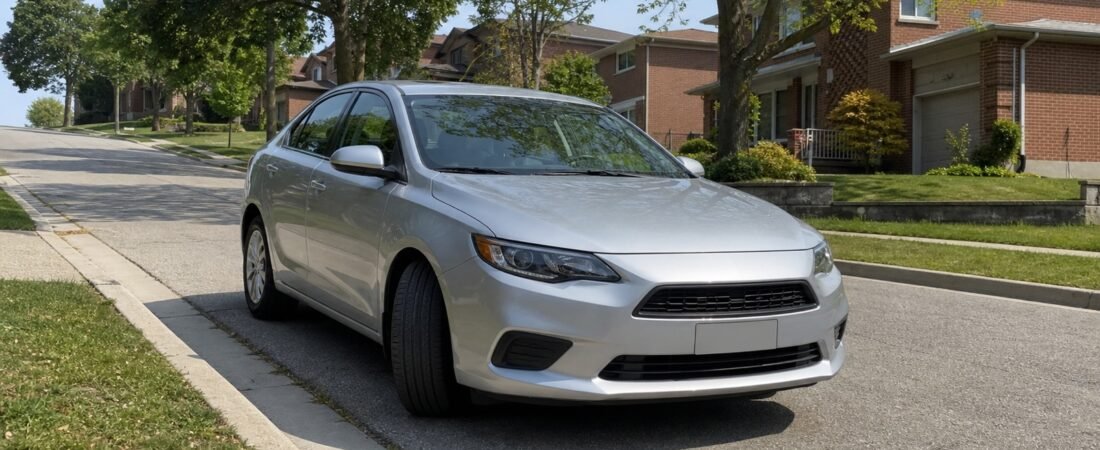
Parking on a slope can feel like a small detail until you have to remember which way to turn the steering wheel. The rule is simple once you connect it to the purpose: if the vehicle moves after you leave it, the front wheels should guide it away from traffic or let the curb help stop it.
This guide explains the Ontario hill-parking directions, a repeatable parking sequence, and common mistakes to avoid on Scarborough streets. It applies whether you are a new G1 or G2 driver building confidence or an experienced driver refreshing a skill.
Hill parking wheel directions at a glance
The Official MTO Driver’s Handbook gives three wheel positions for parking on a hill:
- Facing downhill: turn the front wheels toward the curb or right shoulder.
- Facing uphill with a curb: turn the steering wheel left so the front wheels point toward the road. If the vehicle rolls backward, a tire should catch the curb.
- Facing uphill without a curb: turn the wheels sharply right. If the vehicle rolls backward, it should move off the roadway rather than into traffic.
A useful memory cue is downhill: toward the curb; uphill with a curb: away from the curb; uphill without a curb: toward the shoulder. Do not rely on the wheels alone. The handbook also says to set the parking brake and put an automatic vehicle in Park, or a manual vehicle in first or reverse gear.
Why the curb changes the answer
Hill parking uses several layers of protection. Park or an engaged manual gear helps hold the drivetrain. The parking brake adds a separate restraint. The wheel direction then helps control where the vehicle would go if the other restraints did not hold.
When you park uphill beside a curb, turning left positions a front tire to meet the curb if the car moves backward. Without a curb, there is nothing for that tire to catch, so the safer direction is sharply right, toward the shoulder. Downhill, turning right aims the front of the vehicle toward the curb or road edge rather than into the travel lane.
This is why memorizing only “left for uphill” can cause an error: the presence or absence of a curb matters.
A calm hill-parking sequence
Use the same order every time so wheel direction does not become a last-second guess.
- Choose a legal, visible space. Read all parking signs before committing. The MTO handbook warns that some parking restrictions may not be posted, and the City of Toronto parking regulations page explains the meanings of no-stopping, no-standing, and no-parking restrictions.
- Check the slope. Decide whether the vehicle will face uphill or downhill, then note whether there is a real curb.
- Communicate and observe. Check your mirrors, signal, scan for pedestrians and cyclists, and check the appropriate blind spot before moving toward the curb.
- Position the vehicle. Finish parallel to the road edge and close to the curb without rubbing the tire or blocking a driveway, sidewalk, or crossing. If curb positioning is difficult, practise the reference points in our Ontario parallel-parking guide.
- Stop fully and hold the foot brake. Keep control of the vehicle while you complete the securing steps.
- Turn the wheels in the correct direction. Downhill means right. Uphill with a curb means left. Uphill without a curb means sharply right.
- Secure the vehicle. Apply the parking brake and select Park, or the appropriate gear in a manual vehicle. Turn off the ignition and lights, remove the key if applicable, and lock the vehicle.
- Open the door carefully. Check traffic before opening it and watch especially for cyclists travelling beside parked cars.
Common hill-parking mistakes
Turning left every time the car faces uphill. That works only when there is a curb. Without one, the handbook calls for the wheels to be turned sharply right.
Leaving the wheels straight. A straight wheel provides no useful backup direction if the vehicle begins to move.
Using Park but skipping the parking brake. The official guidance calls for both. Build the parking-brake step into your routine even when the slope looks gentle.
Deciding the wheel direction before checking the slope. A street can appear level from inside the car. Look along the curb, sidewalk, and parked vehicles to confirm which end is lower.
Focusing on the manoeuvre and missing a sign. Correct wheel direction does not make a prohibited space legal. Scarborough streets can have time-based restrictions, school-area rules, permit controls, snow-related needs, or other posted limits. Read the entire sign stack.
Pulling out without a final blind-spot check. Before leaving a roadside position, the MTO says to signal, check mirrors and the blind spot, and move only when the way is clear of vehicles and cyclists. Our mirror-signal-shoulder-check guide can help you make that scan consistent.
How to leave a hill-parking space safely
Start the vehicle while keeping firm pressure on the foot brake. Select the correct drive gear, prepare to move, and release the parking brake only when you are ready. Signal, check your mirrors, and complete a deliberate blind-spot check. Wait for a safe gap; do not let pressure from a following driver rush the decision.
Move away smoothly and straighten the steering as the vehicle enters the travel path. On a steeper grade, use controlled accelerator input so the vehicle does not roll unexpectedly. If you are still coordinating brake release and acceleration, practise first on a quiet, legal street with an experienced accompanying driver or instructor.
A 15-second Scarborough hill-parking checklist
- Legal space and all signs checked?
- Facing uphill or downhill?
- Curb present or no curb?
- Downhill: wheels right, toward the curb?
- Uphill with curb: wheels left?
- Uphill without curb: wheels sharply right?
- Parking brake applied?
- Automatic in Park, or manual in first/reverse?
- Ignition and lights off, vehicle secured?
- Traffic and cyclists checked before opening the door?
Practising this sequence alongside other core parking manoeuvres makes the decision faster and more reliable. The goal is not to rush; it is to use the same safe order every time.
Practise hill parking with a Scarborough instructor
If slopes, curb positioning, parking-brake coordination, or roadside observation still feel uncertain, a focused lesson can turn the checklist into a comfortable habit. SparkOn Driving Academy offers driving lessons in Scarborough and practical road-test preparation tailored to your current skill level.
Contact SparkOn to book a Scarborough driving lesson and practise hill parking, parallel parking, roadside stops, and safe re-entry with calm, step-by-step coaching.