
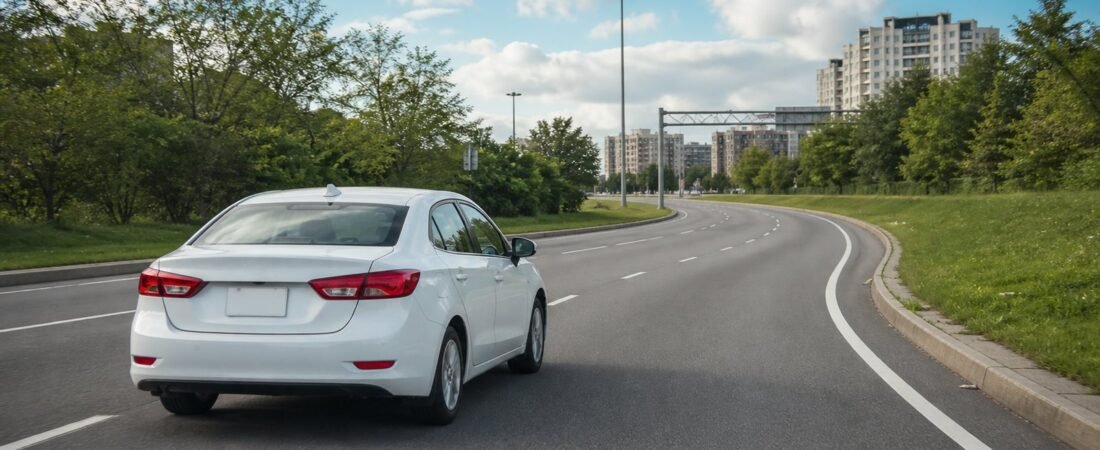
Curves and ramps look simple until speed, steering and traffic all arrive at the same time. For many new Scarborough drivers, the difficult part is not turning the wheel. It is choosing the right speed early enough, keeping the vehicle balanced, and still scanning for signs, lane markings and other road users.
This guide explains a calm routine for driving through curves, entrance ramps and exit ramps in Ontario. It is written for G1, G2 and G drivers practising around Scarborough, including neighbourhood roads, busy arterial streets and Highway 401 connections.
Why curves and ramps catch new drivers off guard
A straight road gives you more time to see what is coming. A curve changes that. Your view may be limited by trees, buildings, signs, hills, parked vehicles or the shape of the road. On a ramp, you may also be dealing with a tighter bend, changing speed, merging traffic or an upcoming stop sign, yield sign or traffic light.
The Official MTO Driver’s Handbook section on signs explains that warning signs can alert drivers to curves, bends, winding roads and advisory speeds. Those signs are not decoration. They give you early information so you can adjust before the vehicle feels rushed.
In Scarborough, this matters because lessons often move between very different road types: quiet residential streets, plaza entrances, multi-lane roads such as Kingston Road or Ellesmere Road, and freeway ramps connecting to Highway 401. The same basic habit works everywhere: see the curve early, set your speed early, then steer smoothly.
Slow before the curve, not halfway through it
The cleanest way to drive a curve is to reduce speed before you enter it. Braking hard inside a curve can make the car feel unsettled, especially if the road is wet, snowy, oily or covered with leaves. New drivers often wait too long because the curve does not look sharp at first. Then, once they are inside it, they realize the vehicle is travelling faster than their comfort level.
Use this simple approach:
- Look far enough ahead to recognize the curve or ramp early.
- Check your mirrors before reducing speed so you know what is behind you.
- Ease off the accelerator first, then brake smoothly if needed.
- Enter the curve at a speed that lets you stay in your lane without sudden steering.
- Once the vehicle is pointed safely out of the curve, build speed again only when conditions allow.
This is especially useful for learners who already read SparkOn’s guide to Ontario road lines and pavement markings. Lane markings help you understand where the lane continues, but speed control gives you the time to follow those markings accurately.
Look where the road is going
Many steering problems start with the driver looking too close to the hood. If your eyes are low, every small correction feels urgent. If your eyes are up, the steering becomes calmer because your hands are following a plan instead of reacting late.
The MTO Driver’s Handbook guidance on driving along tells drivers to keep a routine of looking ahead, behind and from side to side, to check mirrors regularly, and to keep space around the vehicle. That advice becomes even more important on curves because your sightline changes second by second.
Try this habit during practice: before the curve, look into the curve; inside the curve, look toward the exit; after the curve, scan the next block or next lane decision. Your hands should not be your first warning that the road is bending. Your eyes should already know.
Keep a steady lane position
New drivers sometimes drift wide on curves because they enter too fast or look at the lane line instead of the path ahead. Others hug the inside line because they are worried about oncoming traffic. Both habits can create risk.
A better target is a steady position near the centre of your lane, with enough space from the curb, median, parked cars or adjacent traffic. If the road narrows, hold your lane and reduce speed rather than trying to “squeeze through” at the same pace. If you are on a multi-lane curve, avoid unnecessary lane changes until the road straightens and you have time for a full mirror-signal-shoulder-check routine. SparkOn’s lane-change guide is a useful review for that sequence.
Highway 401 ramps need two separate skills
Freeway ramps require both curve control and traffic timing. The MTO Driver’s Handbook section on freeway driving explains that freeway entrances usually include an entrance ramp and an acceleration lane. Drivers use the ramp to assess traffic, then use the acceleration lane to match freeway traffic speed before merging.
That does not mean rushing through the curved part of the ramp. On a Scarborough 401 entrance, separate the job into two phases:
- Ramp phase: control the vehicle through the curve, read signs, scan mirrors and prepare for the merge area.
- Acceleration phase: when the ramp opens into the acceleration lane, build speed smoothly, signal, check blind spots and merge only when there is a safe gap.
Exit ramps need the opposite sequence. The MTO notes that freeway exits usually include a deceleration lane, an exit ramp and then an intersection control such as a stop sign, yield sign or traffic light. Move into the deceleration lane first, then reduce speed gradually to the ramp speed. Be ready for the feeling that you are going slower than you actually are after leaving freeway traffic.
If you want a deeper freeway-specific routine, review SparkOn’s guide to merging onto Highway 401 in Scarborough.
Weather changes the safe speed
A curve that feels easy on dry pavement can feel very different in rain, fog, snow or darkness. Water, glare and reduced visibility all reduce the time you have to notice the curve and adjust. The MTO’s driving at night and in bad weather guidance repeatedly points drivers back to one practical idea: slow down and drive at a speed that suits the conditions.
For Scarborough drivers, be extra careful around ramps, shaded streets, bridges and low areas after heavy rain. If your tires hit standing water while the steering wheel is turned, sudden braking or sharp correction can make the car feel unstable. Slow earlier, keep both hands settled, and leave extra space. SparkOn’s heavy-rain driving guide has more detail on hydroplaning and flooded-road choices.
Scarborough curve and ramp practice checklist
Use this checklist during lessons or supervised practice:
- Read curve, ramp, speed and lane-use signs early.
- Check the rearview mirror before slowing.
- Brake before the curve, then release pressure as steering begins.
- Look through the curve, not at the front bumper.
- Hold a steady lane position and avoid drifting over lane markings.
- Keep extra space from large vehicles because they can block your view.
- On entrance ramps, do not merge until you have checked mirrors and blind spots.
- On exit ramps, expect to stop or yield at the end.
- In rain, fog, snow or glare, choose a lower speed before the bend.
Build confidence with guided Scarborough practice
Curve and ramp control is not about memorizing one road. It is about building a repeatable habit you can use anywhere in Ontario: scan early, set the speed early, steer smoothly, keep space and make the next decision only when the car is stable.
If ramps, multi-lane curves or Highway 401 entrances still feel rushed, book a focused Scarborough lesson with SparkOn Driving Academy. We can help you practise speed control, lane position, mirror timing and safe merging in a structured way before your next independent drive or road-test preparation session.
Book Scarborough driving lessons or review SparkOn’s road-test preparation options to build a calmer plan for your next stage.