
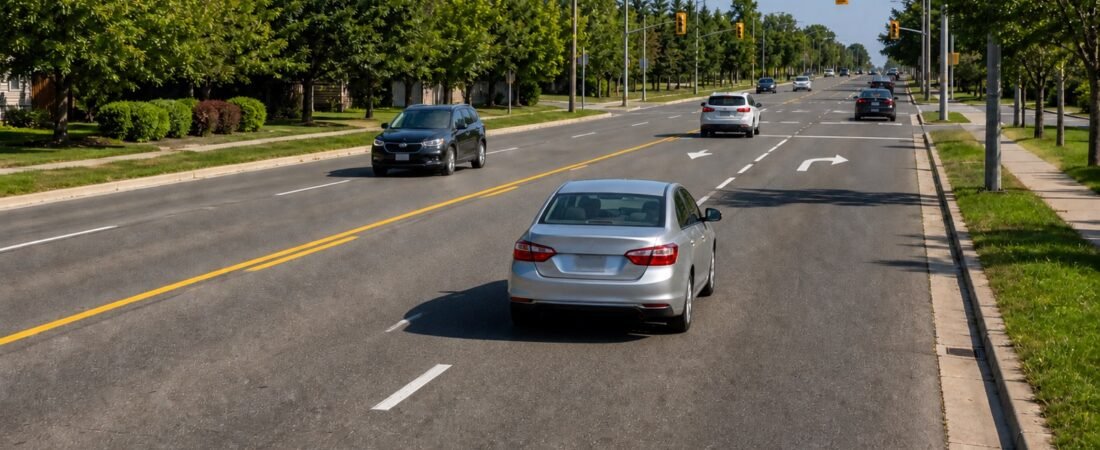
Road lines can look like background details until you need to choose a lane, stop at a busy intersection or recognize that your lane is ending. For a learner driver in Scarborough, reading pavement markings early can turn a rushed decision into a calm one.
This guide explains the Ontario road lines you will see most often, using the current Official MTO Driver’s Handbook pavement-markings section. The goal is not to memorize paint by itself. It is to connect each marking with the safe decision it is asking you to make.
Start with colour: yellow separates, white organizes
The fastest way to understand a road is to notice the colour of its lines. The MTO handbook says yellow lines separate traffic travelling in opposite directions, while white lines separate traffic travelling in the same direction.
On a two-way Scarborough road, a yellow centre line tells you that traffic on the other side is approaching you. On a multi-lane road, broken white lines usually divide the lanes moving beside you in your direction. That distinction matters when you scan ahead: a yellow line helps define opposing traffic, while a white line helps you understand your lane choices.
Do not stare at the paint immediately in front of the hood. Look farther ahead so you can see where lines, arrows and lanes lead. Your near vision can then confirm that the car remains centred.
Solid and broken lines: read the line on your left
According to the MTO handbook, a solid line at the left of your lane means it is unsafe to pass. A broken line at the left means you may pass if the way is clear and there are enough broken lines ahead to complete the pass safely.
“May” does not mean “must.” A broken line does not guarantee a safe gap. Before moving laterally, you still need to check traffic, signal, check mirrors and the blind spot, and confirm that the lane remains available. SparkOn’s Ontario lane-change guide gives a repeatable routine for those checks.
If the paint is worn, covered by leaves or hard to see in rain, avoid guessing. Slow down smoothly, increase your visual search and use the road edge, traffic flow and signs for more context. The MTO’s night and bad-weather guidance recommends using pavement markings for guidance and, in fog, using the right edge of the road rather than the centre line.
Continuity lines warn that a lane is changing
Continuity lines are broken white lines that are wider and closer together than ordinary lane lines. The MTO explains that continuity lines on your left generally mean your lane is ending or exiting, so you must change lanes if you want to continue in the same direction. If continuity lines appear only on your right, your lane continues unaffected.
This is especially useful around highway entrances, exits and lane drops. On a Highway 401 approach, do not wait until the last painted segment to decide what to do. Read the signs and continuity lines early, check mirrors, keep a suitable gap and make one controlled move. Review the same timing in our Highway 401 merging guide for Scarborough drivers.
A practical self-check is simple: “Which side has the continuity line, and where does my lane go?” Answer that before touching the signal.
Stop lines and crosswalks are not the same thing
A stop line is a single white line painted across your lane at an intersection. It shows where you must stop. The MTO sets out the order to use when there is no painted stop line: stop at the crosswalk, whether marked or unmarked; if there is no crosswalk, stop at the edge of the sidewalk; and if there is no sidewalk, stop at the edge of the intersection.
A standard marked crosswalk is shown by two parallel white lines across the road, but intersection crosswalks are not always painted. That is why a faded or missing pair of lines is never a reason to overlook people crossing.
In practice, separate the tasks:
- Identify the correct stopping position before reaching it.
- Bring the vehicle to a complete stop without covering the line or crosswalk.
- Scan for pedestrians, cyclists and conflicting vehicles.
- Proceed only when the signal or right-of-way permits and the path is clear.
For more detail about crossing areas, see SparkOn’s guide to school zones and pedestrian crossovers in Ontario.
Arrows tell you what movements the lane permits
A white arrow painted in a lane means you may move only in the direction shown by the arrow. A straight arrow indicates through travel; a turn arrow identifies a turn movement; and combined arrows show the movements permitted from that lane.
Scarborough’s wide intersections can have several adjacent lanes, so read arrows well before the stop line. If you discover too late that you are in a turn-only lane, follow the marking safely instead of cutting across a solid line or forcing into another lane. You can choose a legal place to turn around or adjust the trip afterward. Missing a turn costs time; a sudden correction can create a conflict.
When approaching an unprotected left turn, lane arrows help you enter the correct lane, but the arrow does not give you the right-of-way. Gap selection and yielding remain separate decisions. Our Scarborough unprotected-left-turn guide explains that process.
Pedestrian crossovers and fixed-object markings
The MTO describes pedestrian crossovers as having specific signs, overhead yellow lights and pavement markings. The pavement treatment uses two sets of double parallel white lines across the road, with an X in each approaching lane. Drivers and cyclists must stop before the line and yield until pedestrians have completely crossed and cleared the roadway.
You may also see two solid lines guiding traffic away from a fixed object such as a concrete island or bridge support. Treat the painted channel as a path around the obstruction, not as an extra lane or a shortcut. Keep your vehicle on the intended side and reduce speed if the available space narrows.
A pavement-marking checklist for Scarborough practice
During a lesson or supervised drive, use this short checklist whenever the road layout changes:
- Colour: Is the line yellow for opposing traffic or white for same-direction traffic?
- Pattern: Is it solid, normally broken or a wider continuity line?
- Direction: Where do the lane arrows say this lane goes?
- Stopping point: Can you identify the stop line and keep the crosswalk clear?
- Lane future: Does your lane continue, end or become an exit?
- Road users: Are pedestrians, cyclists or vehicles about to enter your path?
- Action: Do you need to hold your lane, signal and change lanes, stop, or simply wait?
Practise saying the first three answers quietly before making a move: “white, continuity line on the left, lane ending.” This builds observation without encouraging last-second reactions. Continue checking mirrors and blind spots; pavement paint gives information, but it does not reveal everything around the vehicle.
Learn to read the road before it becomes urgent
Confident drivers do not wait for a lane line to surprise them. They scan far enough ahead to recognize its colour, pattern and direction, then leave themselves time to act smoothly. That habit is useful on residential streets, major Scarborough roads and highway approaches alike.
If road markings, lane positioning or busy intersections still feel rushed, book a Scarborough driving lesson with SparkOn. An instructor can help you practise reading the road early, centring the vehicle and choosing lanes calmly in real local traffic. Contact SparkOn Driving Academy to plan a focused lesson for your G1, G2 or full G goals.