
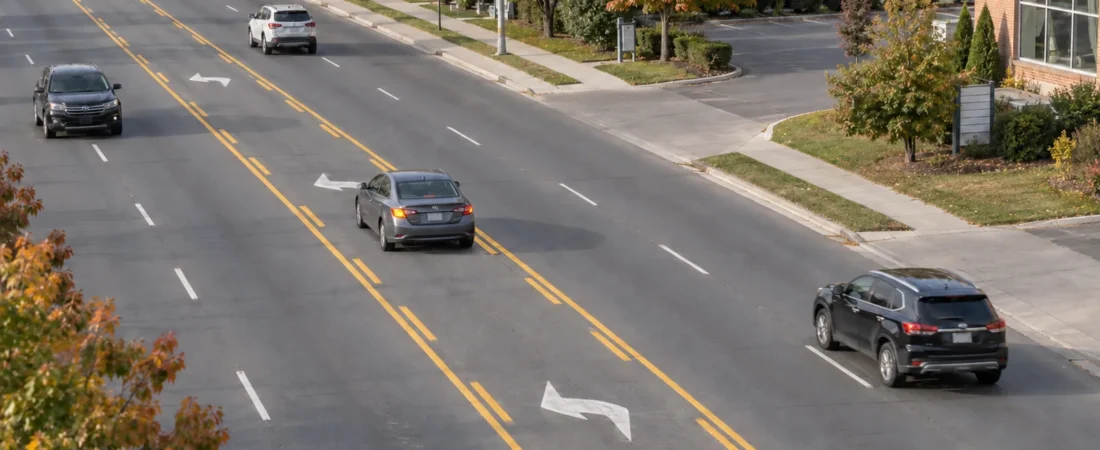
The centre lane on a busy Scarborough road can look confusing at first. Arrows point left in both directions, traffic moves on either side, and sometimes another driver is already waiting ahead of you. Is it a turning lane, a passing lane or a place to merge into traffic?
It is a shared lane for left turns from both directions. Use it by entering at the right time, keeping the car straight and waiting until the path is genuinely clear.
What Ontario’s official handbook says
The Official MTO Driver’s Handbook section on changing directions explains that some roads use the centre lane as a two-way left-turn lane. It allows left-turning drivers from both directions to wait without holding up through traffic.
The handbook gives three basic steps:
- Signal, move into the centre lane shortly before the turn and slow down.
- Move carefully to a position opposite the road or driveway where you want to turn.
- Turn only when the way is clear.
The same official guidance warns that approaching drivers may also use the lane, that waiting vehicles can block your view of oncoming traffic, and that the lane must not be used for passing. Ontario’s traffic-signs and lights guide also confirms that pavement markings and lane-direction signs tell drivers how designated lanes must be used.
Those are the official rules and instructions. The observations and practice routine below are instructor guidance for applying them calmly in Scarborough traffic.
Recognize the lane before you enter it
A two-way left-turn lane runs between opposing streams of traffic. You will normally see left-turn arrows facing in alternating directions. The lane may also be identified by a sign showing arrows for turns from both directions.
Do not confuse it with a painted median, an intersection turn pocket or an empty through lane. Read the full pattern before deciding what it is for. Our Ontario pavement-markings guide can help if solid and broken lines still feel difficult.
On Scarborough arterial roads, a shared turn lane may serve several plaza entrances, apartment driveways or side streets along one stretch. That does not make the whole lane a place to travel. The MTO instruction is to enter shortly before your turn.
A calm entry routine
Suppose you are travelling beside the centre lane and need to turn left into a driveway. Use this order:
- Identify the exact entrance. Do not enter until you know where you are turning.
- Check the centre lane ahead. Look for vehicles using it from both directions, not only in your direction of travel.
- Check your mirrors. Know what the driver behind you is doing before you begin slowing.
- Signal left early enough to communicate. A signal does not reserve the lane; it tells others what you intend to do.
- Check the left side and blind spot. Make sure another road user is not already beside you.
- Move into the centre lane smoothly. Enter shortly before the driveway and align the car straight within the lane.
- Slow and wait opposite the entrance. Keep the wheels straight until you are ready to turn.
That final point matters. The MTO handbook advises drivers waiting to turn left not to turn the steering wheel left before they can complete the turn. If your vehicle is struck from behind while the wheels are already turned, it can be pushed toward oncoming traffic.
The centre lane is shared, not owned
One of the most common learner mistakes is looking only at oncoming through traffic. Before entering, scan the centre lane itself as far ahead as you can. A vehicle from the opposite direction may be preparing to use the same space.
If another driver is already waiting, do not pull beside them. Stay back where both vehicles have room and you can still see. If two vehicles meet nose-to-nose, stop rather than trying to squeeze past.
Also watch for drivers leaving a driveway. They may be waiting in or crossing the centre lane. Their presence does not remove your responsibility to confirm that every part of your path is clear.
Do not use it to pass or build speed
The handbook is direct: two-way left-turn lanes are not passing lanes. Do not enter the centre simply because traffic ahead has slowed, a bus has stopped or you want to reach an intersection faster.
Avoid travelling in the lane while searching for an address. That makes your intentions unclear and increases conflict with opposing users. If you miss the driveway, continue safely and find a legal place to turn later.
The lane is also not an acceleration lane. If you are turning left out of a driveway, do not assume you can stop in the centre lane and drive along it while waiting to merge right. The centre lane’s designated purpose is left turns. Choose a gap that lets you complete the intended movement safely, or wait. When your movement requires joining a through lane, apply the same observation habits from our lane-change guide.
When a waiting vehicle blocks your view
A vehicle opposite you may also be waiting to turn left. It can hide an oncoming car, motorcycle or cyclist behind it. The MTO handbook specifically warns about this visibility problem.
Do not edge across the oncoming lane just to “peek.” Stay stopped and keep scanning. If you cannot see far enough to confirm a safe gap, you do not have a safe gap. Wait for the obstructing vehicle to turn or for the view to open.
This is especially important when the opposite vehicle is a van, SUV or truck. A driver behind it may continue straight and become visible only at the last moment. Our unprotected left-turn guide explains the wider gap-selection routine.
Common mistakes to fix in practice
Entering too early. The longer you travel in the centre lane, the more chances there are for conflict. Enter shortly before the turn.
Stopping diagonally. Align the car straight. A diagonal position uses more lane width and can point the vehicle toward opposing traffic.
Turning the wheels while waiting. Keep them straight until the turn begins.
Watching only the driveway. Scan oncoming through lanes, the shared centre lane, sidewalks and the entrance itself.
Following another turning car blindly. The first driver’s gap may not be large enough for two vehicles. Make your own decision.
Assuming a signal creates priority. It communicates intent but does not make other traffic disappear or give you an automatic right to move.
Rushing because traffic is waiting behind. Drivers in the through lane can continue past once you have entered the centre safely. Your job is to wait for a clear turn, not satisfy an impatient driver.
A short centre-lane checklist
Before entering, ask:
- Is this definitely a two-way left-turn lane?
- Do I know the exact driveway or side road I am using?
- Is the shared lane clear from both directions?
- Have I checked mirrors, signal and blind spot?
- Can I enter shortly before the turn rather than travel along the lane?
- Can I stop straight with the wheels straight?
- Can I clearly see all oncoming lanes before turning?
If one answer is no, wait in your current lane or continue to a safer place to turn.
Practise the timing, not just the steering
The steering movement into a centre lane is simple. The difficult part is reading the markings, choosing the entry point and managing several traffic streams without rushing. Start practice in lighter traffic with a qualified accompanying driver or instructor, then build toward busier Scarborough corridors when your observation routine is consistent.
SparkOn offers driving lessons in Scarborough for learners who want focused help with lane choice, left turns and busy arterial roads. Book a Scarborough lesson and ask to practise centre two-way left-turn lanes as part of a wider lane-position and gap-judgment session.