
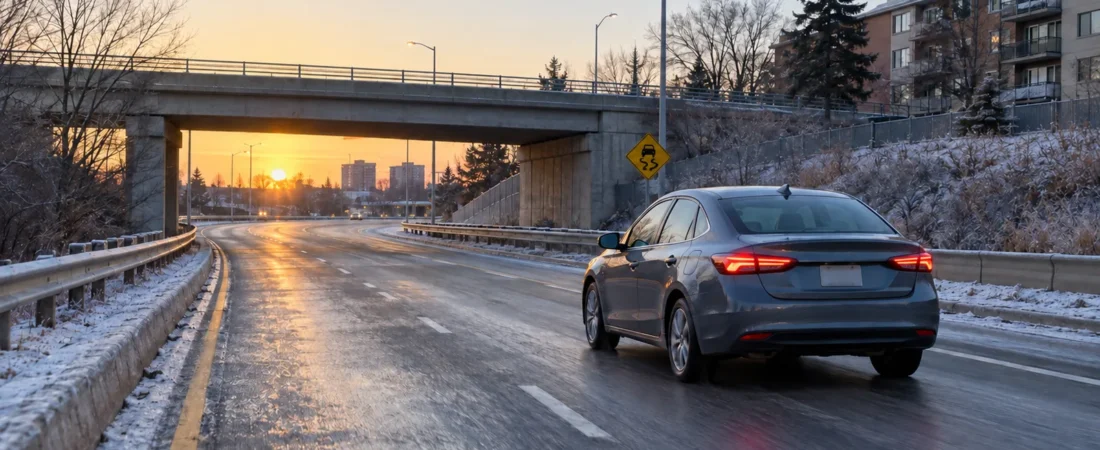
Black ice is difficult for a new driver because the road can look merely wet until the car stops responding the way you expect. In Scarborough, the first slippery patch may be on an overpass, a shaded ramp or a quiet street after temperatures fall overnight. The safest response begins before the tires reach that patch: notice the clues, reduce speed early and keep every input smooth.
What Ontario’s official guidance says about black ice
The Official MTO Driver’s Handbook explains that wet roads become icy as temperatures drop below freezing. It warns that shaded sections, bridges and overpasses freeze first. A road that looks black and shiny may have a thin layer of black ice; winter pavement will often look more grey-white.
The same handbook says most skids result from driving too fast for the conditions, while hard braking and aggressive steering or acceleration can also break traction. Ontario’s practical advice is to reduce speed and operate the controls smoothly. This is official safety guidance. My instructor advice is how to turn it into a routine you can actually use on Scarborough roads.
Read the conditions before you feel the slide
Do not wait for the steering wheel to feel light. Start reading the environment as soon as the temperature is near freezing. Watch for a glossy patch that reflects streetlights or sunrise differently from the surrounding pavement. Pay extra attention where the road crosses above another road, where buildings or trees keep pavement shaded, and where meltwater may refreeze overnight.
A common student mistake is looking only at the vehicle directly ahead. Lift your eyes and scan farther along the lane. If several vehicles ahead suddenly stop accelerating, make small steering corrections or leave a wider gap, that is useful information. It does not prove there is ice, but it gives you time to become more cautious.
Before leaving, check the forecast and road conditions. Ontario’s winter-driving page points drivers to Ontario 511 for road conditions. A clear driveway does not guarantee that every bridge, ramp or shaded street will have the same grip.
Slow down before the icy section
If you suspect black ice ahead, ease off the accelerator early and let the vehicle lose speed gradually while it still has good traction. Create more space behind the vehicle in front. Finish any necessary braking before the shiny section when possible, then travel across it with a steady steering wheel and gentle throttle.
Avoid last-second lane changes. On a Scarborough arterial, it is better to stay in a safe lane and miss a turn than to brake and steer sharply across a slick patch. On a Highway 401 ramp or overpass, hold a predictable line and avoid cruise control when winter conditions are poor. The MTO handbook specifically advises against cruise control in snow and other inclement weather.
This is where practice with following distance matters. Two seconds is a useful starting point in good conditions, but it is not a fixed promise of safe stopping distance. Give yourself substantially more room when traction may be reduced.
If the car starts to skid
The MTO’s skid guidance is straightforward: do not panic, ease off the accelerator or brake, and continue steering in the direction you want to go without oversteering. Once control returns, brake gently and smoothly as needed.
In the moment, use this short sequence:
- Look where you want the car to travel. Your hands tend to follow your eyes, so do not stare at the curb or guardrail.
- Ease off the accelerator. Avoid snapping your foot away or adding power.
- Reduce braking pressure. A hard brake input can demand more grip than the tires have available.
- Steer smoothly. Make a small correction toward your intended path. Do not saw the wheel back and forth.
- Wait for grip to return. Only then should you gently adjust speed or position.
If your vehicle has anti-lock brakes and you must make an emergency stop, the MTO says to press the brake pedal hard and allow the system to control wheel lock. The pedal may pulsate. Do not assume ABS will shorten the stopping distance; its purpose is to help prevent wheel lock and preserve steering control. Because vehicles respond differently, check the owner’s manual and learn the feel of your own braking system in controlled conditions with a qualified instructor.
Common mistakes that make a small slide worse
Braking and turning hard together: the tires have limited grip. Asking them to make a sharp turn while braking heavily can overwhelm it.
Overcorrecting: a learner feels the rear move, turns too far, then makes an equally large correction the other way. Use smaller steering movements and keep looking along the safe path.
Following the speed of other drivers: another car travelling quickly does not tell you that the road is safe. Its tires, weight and driver inputs may be different from yours.
Assuming all-wheel drive creates extra stopping grip: it can help a vehicle move, but braking and cornering still depend on tire traction. Leave space and slow down regardless of the drivetrain.
Waiting until the bridge deck to reduce speed: the point is to arrive at the possible ice patch already settled and slow, not to make a sudden correction on it.
A quick black-ice checklist for Scarborough learners
- Check the forecast and Ontario 511 before a cold-weather trip.
- Clear every window and mirror so you can read the road surface.
- Watch shaded pavement, bridges, overpasses and ramps carefully.
- Reduce speed gradually before a suspicious patch.
- Increase the space in front and avoid cruise control.
- Keep steering, braking and acceleration smooth.
- If grip disappears, look ahead, ease off and avoid overcorrecting.
- If conditions feel beyond your ability, delay the trip or pull into a safe parking area.
Preparation matters too. Review SparkOn’s guide to winter tires and washer-fluid preparation, and remember that the slick surface may not look dramatic. The goal is not to prove you can recover from a skid. It is to make calm decisions early enough that the skid never starts.
Build winter control one skill at a time
Black-ice awareness combines observation, speed control, following distance and smooth steering. Those are learnable habits, but they are much easier to build before the first genuinely slippery morning.
If you want help practising calm winter-driving routines in familiar local conditions, book a driving lesson in Scarborough with SparkOn Driving Academy. We can work on forward scanning, progressive braking and keeping the car balanced without turning an ordinary lesson into a risky skid exercise.