
Last verified: October 2, 2026.
The Port Union G2 test checks whether you can handle ordinary city driving safely and independently. It does not require highway driving. Prepare for residential streets, multi-lane roads, controlled intersections, lane changes and parking manoeuvres rather than trying to memorize a rumoured route.
Start with the right expectation
DriveTest uses set routes and tasks, but it does not publish a guaranteed route for candidates. Routes, examiner directions, traffic, construction and even the format used on a particular day can change. This guide is practice-area guidance, not an official route map. The useful question is not “Which street will I get?” It is “Can I make a safe decision on any street the examiner chooses?”
Ontario calls the G2 test the G1 exit test. The province says it assesses basic skills including turns, stops, lane changes, traffic controls, residential driving, parallel parking and three-point turns. A successful result moves a G1 driver to Class G2. Review the province’s current graduated-licensing requirements before booking.
What the Port Union area asks you to manage
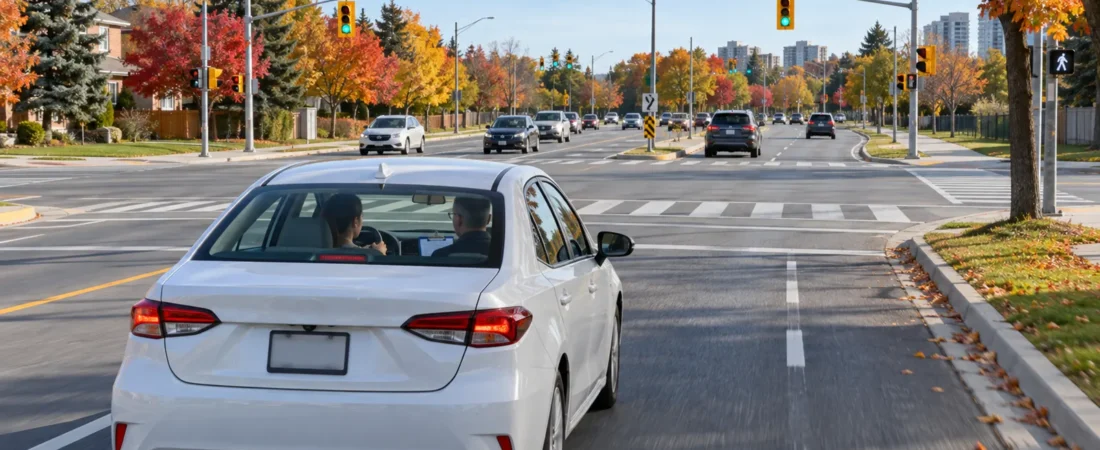
Port Union sits in east Scarborough, where a learner can move quickly between quieter neighbourhood streets and broader arterial roads. That mix is useful preparation. On residential streets, parked vehicles can narrow your view and make space judgement important. On larger roads, you need earlier mirror checks, a clean signal and a decisive shoulder check before changing lanes.
Practise reading every posted sign rather than assuming the speed from the road’s appearance. Build the habit of easing off the accelerator when visibility is limited by bends, trees, parked vehicles or a crest. At larger intersections, scan for pedestrians finishing their crossing and vehicles turning across your path. A green light gives permission to proceed only when the way is clear.
Do not practise by circling the DriveTest property repeatedly or interfering with tests. Use a variety of legal public roads in the wider area and follow all posted restrictions. The goal is transferable skill, not recognition of a few corners.
The core G2 skills to make consistent
Observation that an examiner can see
Move your eyes and head naturally. Check the rear-view mirror before slowing, side mirrors before moving laterally, and the relevant blind spot immediately before a lane change or pulling away from the curb. Do not exaggerate every movement, but do not rely on quick eye movements that are impossible to notice. Driver-assistance lights are useful warnings; they do not replace direct checks.
Stops that are complete and properly placed
Reduce speed early and stop fully before the marked line. If there is no line, stop before the crosswalk; if there is no crosswalk, stop at the edge of the intersection where you can do so safely. After the stop, creep only when you need a better view and only after checking for pedestrians. A rolling stop is still a common practice mistake.
Turns with correct speed and lane position
Set your speed before the turn, look through the corner and steer into the correct lane. Avoid cutting a left turn or swinging wide on a right. On a right turn, check the right mirror and blind area for a cyclist before crossing their path. On an unprotected left, keep the wheels straight while waiting and turn only when the gap is genuinely safe.
Lane changes without hesitation or rush
Use a repeatable sequence: mirror, signal, blind-spot check, move smoothly, cancel the signal. A signal requests space; it does not create it. Match traffic speed within the posted limit and avoid drifting while you look over your shoulder. Our detailed lane-change routine is useful for focused practice.
Low-speed manoeuvres under control
Parallel parking and three-point turns should be slow enough that you can keep observing. Before reversing, look all around, then keep checking the direction of travel instead of staring at one mirror or camera. If your position is not ideal, correct it safely. Control and observation matter more than trying to perform a memorized steering trick at speed.
A practical Port Union practice session
Begin on a quiet street and spend ten minutes making complete stops, smooth right turns and careful left turns. Then move to a busier road and practise maintaining a steady speed, reading signs early and making two or three well-planned lane changes. Finish with parking and a three-point turn where legal and safe.
Change the time of day across sessions. Light traffic can hide weak gap judgement, while the busiest period may overload a new learner. Build from quiet to moderate traffic. Practise in dry weather first, then add rain only when the supervising driver and learner are comfortable. Never rehearse a manoeuvre where it would block traffic or create a hazard.
Ask your supervising driver to give directions early but not coach every pedal movement. On the test you must listen, identify a safe place and carry out the instruction yourself. If a direction is unclear, ask the examiner to repeat it. Do not make an unsafe last-second movement to follow a missed instruction.
Use each practice drive to measure something
A vague goal such as “drive better” is hard to improve. Count how many times you needed a reminder to check a blind spot, how often your speed wandered, or whether each stop finished before the line. The numbers are for practice only, not a prediction of an examiner’s scoring. They help you decide what the next session should address.
After the drive, discuss one decision that went well and two that need work. If the problem was a late lane change, practise reading signs earlier rather than repeating the same last-second movement. If parking broke down, slow the manoeuvre and restore all-around observation before worrying about the final curb distance. Specific correction builds confidence faster than praise or criticism without detail.
Also practise recovering from small errors. If the signal stays on, cancel it when safe and continue. If you choose the wrong lane, follow that lane legally and respond to the next direction. Safe recovery demonstrates better judgement than a sudden correction made to protect a perfect-looking route.
Include one drive with an unfamiliar destination selected by the supervising driver. Navigating different legal streets reveals whether you are reading signs and traffic in real time. Stay within the learner conditions on your licence, and let safe decisions take priority over reaching the destination quickly.
Common mistakes to fix before test day
- Looking but not seeing: a fast head movement without checking whether the space is clear.
- Stopping too late: the front of the vehicle crosses the line before the wheels stop.
- Speed drifting: the learner focuses on steering and stops monitoring the posted limit.
- Wide or cut turns: poor approach speed leads to the wrong lane position.
- Blind-spot timing: the shoulder check happens too early and conditions change before the car moves.
- Camera dependence: the learner reverses using only the screen.
- Route anxiety: attention shifts from present hazards to guessing where the examiner will go.
Test-day checklist
DriveTest and the MTO say to bring a vehicle in good working order, applicable fees, and glasses or contacts if you need them. The MTO handbook advises arriving at least 30 minutes before the appointment. Before leaving home, check the brake lights, turn signals, horn, tires, windshield, mirrors, seatbelts, fuel level and licence plates. A defect can make the test out of order before the drive begins.
- Confirm the centre, date and time from the official booking confirmation.
- Bring your valid driver’s licence and any required corrective lenses.
- Arrive early enough to check in without rushing.
- Remove loose items and set the seat and mirrors before the examiner enters.
- Turn off distractions and know how to operate the lights, wipers, defroster and parking brake.
Read SparkOn’s road-test document checklist and vehicle checklist a few days ahead, not in the parking lot.
Prepare for skill, not a secret route
A calm Port Union test starts with broad preparation: controlled steering, complete stops, visible observation, sensible speed and safe decisions when traffic does something unexpected. If one turn is imperfect, reset your attention and continue. One moment does not justify rushing the next five.
If you want structured practice in east Scarborough, SparkOn can build a lesson around the specific skills you still need rather than promising a test route or a pass. Review our Scarborough road-test preparation options and book a focused G2 lesson when you are ready.
Official sources: Ontario graduated licensing; Official MTO Driver’s Handbook; DriveTest road tests for cars.