
Last verified: October 2, 2026.
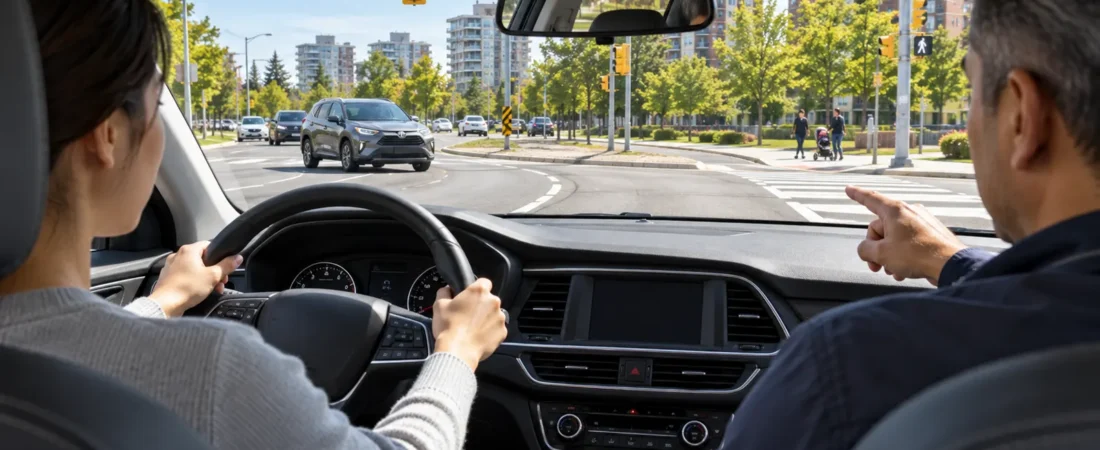
Ontario’s G2 road test is the first on-road test for most new drivers. It checks everyday city-driving skills: observation, turns, stops, lane changes, traffic controls, residential driving and parking manoeuvres. Highway driving is not the focus. Prepare by making safe routines consistent without coaching.
When you are eligible
Most new drivers must hold a G1 licence for 12 months before taking the G2 test. Completing a government-approved Beginner Driver Education course can reduce the Level One period to eight months. An appointment opening does not remove that eligibility rule.
Ontario’s graduated-licensing page is the best place to confirm your timeline. Rules can differ for licence exchanges and credited foreign experience, particularly after the July 2026 changes, so newcomers should verify their individual record rather than relying on a general guide.
What the official test covers
Ontario lists left and right turns, stopping, parallel parking, one-way streets, lane changes, three-point turns, residential driving, traffic lights, stop signs and yield signs among the G2 test skills. DriveTest says its road tests assess driving skills against MTO criteria using predefined tasks, routes and score sheets.
The examiner provides directions and observes how you operate the car, apply road rules and respond to traffic. Your job is to drive safely, not narrate or impress. If an instruction is unclear, ask for it to be repeated. If you miss a turn, continue safely rather than forcing a late movement.
Observation: make it timely and useful
Good observation is a cycle. Look well ahead, check mirrors regularly and scan the sides for developing hazards. Before slowing, glance at the rear-view mirror. Before moving sideways, check the appropriate mirror, signal, check the blind spot and move only when the space is safe.
A common mistake is moving the head without processing the view. Another is checking the blind spot too early, waiting several seconds and then changing lanes after conditions have changed. Make the final shoulder check immediately before the car moves. Cameras and warning systems can help, but the MTO expects you to demonstrate the underlying checks without relying on an aid.
Speed, space and braking
Read posted signs; do not guess the limit from the width of the road. Reach an appropriate speed smoothly and keep monitoring it, especially after turns and downhill sections. Driving far below the flow without a reason can create problems, while exceeding the limit reduces your time to respond.
Leave enough following space to slow gradually. The MTO handbook recommends at least a two-second gap in ideal conditions and more when conditions are poor. Watch beyond the vehicle ahead so changing signals and brake lights do not surprise you. Check the mirror, ease off the accelerator and brake progressively.
Stops and intersections
At a stop sign or red light, stop fully before the marked line. If there is no line, stop before the crosswalk; without either, stop at the edge of the intersection. Keep crosswalks clear. When visibility is blocked, make the proper stop first and then inch forward carefully for a better view.
At a green light, scan before entering. Look for a pedestrian finishing the crossing, a cyclist approaching the corner or a vehicle turning across your path. At a yellow light, stop if you can do so safely; otherwise proceed with caution. Never accelerate simply to avoid waiting.
Turns and right of way
Prepare before the corner: mirror, signal, position and speed. Look through the turn and enter the correct lane. Avoid cutting a left turn or swinging wide on a right. Before turning right, check the mirror and blind area for a cyclist or pedestrian whose path you will cross.
On an unprotected left, keep the front wheels straight while waiting. Judge oncoming traffic, the width of the road and pedestrians crossing the street you want to enter. Wait for a genuinely safe gap. Pressure from a driver behind you is not part of the right-of-way rule.
Lane changes
Use the same sequence every time: mirror, signal, blind-spot check, smooth movement, signal off. Keep a stable speed and lane position while checking. Do not drift toward the next lane before the final look. A signal announces your plan; it does not require another driver to make space.
Plan lane changes early when a lane ends or becomes turn-only. Read signs and pavement arrows far enough ahead to act calmly. SparkOn’s lane-change practice guide breaks down the routine.
Parking, reversing and the three-point turn
Low-speed manoeuvres show control and observation. Move slowly enough to correct the car, check all around before reversing and continue looking in the direction of travel. Do not stare only at a camera or one mirror. Yield when another road user approaches.
For parallel parking, choose a safe legal space and keep the vehicle controlled near the curb without contact. For a three-point turn, select a place with good visibility and no restriction, signal as appropriate, and check in both directions during every stage. Practise the principles in SparkOn’s G2 parking manoeuvres guide.
Common mistakes that make a drive look unready
- Rolling through stop signs or stopping beyond the line.
- Checking mirrors without completing a blind-spot check.
- Letting speed drift while concentrating on steering.
- Turning into the wrong lane or crossing a centre line.
- Following too closely and braking late.
- Blocking a crosswalk or intersection.
- Using a reversing camera as the only observation method.
- Needing continuous prompts from the supervising driver.
- Rushing after one mistake instead of resetting.
A preparation plan that builds independence
Start with short sessions focused on one or two skills. Make stops and turns consistent before adding busy intersections. Add lane changes after you can hold speed and position. Practise manoeuvres at the end, when mental fatigue may reveal whether the routine is truly learned.
Next, combine the skills on unfamiliar roads. Ask the supervising driver to give route directions but not coach each decision. Complete at least one realistic practice drive in which you manage signs, gaps, speed and manoeuvres independently. Afterwards, choose the two most important weaknesses and practise those—not the entire test all over again.
Vary conditions gradually. Dry daylight is the right starting point. Add moderate traffic, light rain or dusk only when the basic routine is dependable and the supervising driver agrees it is safe. You do not need to seek difficult conditions simply to prove confidence.
Test-day requirements and vehicle check
The MTO handbook tells applicants to bring a vehicle in good working order, applicable fees and any required glasses or contact lenses, and to arrive at least 30 minutes before the appointment. DriveTest can declare a test out of order if the vehicle or paperwork does not meet requirements.
- Confirm the centre, time and test class from the official booking.
- Bring your valid licence and corrective lenses if required.
- Check tires, lights, signals, horn, windshield, mirrors, seatbelts and fuel.
- Know how to operate the parking brake, lights, wipers and defroster.
- Remove loose items and adjust the seat and mirrors.
- Arrive early enough to check in calmly.
Use SparkOn’s what-to-bring checklist and vehicle checklist several days before the test.
After the test
DriveTest provides feedback on your performance. If the result is unsuccessful, use the score sheet to identify specific areas for practice rather than guessing. The MTO handbook states that you must wait at least 10 days between Class G road-test attempts, but being eligible to rebook does not necessarily mean you are ready. Give yourself enough time to correct the pattern.
If you pass, you move to G2 and can drive independently on Ontario roads, subject to G2 conditions. Ontario requires zero blood alcohol for G2 drivers, and passenger restrictions apply between midnight and 5 a.m. to G2 drivers aged 19 and under in specified circumstances. Review the current official conditions rather than relying on memory.
Prepare calmly in Scarborough
A successful-looking G2 drive is usually simple: early observation, full stops, steady speed, correct lanes and patient decisions. You do not need a perfect performance or a secret route. You need habits that remain dependable when the road is unfamiliar.
If you want a structured review, SparkOn offers G2 road-test preparation in Scarborough. We can focus on your weak areas and help you assess readiness, without promising a route or guaranteeing a pass.
Official sources: Ontario graduated licensing; Official MTO Driver’s Handbook; DriveTest road tests for cars; DriveTest booking overview.