
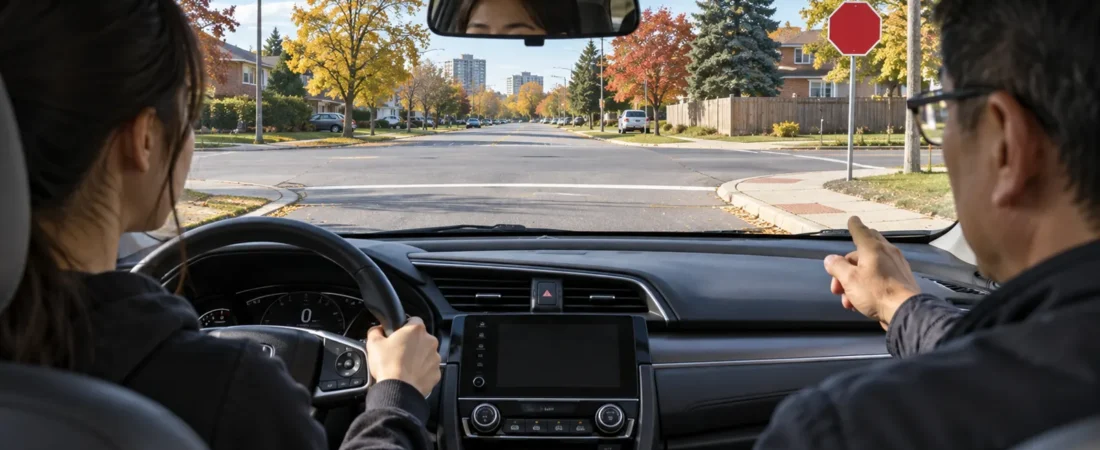
A G2 road test usually goes wrong through a pattern, not one imperfect parking angle. The examiner is assessing whether you can apply Ontario’s rules, control the vehicle and make safe decisions without coaching. The best preparation is therefore not memorizing a Scarborough route. It is removing the habits that make your driving unpredictable.
This guide groups common mistakes by the driving problem underneath them. Ontario does not publish a simple official list saying each mistake automatically causes failure, so avoid anyone who promises a pass based on a secret scoring formula.
Observation that happens too late
Many learners know they should check mirrors and blind spots, but complete the check after they have begun steering. By then, the information cannot guide the decision.
Build the order into every move: mirror, signal when required, blind-spot check, then movement when safe. For a right turn, scan the sidewalk and crosswalk for pedestrians and cyclists before the car crosses their path. When reversing, keep observing around the vehicle rather than locking your eyes on one mirror or the backup camera.
Practice drill: say “information before movement” quietly during practice. Your supervising driver should note only whether each check occurred before the steering input.
Stops that are incomplete or badly placed
The Official MTO Driver’s Handbook lists stopping, signs, lights and intersections among tested skills. Slow rolling is not a complete stop. Stopping beyond the line can place the vehicle in a crosswalk or too close to moving traffic.
Stop fully at the legal stopping position. Pause, scan, and move only when the right-of-way decision is clear. If visibility is blocked, make the required stop first, then edge forward carefully for a better view without blocking people using the crossing.
Practice drill: use a residential loop with several stop signs. Ask your supervisor to watch wheel movement and stopping position, not just whether you looked left and right.
Turning without solving the whole intersection
A turn is more than steering. You need the correct lane, a legal stop when required, a safe gap, pedestrian and cyclist checks, controlled speed and a predictable finish. Common problems include turning too wide, cutting the corner, entering the wrong lane, hesitating when a clearly safe opportunity exists, or accepting a gap that forces another road user to react.
On busy Scarborough roads, do not let pressure from a driver behind choose your gap. Keep the wheels straight while waiting to turn left and move only when the path is safe. For a right turn, check the near-side sidewalk and blind spot before crossing the curb lane or bike space.
Speed that does not match the situation
Driving well below the limit is not automatically safer. It can show that the driver is uncertain or not responding normally to clear conditions. Driving too fast reduces the time available for hazards, curves, parked cars and changing signals.
Read the posted limit, but also adjust for weather, visibility and traffic. Build speed smoothly after a turn, then settle into a steady pace. Check the speedometer briefly without staring down. The goal is controlled progress, not chasing an exact number every second.
Lane changes that are rushed or unfinished
A safe lane change needs a real reason, early information and a suitable gap. Frequent mistakes include signalling before checking whether a gap exists, skipping the blind spot, slowing sharply in the current lane, drifting across the line, or cancelling the signal before the vehicle is established.
Use a calm sequence: mirror, signal, blind spot, gap, smooth move, centre the car and cancel. Keep a stable speed unless traffic conditions require otherwise. Read SparkOn’s mirror and scanning routine if your checks feel forced.
Parking and reversing without continuous observation
Parking is performed at low speed, but it still requires awareness. Rushing the setup, turning while the vehicle is moving too quickly, staring at one reference point or failing to check the front swing can create avoidable risk.
Go slowly enough to think. Observe all around before moving, continue scanning while reversing, and stop if a pedestrian, vehicle or uncertainty enters the space. A correction can be safer than forcing a poor angle. Practise process and safety, not a single parking-lot marker.
Nerves that replace decisions with guesses
Nervous drivers sometimes wait for the examiner to reassure them, copy the car ahead or rush because silence feels uncomfortable. The examiner gives directions but does not coach during the test. If you did not hear an instruction, ask for it to be repeated. Never make an unsafe last-second move to follow a direction.
A small mistake does not tell you the result. Reset your breathing, return your eyes to the road and complete the next task safely. Mentally replaying the last turn takes attention away from the current hazard.
Your final G2 practice checklist
- Checks happen before steering, braking or moving away.
- Every required stop is complete and correctly placed.
- Turns finish in the proper lane with a safe gap.
- Speed is legal, steady and adjusted for conditions.
- Lane changes are planned, checked and smooth.
- Reversing stays slow with continuous observation.
- You can drive without reminders from the passenger seat.
For a broader overview, see SparkOn’s existing five common G2 mistakes guide. When you want a diagnostic drive instead of another general checklist, book a Scarborough G2 preparation lesson. We will identify the repeated habit underneath each error and build practice around it.