
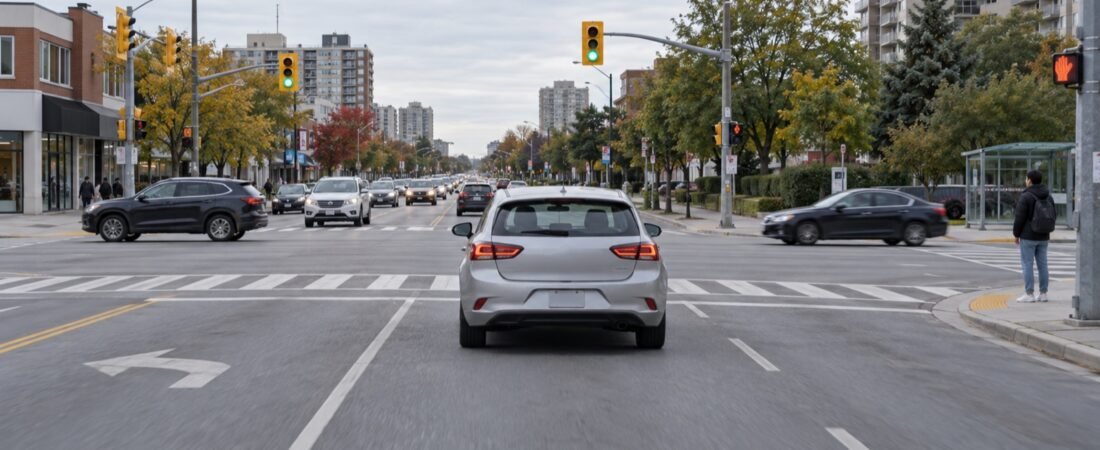
A green light is permission to proceed, not a promise that the intersection is clear. In Scarborough, a bus can hide a pedestrian, a driver can run a late red, and traffic can be backed up past the far crosswalk. New drivers often look only at the signal and the vehicle directly ahead. I want you to build a wider habit: read the light, scan the space, and enter only when you have room to clear it.
This guide separates Ontario’s official traffic rules from the practical scanning routine I teach learners. It is useful for everyday driving and for the intersection portion of a G2 or G road test.
What a green light actually means
The Official MTO Driver’s Handbook says a green light means you may turn left, go straight or turn right after yielding to vehicles and pedestrians already in the intersection. A green light does not remove your duty to check for people, cyclists or vehicles that are still clearing the crossing.
For a turn, “green” is not the same as “go immediately.” You still need a clear path and enough space to complete the movement. If you are turning right, watch the near-side crosswalk and the curb area. If you are turning left on a regular green, yield to oncoming traffic and pedestrians. A signal tells you whose turn is organized; it does not do the visual checking for you.
Read the light before you reach the line
As you approach an intersection, ask yourself whether the green is fresh or has been green for a while. You cannot know exactly when it will change, so do not try to predict a countdown. Instead, ease off the accelerator if the light has been showing for a long time, check your mirrors, and prepare to stop if it turns yellow. The MTO’s intersection guidance says to be ready for a yellow and to proceed with caution if you are already too close to stop safely.
A common student mistake is accelerating as soon as a light turns green from red, without checking the cross street. Take a short look left, ahead and right before you cross the stop line. That glance is especially important after a long red cycle, when a driver facing the other direction may be impatient.
Keep the intersection exit visible
Before moving, look beyond the intersection. If traffic is stopped and you cannot fit completely on the other side, wait behind the line. The handbook specifically says that when a main-road intersection is blocked, you should stop before entering and wait for traffic ahead to move.
This is one of the easiest habits to practise along Scarborough’s busy arterials. At a signal near a shopping plaza or TTC stop, leave enough room for the vehicles ahead to move. Do not roll into the crosswalk simply because your light is green. Blocking the crossing creates a problem for pedestrians and leaves you trapped if the signal changes.
Use a simple left–ahead–right scan
When you have a green light and the exit is open, use this sequence:
- Left: check for a vehicle entering late, a cyclist, or a pedestrian still clearing the crossing.
- Ahead: confirm your lane is open and identify any vehicle edging around a stopped car.
- Right: check the near crosswalk, curb, bus stop and vehicles turning across your path.
- Go smoothly: keep both hands on the wheel, hold your lane and accelerate only enough to blend with traffic.
The scan is not a theatrical head movement. Keep your eyes moving naturally and do not stare at one corner. In a good mirror-and-scanning routine, your attention returns to the road ahead before the car reaches the centre of the intersection.
Pedestrians and cyclists can still be in your path
Ontario’s handbook explains that pedestrians crossing with a walk signal have the right-of-way, including while the signal changes to a flashing or steady hand. The pedestrian-signal page also reminds drivers that people who have already started crossing must be allowed to reach a safe area.
At a right turn, check the sidewalk and bike lane before you steer. A cyclist may be travelling beside you even when the signal is green. A pedestrian may be partly hidden by a vehicle in the next lane. Slow enough that you can stop, and make eye contact when it is available. If you cannot see around a large vehicle, wait for the view instead of guessing.
When another driver makes a mistake
Defensive driving assumes that someone else may be late, distracted or confused. The MTO describes defensive driving through visibility, space and communication in its safe-and-responsible-driving guidance. At a green light, that means leaving a little space in front, keeping your speed controlled, and watching the wheels of cross-traffic—not just the driver’s face.
If a vehicle begins to turn across you, brake firmly and stay in your lane unless steering away is clearly safer. Do not use the horn as your first plan. If a driver is creeping from a side street, cover the brake and be ready to stop. Your goal is not to prove that you had the right-of-way; it is to avoid the collision.
Special signals and a power outage
Scarborough intersections can include advance green arrows, flashing signals and transit-priority signals. Read the signal that faces your lane rather than copying the car beside you. The MTO traffic-light page explains that an advance green permits a turn or movement while opposing traffic still faces red, while a flashing red requires a complete stop.
If traffic lights are blank because of a power loss, treat the intersection cautiously. The handbook says to yield to vehicles already in the intersection and to vehicles entering from your right, using it like an all-way stop. If you are unsure who should proceed, stop and communicate rather than forcing a decision.
Common learner mistakes at green lights
- Watching only the signal: scan the roadway and sidewalks as well.
- Entering a blocked intersection: wait behind the line until the exit is available.
- Turning too quickly: reduce speed first so you can see the crosswalk and bike lane.
- Changing lanes in the intersection: hold your lane and complete the crossing before repositioning.
- Following a bus or truck too closely: leave a gap so its movement does not hide your view.
A Scarborough practice checklist
On your next supervised drive, practise the same five questions at every signal:
- How long has this light been green?
- Can I see the far side and a clear exit?
- Who might still be crossing from the left or right?
- What are the nearest vehicles’ wheels doing?
- Where is my safe stopping space if something changes?
Try the routine on a quiet residential arterial first, then on a busier road near a plaza or transit stop. Ask your supervising driver to name one hazard you noticed and one you missed. That feedback builds judgement faster than chasing a perfect-looking green-light launch.
Practise calm intersection decisions
Good intersection driving is a repeatable process: see the signal, check the space, scan for people and traffic, then move smoothly. If you are preparing for a G2 or G road test, book a Scarborough driving lesson with SparkOn Driving Academy. We can practise green-light scanning, blocked exits, right and left turns, TTC-area traffic and the calm decisions examiners expect to see. Contact us to arrange your next lesson.
Official sources: Ontario Ministry of Transportation, Traffic lights; Driving through intersections; Pedestrian signals; and Safe and responsible driving.