
Last verified: October 2, 2026.
Toronto Metro East can suit Scarborough drivers who want a G road test near the Don Valley Parkway and busy Toronto arterial roads. The useful preparation is not memorizing a neighbourhood loop. It is learning to read ramps, multi-lane traffic, commercial entrances and intersections while following directions calmly.
This guide is based on current official DriveTest and Ontario information. It does not identify an exact or guaranteed road-test route. Examiner directions, routes, construction, traffic and the test format can change at any time.
Official Toronto Metro East centre details
DriveTest’s official centre list places Toronto Metro East at Victoria Terrace Plaza, 1448 Lawrence Avenue East, Unit 15, Toronto, Ontario M4A 2V6. The centre lists G2, G, M2, M, LM2 and LM road tests.
As of the verification date above, DriveTest lists inside services Monday to Friday from 7:00 a.m. to 7:00 p.m. and Saturday from 8:30 a.m. to 5:00 p.m. Road-test appointments are listed Monday to Saturday from 8:00 a.m. to 5:00 p.m. Check the official listing and your confirmation before travelling because hours and services may change.
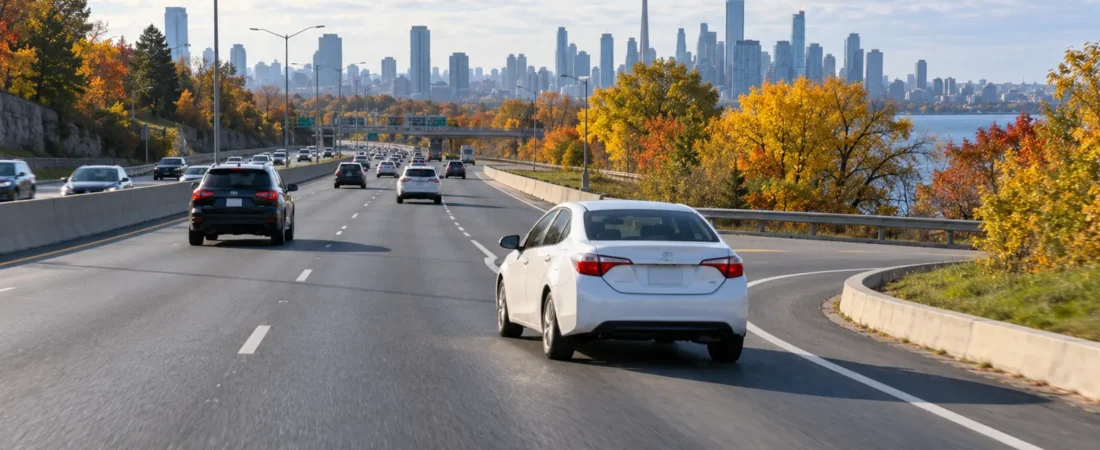
The centre is in a shopping plaza near busy urban roads and access to a high-speed expressway. Those are sensible environments to practise. They do not establish the route the examiner will choose.
What Ontario currently includes in the G test
The Official MTO Driver’s Handbook describes the G test as an assessment of advanced driving. It includes driving on major roads and expressways, merging on and off, managing speed and space, signalling, turns, curves, lane changes, intersections and business areas.
Ontario currently says that, until further notice, the test does not include parallel parking, roadside stops, three-point turns or residential-neighbourhood driving because those were assessed at the G2 level. This temporary format may change, so verify it again near your test date.
G applicants must also complete a Declaration of Highway Driving Experience. You report eligible freeway and/or highway trips with a speed limit of at least 80 km/h made during the previous three months, along with their average length. The MTO list includes the Don Valley Parkway. If the experience is insufficient, the examiner must declare the test out of order.
Start with calm plaza observation
Shopping-plaza traffic is unpredictable in a different way from expressway traffic. Speeds are low, but sight lines can be blocked by parked vehicles. Pedestrians may cross outside a marked area, and drivers may reverse suddenly or turn across an aisle.
Before moving, settle the seat and mirrors, fasten the belt, confirm the vehicle is ready and listen fully to the direction. Scan around the car. Move at a speed that gives you time to react, and do not cut across empty parking spaces as if they are an extra lane.
At the plaza exit, stop where required and yield to the sidewalk before focusing on the road. If the view is blocked, inch forward only after the pedestrian path is clear. Recheck both directions before entering. A common mistake is finding a traffic gap and then staring at it so long that a pedestrian enters from the other side.
Urban major roads demand early decisions
Roads around Metro East can combine several lanes, frequent signals, transit stops, driveways and changing traffic speeds. Look 12 to 15 seconds ahead, as the MTO test guide recommends. Early information lets you adjust gently instead of braking hard or changing lanes at the last moment.
Choose a safe lane for through travel. The handbook notes that this is usually the curb lane, although a centre lane may be safer where the curb lane is blocked or filled with hazards. This is a judgment decision, not a rule to stay permanently in one lane.
Watch business entrances and side streets. A vehicle edging forward may not see you, and a bus can block a pedestrian or turning vehicle. Keep at least a two- to three-second following distance under ordinary conditions, then increase it when visibility, weather or traffic makes extra space useful.
Students sometimes respond to complexity by driving far below an appropriate speed. That does not automatically make the drive safer. Follow the posted limit while adjusting for actual conditions, and return smoothly to traffic speed after turns or slowdowns.
DVP preparation begins before the ramp
The Don Valley Parkway is an expressway specifically named in Ontario’s highway-experience declaration guidance. Its traffic can vary significantly by time and conditions, which is why experience matters more than memorizing one trip.
Before entering a ramp, know what traffic is doing behind you and leave space ahead. Control speed through the ramp curve. As the freeway becomes visible, begin checking the mirror and blind spot while continuing to monitor the vehicle in front.
The MTO’s freeway-driving guidance says to use the acceleration lane to increase speed to the speed of freeway traffic before merging. Signal where freeway drivers can see the intention, select a gap and blend in smoothly. Road, weather and congestion still govern what speed is safe and legal.
A common Metro East preparation mistake is practising only when the DVP is nearly empty. Light traffic helps you learn the ramp, but it does not teach moving-gap judgment. Build experience gradually under lawful supervision across realistic conditions. Do not begin with traffic that exceeds your current ability.
Merge by managing a gap, not chasing a car
Look for open space rather than staring at the nearest vehicle. Decide whether you will merge ahead of it or behind it, then adjust speed smoothly. Keep a backup gap in mind because traffic can change.
Do not slow to a crawl in the acceleration lane when a safe, legal acceleration would create a better merge. Do not speed aggressively to force your way in either. A signal requests space; it does not give priority. The final blind-spot check confirms that the chosen space remains open.
Keep the shoulder check short. A long look away from the front can cause lane drift or reduce following distance on the ramp. Check, look forward, adjust and repeat when necessary.
Drive the expressway as one continuous scan
After merging, centre the car, cancel the signal and create a stable following distance. The official guide recommends mirror checks every five to ten seconds. Use those checks to track changing vehicles, not to perform a mechanical head movement.
Look well ahead for brake lights and congestion. The DVP can change pace quickly, so space is your main protection. If traffic slows, ease off early and brake progressively. Avoid closing the gap simply because another driver may enter it.
For a requested lane change, check mirrors, signal, check the blind spot, move gradually, centre the vehicle and cancel the signal. Keep speed steady when conditions permit. If the lane is unsafe, wait rather than forcing the move. Our Ontario lane-change guide provides a repeatable routine.
Exiting safely when traffic is busy
Prepare for the exit before reaching it. Check the lane situation, signal and move into the exit lane at its beginning. The MTO says not to slow down before you are fully in the exit lane. Once inside it, reduce speed gradually and follow any posted ramp guidance.
Be especially careful where entry and exit movements occur close together. Check the right blind spot where an acceleration lane or another lane may hold a vehicle. Do not assume a driver will remain in the same lane.
Continue looking through the ramp curve. Students sometimes focus on the speedometer or the pavement beside the car and then make repeated steering corrections. A farther visual target helps produce a smoother line.
Intersection and turning habits cannot disappear
A G candidate can perform a good expressway merge and still show weak judgment on local roads. At intersections, scan left, ahead and right. Before slowing, check behind. Approach turns in the correct lane, signal clearly, control speed and finish in the corresponding lane.
When waiting for a left turn, keep the front wheels straight until starting the turn. Continue checking for pedestrians and changing traffic. At a green light, do not follow the vehicle ahead without confirming that your own path is clear.
Metro East’s surrounding road environment rewards patient observation. Commercial entrances, buses and multiple turn lanes can change what the safest lane is. Read signs and markings instead of following the vehicle ahead automatically.
Metro East preparation checklist
- Verify the Metro East address, appointment and current hours on DriveTest.
- Accumulate honest, recent qualifying highway experience before the declaration.
- Practise plaza exits with separate pedestrian, cyclist and traffic checks.
- Build experience on multi-lane major roads without depending on a memorized sequence.
- Practise DVP-style acceleration, gap selection, merging, lane changes and exits.
- Maintain steady observation, speed and following distance in changing traffic.
- Check the vehicle’s lights, horn, tires, mirrors, windshield and seat belts.
- Bring your licence, confirmation information and corrective lenses if required.
- Review SparkOn’s road-test vehicle checklist.
- Check official service disruptions before leaving.
Do not let a route video narrow your skills
A recorded route shows what happened on one drive. It cannot promise your examiner’s directions, traffic, construction or test format. Over-practising a sequence can also create unsafe expectations: you may change lanes or prepare for a turn before receiving the instruction.
Use local practice to understand road types and decision-making demands. Practise more than one legal ramp, intersection and major-road situation. You should be able to hear a new direction, check whether it is safe, and respond without losing the basic driving routine.
SparkOn Driving Academy provides Scarborough G-test preparation for expressway merging, urban lane changes and major-road judgment. For structured feedback near Metro East or elsewhere in Scarborough, book a Scarborough driving lesson or arrange a mock G road test.