
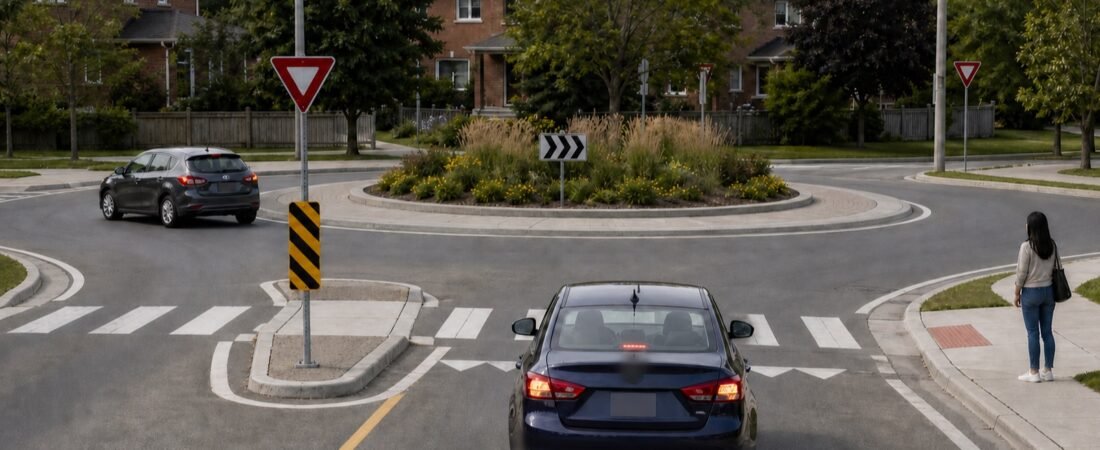
A roundabout can feel busy because the driver has to read signs, choose a lane, watch the crosswalk, judge a gap and find the correct exit in a short time. For learner drivers in Scarborough, the answer is not to rush. Use one repeatable sequence: plan before the yield line, give way to traffic already circulating, hold your lane and signal your exit.
Roundabout or Traffic Circle: What Is the Difference?
The terms are sometimes used as if they mean the same thing, but Ontario’s Official MTO Driver’s Handbook distinguishes modern roundabouts from older traffic circles. A modern roundabout is designed with a smaller centre island and entry features that reduce vehicle speed. Older traffic circles are generally larger and can involve more merging and weaving.
For a driver, the practical rule at a modern roundabout is simple: vehicles already circulating have priority over vehicles trying to enter. Do not apply the arrival-order routine used at an all-way stop. If you want to review that separate situation, see SparkOn’s guide to four-way stops in Scarborough.
Step 1: Read the Signs and Choose Your Lane Early
Start planning well before the yield line. Look for the roundabout warning sign, destination signs, lane-use arrows and pavement markings. The MTO handbook says to choose your lane as you would at another intersection and to follow the signs provided at the actual roundabout.
On a typical two-lane approach, the handbook gives this general pattern:
- Turning right: use the right lane.
- Going straight: either lane may be available, subject to signs and markings.
- Turning left: use the left lane; do not enter from the right lane to turn left.
The signs at the intersection control your choice, so do not treat the general pattern as permission to ignore a lane arrow. Complete any needed lane change before the roundabout. A last-second move near the splitter island leaves less time to check traffic and creates doubt for the driver beside you. SparkOn’s Ontario lane-change routine can help you practise earlier, calmer positioning.
Step 2: Slow Down, Check the Crosswalk and Yield Left
Reduce speed on the approach. Scan the sidewalk and crosswalk before focusing on the circulating lane. If a person is crossing your entry, wait before the crosswalk and keep the pedestrian area clear.
At the yield line, look left for vehicles already in the roundabout. Ontario’s Highway Traffic Act rule for yield signs requires a driver to slow to a reasonable speed, stop if necessary and yield when traffic is close enough to create an immediate hazard. Enter only when there is a safe gap.
A yield sign does not automatically mean a full stop when the way is clearly open, but it does mean you must be prepared to stop. Avoid rolling forward while staring only to the left; a cyclist or pedestrian may be approaching the crossing from the other direction.
Step 3: Enter Counter-Clockwise and Hold Your Lane
All vehicle traffic moves to the right of the centre island, counter-clockwise. Once you enter, follow the curve at a controlled speed and maintain your lane. Do not straighten the circle by clipping lane markings, and do not change lanes beside another vehicle.
In a multi-lane roundabout, keep the same relative position you established at entry. The MTO says a driver who entered from the left lane should stay left, while a driver who entered from the right lane should stay right. Watch farther ahead than the vehicle directly in front so you can see braking, the next exit and any large vehicle occupying extra space.
Step 4: Signal Right and Exit Without Cutting Across
After you pass the exit immediately before yours, activate the right-turn signal. Continue checking the lane, the crosswalk at the exit and the movement of any vehicle beside you. Then leave through the lane that continues from your circulating lane.
If you are exiting from the left lane of a multi-lane roundabout, pay particular attention to a vehicle on your right that may continue around. Do not force your way across its path. If a driver beside you makes an unexpected movement, manage the immediate risk first rather than insisting on your intended exit.
What If You Miss Your Exit?
Keep circulating and take the exit the next time around. The MTO specifically tells drivers in the inside lane to continue around if they miss their exit. Never stop inside the roundabout, reverse or cut across another lane to rescue the turn. A missed exit costs a few seconds; an abrupt correction can create a conflict.
This is a useful lesson for nervous drivers: the safe decision does not have to be the shortest decision. If navigation instructions arrive too late, continue safely and let the route recalculate.
Pedestrians, Cyclists, Trucks and Emergency Vehicles
Pedestrians
Check the crossing twice: once before entering and again before exiting. Splitter islands may let a person cross one direction of traffic at a time, but the driver still has to see the person and yield where required. Ontario’s intersection guidance reminds drivers to scan sidewalks, paths and roadways, not just motor traffic.
Cyclists
The MTO says cyclists generally ride in the centre of the appropriate lane or dismount and use the roundabout as a pedestrian. Do not squeeze past a cyclist within the circle. Treat a cyclist occupying the lane as traffic, maintain space and wait for a safe opportunity after leaving the roundabout.
Large Vehicles
Trucks and buses may need extra width and may use a mountable apron beside the centre island. Do not drive alongside a large vehicle through the roundabout. Give it room on the approach and while it circulates, even if part of its movement crosses a lane line.
Emergency Vehicles
If an emergency vehicle approaches before you enter, pull to the right if possible and wait. If you are already in the roundabout, the MTO says to take your intended exit, travel beyond the traffic island and then pull over. Stopping inside the circle can block the emergency vehicle and other road users.
Common Roundabout Mistakes to Avoid
- Watching circulating traffic but missing a pedestrian at the entry crosswalk.
- Entering beside a vehicle that is already in the roundabout.
- Using the right approach lane for a left turn.
- Changing lanes within the roundabout or drifting across lane markings.
- Signalling too early, which can make another driver think you are taking an earlier exit.
- Stopping inside the roundabout to let an entering vehicle go.
- Trying to reverse or cut across lanes after missing an exit.
- Driving beside a truck or bus that needs extra turning space.
A Practice Checklist for Scarborough Learners
You do not need to memorize a supposed road-test route. Build habits that work at any signed roundabout in Ontario. During supervised practice or a structured road-test preparation lesson, ask your accompanying driver to watch whether you:
- recognized the warning and lane-use signs early;
- finished braking and lane selection before the yield line;
- checked the entry crosswalk before looking left;
- waited for a clearly safe gap in circulating traffic;
- held one lane and a steady speed through the circle;
- signalled right at the correct time;
- rechecked the exit crosswalk; and
- continued around calmly after a missed exit.
Start with a quiet, single-lane example when conditions are good, then progress to more complex layouts only when the basic sequence is consistent. The goal is not to enter quickly. It is to observe early enough that the correct gap and exit feel unhurried.
Practise Roundabouts With a Scarborough Instructor
SparkOn’s one-on-one driving lessons in Scarborough help G1, G2 and G drivers practise lane planning, yielding, pedestrian checks and calm decision-making at unfamiliar intersections.
Book a Scarborough driving lesson and tell us which intersection situations you want to practise.