
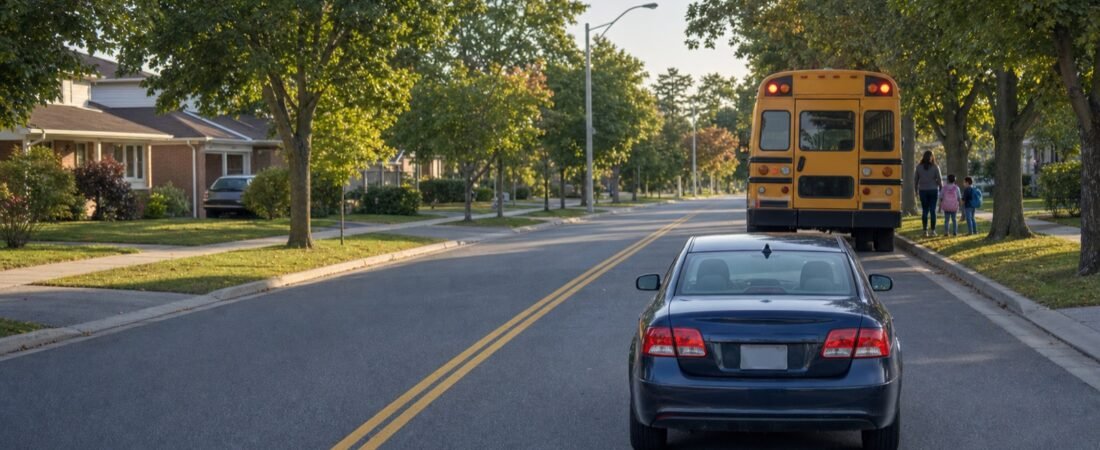
A slowing school bus can turn an ordinary Scarborough drive into a high-stakes decision. New drivers need to recognize the warning-light sequence, know whether traffic in both directions must stop, and leave enough space for children who may be difficult to see. This guide turns Ontario’s rules into a calm routine you can use on residential streets and wider multi-lane roads.
Amber Lights and Red Lights Mean Different Things
Ontario school buses use amber and red warning lights to give drivers time to react. According to Ontario’s school bus safety guidance, flashing overhead amber lights mean the bus is coming to a stop to pick up or drop off passengers. Slow down, check your mirror and prepare to stop whether you are behind the bus or approaching it from the front.
Once the bus is stopped, flashing overhead red lights or an activated stop arm mean you must stop when the rule applies to your side of the road. Do not try to squeeze past before the arm is fully extended. The amber phase is your warning to create the space and time needed for a smooth stop.
Avoid treating the bus like an ordinary vehicle signalling a curbside stop. Children may approach from a driveway, sidewalk or the opposite side of the road, and the bus can hide them from your view.
Who Must Stop on a Road Without a Median?
On a road with no physical median, drivers in both directions must stop for a stopped school bus when its overhead red lights are flashing or its stop arm is activated. That applies even if the road has several lanes or a painted centre line.
- Driving behind the bus: stop at least 20 metres back.
- Approaching the front of the bus: stop at a safe distance that gives children room to get on or off and cross.
- Driving in an adjacent lane in the same direction: stop; an extra lane is not permission to pass.
The Official MTO Driver’s Handbook says the school-bus law applies on any road, regardless of the number of lanes or the posted speed limit. A wide Scarborough arterial without a physical divider is still an undivided road for this rule.
What Changes When There Is a Physical Median?
A median is a physical strip or barrier separating traffic travelling in opposite directions. It can be raised, lowered, earth-filled or paved, but vehicles cannot cross over it. On a road divided by that kind of median:
- drivers travelling behind the bus in the same direction must stop; and
- drivers on the opposite side of the median are not required to stop.
A painted yellow line, a centre turning lane or extra road width is not the same as a physical median. If there is no constructed divider, use the no-median rule and expect traffic in both directions to stop.
Even when you are on the opposite side of a true median and are not required to stop, keep scanning. Other drivers may brake suddenly, and activity around the bus can be distracting.
How Far Back to Stop—and When to Move Again
If you are behind the school bus, Ontario requires you to stop at least 20 metres away. That space helps the bus driver monitor the area and gives children a larger safety buffer. Stop in your lane, keep the wheels straight and avoid creeping forward.
Remain stopped until the bus begins moving, its overhead red lights stop flashing and the stop arm is no longer activated. Before accelerating, scan the road edges and the space around the bus again. A child may have crossed but not yet reached the sidewalk, or another road user may move unexpectedly as traffic restarts.
If the bus is stopped just beyond an intersection, do not enter and block the intersection while waiting. Hold back where you can remain legally stopped, keep the crossing clear and preserve your view.
A Five-Step School-Bus Routine for Scarborough Drivers
- Recognize the bus early. Look well ahead for a chrome-yellow school bus slowing near the curb.
- Read the lights. Amber means slow and prepare; red lights or a stop arm mean stop when the rule applies to you.
- Check the road design. Decide whether there is a true physical median, not just paint or a centre lane.
- Stop smoothly and leave space. Check your rear-view mirror, brake progressively and stay at least 20 metres back when following the bus.
- Wait, rescan and restart gently. Confirm the bus is moving, the red lights are off and the arm is retracted, then check for children before proceeding.
This routine is especially useful when parked vehicles, trees or driveways make the sidewalk difficult to read. It also reinforces the observation habits in SparkOn’s guide to school zones and pedestrian crossovers in Ontario.
Common Mistakes to Avoid
- Passing during the amber phase: amber is a warning that the bus is about to stop, not an invitation to rush by.
- Stopping too close: a normal following gap is not enough; drivers behind must leave at least 20 metres.
- Assuming four lanes means divided: without a physical median, the stop requirement applies in both directions.
- Following the car ahead: make your own decision from the bus lights, stop arm and road design.
- Moving as soon as the arm starts folding: wait until the bus is moving, the red lights have stopped and the arm is no longer active.
- Watching only the bus: scan sidewalks, driveways, the road edge and your mirrors for children and other drivers.
Do Not Confuse a Railway Stop With a Passenger Stop
School buses must stop at railway crossings, but the MTO handbook notes that they do not use their upper alternating red lights for those stops. If you are following a school bus toward tracks, expect it to stop and leave extra room. Do not assume children are loading or unloading unless the red warning system or stop arm is active.
Practice Checklist for G1, G2 and G Drivers
Use this checklist during supervised practice or a refresher lesson:
- Did you notice the bus slowing before the warning lights changed?
- Did you check the mirror before braking?
- Could you correctly identify a physical median?
- Did you stop in your lane with a clear 20-metre buffer behind the bus?
- Did you scan both sidewalks instead of staring only at the warning lights?
- Did you wait for every restart cue and then accelerate smoothly?
If stopping distances still feel uncertain, review SparkOn’s Ontario following-distance guide. The school-bus rule sets a specific minimum distance; everyday following space still needs to grow when visibility or road conditions worsen.
Practise School-Bus Situations With a Scarborough Instructor
SparkOn’s one-on-one driving lessons in Scarborough help G1, G2 and G drivers practise early hazard recognition, smooth stops, road-design decisions and pedestrian scanning in real traffic.
Book a Scarborough driving lesson and ask to work on school zones, bus stops and safe following space.