
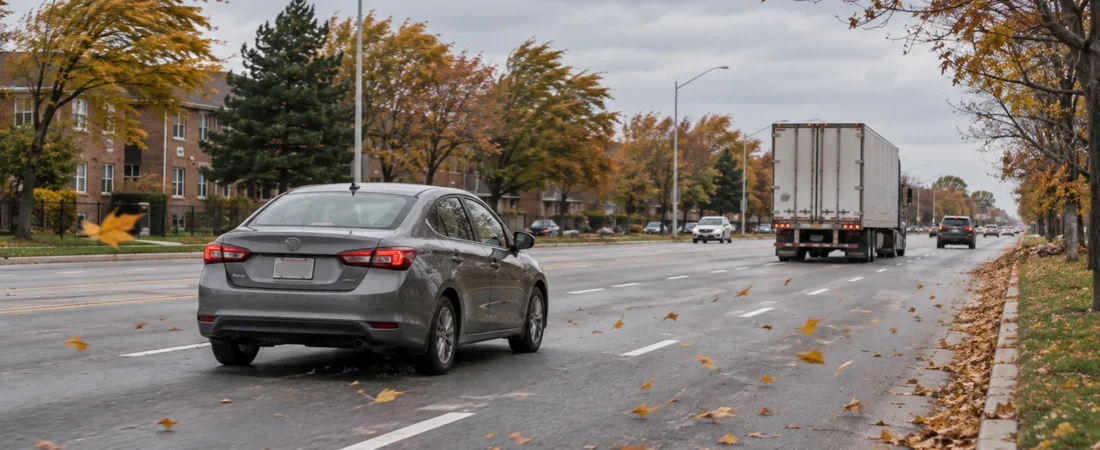
A windy day can make an ordinary Scarborough drive feel surprisingly busy. The car may drift within the lane, leaves can sweep across the road, and a passing truck can suddenly change the air pressure around you. The answer is not a tight grip or a sharp correction. It is a calmer routine: look farther ahead, create space and make small, smooth steering inputs.
This guide separates Ontario’s official safe-driving advice from the practical habits I recommend learners practise with an instructor.
What Ontario’s official guidance says
The Official MTO Driver’s Handbook tells drivers to steer smoothly and precisely, keep a cushion of space around the vehicle and avoid sudden lane changes. It also says the familiar two-second following distance is a minimum for ideal conditions; extra space is needed in bad weather and around large trucks.
The City of Toronto’s extreme-weather guidance notes that strong, gusty winds can create unsafe conditions for driving and can turn loose objects into hazards. Before a highway trip, Ontario 511 is the official place to check current highway incidents, closures, construction and weather-related conditions.
Those sources give the safety framework. The techniques below are practical instructor guidance for applying it on Scarborough roads; they are not special laws or road-test rules.
Why crosswinds catch learners by surprise
A headwind or tailwind acts mostly along the direction you are travelling. A crosswind pushes from the side. The push may be steady, but gusts are more difficult because their strength changes quickly.
You may notice the effect when you leave a protected residential block and enter an open stretch of road, cross a bridge, pass a gap between buildings or drive beside a large vehicle. On Highway 401, the combination of higher speed and open exposure can make a gust feel stronger than it did on a local street.
The common student mistake is waiting until the car has moved noticeably, then turning the wheel too far. When the gust eases, the car moves back the other way and the driver corrects again. That back-and-forth motion is an overcorrection cycle. Good wind control usually looks almost boring: eyes well ahead, both hands ready and tiny adjustments made early.
Use a steady steering routine
Start by sitting in a position that lets you reach the wheel without locking your elbows. If your arms are rigid, every small movement in your shoulders can become a steering input. Our seat and mirror setup guide explains a practical pre-drive position.
On the road:
- Look well ahead toward the centre of your lane rather than staring at the hood or the lane line beside you.
- Keep a relaxed, balanced hold on the wheel with both hands available.
- If the vehicle begins to drift, guide it back with one small input.
- As the gust eases, unwind that input smoothly instead of snapping the wheel straight.
- Keep scanning mirrors so you know whether another road user is beside you.
Do not try to “fight” every movement. A vehicle can move slightly within its lane without requiring a dramatic response. Your job is to preserve a stable path and stay comfortably inside the lane markings.
Create more room before the wind creates a problem
Space gives you time to notice a gust and respond without rushing. Increase your following distance beyond the normal minimum when conditions are unsettled. Avoid sitting beside another vehicle when you could safely move ahead or drop back without speeding.
This matters especially around transport trucks and buses. A large vehicle can block the crosswind briefly. When you emerge from its shelter, the wind may push your car again. Do not linger beside the truck, but do not rush past it either. Hold a lawful, steady speed, keep out of its blind spots and pass only when there is enough clear space. For more detail, read our guide to driving near large trucks in Scarborough.
On a multi-lane Scarborough road, also leave room for cyclists, motorcycles and pedestrians who may be affected by a gust. A blowing recycling bin, branch or piece of debris is another reason not to drive tightly beside parked cars or the curb.
Scarborough situations that deserve extra attention
Wind can feel different from one block to the next. Watch for clues rather than relying only on the weather app:
- treetops, flags or blowing leaves suddenly moving harder;
- an open area appearing beyond a row of buildings;
- a bridge, elevated ramp or exposed Highway 401 section;
- a large truck beginning to pass or being passed;
- cyclists leaning into the wind;
- bins, branches or construction materials near the roadway.
Long arterial roads such as Ellesmere, Sheppard, Finch and Kingston Road can alternate between sheltered and exposed sections. This is not a claim that one of these roads is always windier. It is a reminder that broad corridors, open lots and building gaps can change the conditions quickly.
If a gust makes you uncomfortable, ease off the accelerator smoothly and increase your space. Do not brake sharply unless the traffic situation requires it. A lower speed can give you more time, but it must still suit surrounding traffic and the posted limit. If conditions feel beyond your present skill, postpone the trip or turn into a safe parking area and reassess.
Common mistakes to correct in practice
Staring at the nearest lane line. This makes every small movement feel urgent. Shift your vision farther up the lane and use peripheral vision to monitor position.
Holding the wheel too tightly. Tension often produces jerky corrections. Keep control, but let your elbows stay slightly bent.
Driving beside a truck for too long. The changing airflow can surprise you, and the truck has large blind spots. Choose a safe position with clear space.
Using cruise control automatically. If gusts require frequent speed adjustments or the road is wet, take direct control of the accelerator and follow your vehicle owner’s manual. Cruise control is a convenience, not a substitute for active driving.
Swerving around debris. First reduce speed smoothly and check mirrors. A sudden swerve can create a larger danger than the object you are avoiding. If the lane is blocked, stop or change lanes only when your checks show it is safe.
Continuing because other drivers do. Another driver’s speed is not proof that conditions are suitable for you. The MTO’s core advice is to drive at a speed that lets you stop safely and to adjust for conditions.
A five-point windy-day checklist
Before moving, ask yourself:
- Are the doors, trunk and hood fully closed, and are loose items secured?
- Are the tires properly inflated according to the vehicle manufacturer’s label?
- Can I see clearly through every window and mirror?
- Have I checked the forecast and, for a highway trip, Ontario 511?
- Am I willing to delay the drive if warnings or conditions are severe?
During the drive, keep the routine short: eyes far ahead, both hands ready, extra space, small steering inputs, no rushed lane changes.
Practise the skill before a difficult day
You do not need extreme weather to learn steadier lane control. Begin on a quieter Scarborough road in mild wind, then add busier arterials as your steering and scanning become consistent. Highway practice should come only when your basic lane position, mirror checks and speed control are already dependable. Our Highway 401 merging guide can help you review the related routine.
If crosswinds, trucks or highway speeds make you tense, a focused lesson can break the situation into manageable steps. SparkOn offers driving lessons in Scarborough and highway driving lessons built around your current level. Book a Scarborough lesson and ask to work specifically on steady lane position, safe spacing and calm corrections in real traffic.