
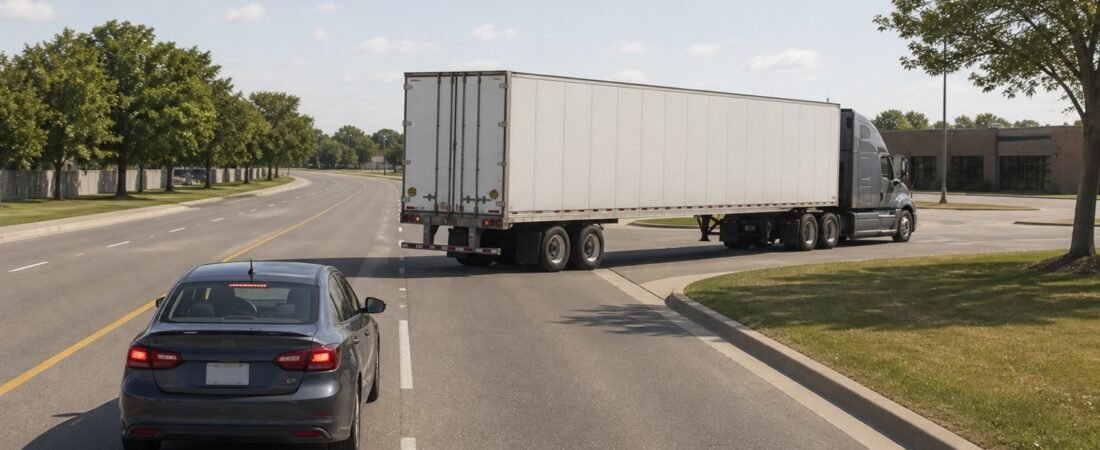
A transport truck may share the same lane markings as your car, but it cannot move, stop or see the road in the same way. On Scarborough arterials and Highway 401, safer driving around a large truck comes down to one practical idea: give the driver space to see you and space to complete the manoeuvre.
This guide helps G1, G2 and G drivers recognize truck blind spots, wide turns and stopping needs. It is designed for everyday practice and driving lessons in Scarborough, not for memorizing a road-test route.
Why a truck needs different space
The Official MTO Driver’s Handbook identifies several limitations of large commercial vehicles: extensive blind spots, longer stopping distance, wide turns, possible rollback after a stop, heavy spray in bad weather and air turbulence while being passed.
These are not reasons to panic or avoid every truck. They are reasons to keep your decisions visible and predictable. Do not hover beside a trailer, follow so closely that you lose your view, or use the open space beside a turning truck as an extra lane.
Understand the truck’s blind spots
A tractor-trailer has large areas beside and behind it that its driver may not be able to see. The MTO gives drivers of smaller vehicles a useful test: if you cannot see the truck driver’s face in the truck’s side mirror, assume the driver cannot see you.
Use that idea as a warning, not as permission to stare at the mirror. Keep scanning ahead and around your own car. If you find yourself alongside the cab, trailer or directly behind it for too long, adjust your speed when safe to create a clearer position.
- Beside the cab: do not match the truck’s speed and remain hidden.
- Along the trailer: avoid staying there when traffic ahead could close your escape space.
- Directly behind: increase your gap so you can see farther ahead and the truck driver has a better chance of seeing you.
- Immediately in front: do not merge back so closely that you remove the truck’s stopping cushion.
Before moving around any truck, use the full mirror-signal-shoulder-check routine from SparkOn’s Ontario lane-change guide. Blind-spot monitoring can assist you, but it does not replace a direct check; see SparkOn’s guide to driver-assistance technology and shoulder checks.
Never enter the space beside a wide turn
A large truck turning right may first move left to create enough room for the trailer to clear the curb. That left movement does not mean the truck has abandoned the right lane. The trailer will track back toward the curb as the turn continues.
If a truck ahead signals right and opens space on its right side, stay back. Do not drive into the gap between the trailer and the curb. The MTO warns that a smaller vehicle in this space can be squeezed as the trailer completes the turn.
The same patience matters when a truck uses extra space for a left turn or navigates a tight driveway. Read the signal, watch the whole vehicle and wait until the trailer has completely cleared your lane before proceeding. This habit also strengthens the patient observation needed for unprotected left turns in Scarborough.
Leave extra following distance
Following closely behind a truck creates two problems. The truck may hide slowing traffic, a signal or a hazard ahead, and the truck driver may not see your car. Increase your time-based gap so you can see more of the road and respond smoothly.
The MTO says the familiar two-second following distance is a minimum for ideal conditions and that drivers need extra space in situations such as following large trucks or driving in bad weather. SparkOn’s following-distance guide explains how to measure the gap with a fixed roadside point.
When stopped behind a truck, leave useful space rather than resting close to its rear bumper. A large vehicle can roll backward as it begins moving. The extra room also improves your view and gives you options if traffic changes.
Pass with a plan, not a burst of speed
Before passing on a multi-lane road, confirm that there is enough clear space ahead to finish the manoeuvre without exceeding the speed limit or cutting in. Signal, check mirrors and blind spot, then move smoothly into the passing lane.
Avoid lingering beside the trailer. Continue at a legal, steady speed and keep both hands settled on the wheel. A truck can create air turbulence as you pass; hold your lane without steering sharply toward or away from it.
Return only when you can see the entire front of the truck in your rear-view mirror and have a generous gap. Signal and move over gradually. Cutting closely in front removes the stopping space the truck needs and may force its driver to brake.
Be careful around trucks on Highway 401
On a freeway, a truck can block your view of traffic well ahead. Ontario’s freeway-driving guidance tells drivers to stay clear of large vehicles, leave space around their cars and keep scanning frequently.
When entering Highway 401, avoid planning a merge that ends beside a truck. Use the acceleration lane to adjust your position toward a gap ahead of or behind it. Do not expect the truck driver to change lanes for you. SparkOn’s Highway 401 merging guide provides a step-by-step entrance and exit routine.
If a truck is entering from a ramp while you are already on the freeway, identify the developing conflict early. Maintain a predictable speed or create space with a safe lane change when conditions allow. Sudden braking or matching the truck’s position beside the merge area makes the problem harder for everyone.
Rain, spray and reduced visibility
Truck tires can throw enough water, slush or debris to cover a windshield temporarily. In rain, increase your following distance before the spray becomes heavy, keep the wipers and lights working, and avoid passing unless you can see a clear path through the spray.
If visibility suddenly drops, hold the wheel steadily, ease off the accelerator and avoid an abrupt lane change. Build these habits with SparkOn’s guide to heavy-rain driving in Scarborough.
Common mistakes to replace
- “The truck moved left, so the right side is open.” Check its signal and stay out of the wide-turn space.
- “The driver must see me.” Assume you are hidden if you cannot see the driver in the side mirror.
- “I will merge back as soon as my bumper clears.” Leave a generous stopping cushion in front of the truck.
- “Following closely helps me draft through traffic.” Increase the gap so you can see and be seen.
- “I need to escape the spray immediately.” Keep control, adjust smoothly and change lanes only after checking.
Scarborough truck-safety checklist
During your next supervised drive, ask:
- Can I see enough road beyond the truck?
- Am I staying out of the long side and rear blind spots?
- Have I left extra space behind and when merging in front?
- Is the truck signalling or positioning for a wide turn?
- Can I complete a pass without lingering beside the trailer?
- Could spray, turbulence or a ramp change the situation?
- Would waiting a few seconds give the truck room to finish safely?
Good truck awareness is a form of defensive driving: you recognize the larger vehicle’s limits early and keep your own actions easy to understand. A SparkOn instructor can help you practise that observation and spacing on Scarborough arterials or, when appropriate for your licence and experience, Highway 401.
Want focused local practice? Explore road-test preparation or contact SparkOn Driving Academy to book a Scarborough driving lesson.