
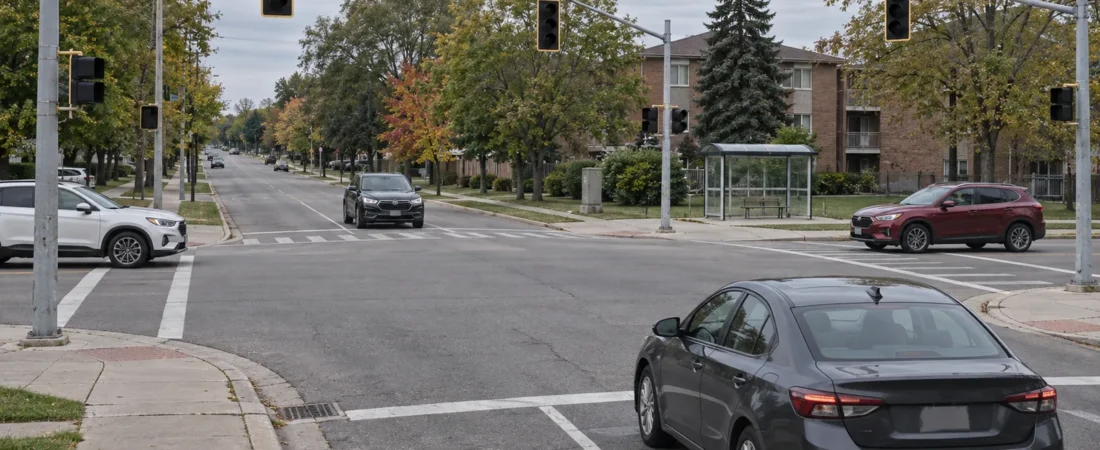
A completely dark traffic signal can catch you off guard. There is no red, yellow or green to organize the intersection, several lanes may arrive at once, and pedestrians may be unsure whether drivers have seen them. This is exactly when a calm, predictable routine matters.
Ontario and the City of Toronto give clear guidance: treat the dark signalized intersection like an all-way stop. The difficult part is applying that rule when the intersection is wide, traffic is heavy or other drivers are impatient.
The official Ontario and Toronto rules
The Official MTO Driver’s Handbook says that during a power loss, blank traffic lights should be handled the same way as an intersection with all-way stop signs. Drivers must yield to vehicles already in the intersection and to vehicles entering from their right, then proceed cautiously.
The City of Toronto’s signal power-outage guidance adds the familiar all-way-stop order:
- the first vehicle to make a complete stop goes first;
- if two vehicles stop at the same time, the vehicle on the right goes first;
- if two vehicles facing each other stop at about the same time, a driver turning left yields to the driver going straight;
- all vehicles yield to pedestrians;
- the outage should be reported to 311.
These are the official rules. The routines below are practical instructor guidance for reading the situation and communicating clearly; they do not replace directions from a police officer or other authorized traffic controller.
Spot the outage before you reach the stop line
Look beyond the vehicle directly ahead. A row of dark signal heads, stopped traffic in every direction or inactive pedestrian displays are early clues. Begin easing off the accelerator and check your rear-view mirror so your slowing does not surprise the driver behind.
Do not assume the signal is green simply because the car ahead continues. That driver may not have noticed the outage. Also check whether temporary stop signs, a police officer or a traffic-control person is directing movement. Their directions can change what you should do.
At night or in poor weather, a dark intersection can blend into the background. Reduce speed early enough to find the stop line, crosswalk and lane markings without a last-second brake application.
Make a real stop in the correct place
Treat the intersection as though every approach has a stop sign. Come to a complete stop at the marked stop line. If the line is faded or covered, stop before the crosswalk. Keep the crosswalk open for people walking, using mobility devices or cycling across the intersection.
A rolling stop makes the situation harder for everyone. Other drivers cannot tell whether you intend to yield or continue. A full stop gives you a moment to identify who arrived first and whether a pedestrian is entering.
If several cars are queued in your lane, your turn is not automatically linked to the car ahead. Stop again when you reach the line. The next vehicle in every approach needs a clear opportunity to reassess the order.
Decide who goes next
Start with vehicles already inside the intersection. Let them clear. Then consider the stopped vehicles at the approaches.
If you clearly stopped first, you normally proceed first after yielding to pedestrians. If another driver stopped first, let that driver go. When arrivals are simultaneous, yield to the vehicle on your right.
Drivers facing each other can sometimes proceed straight at the same time if their paths do not conflict. If one driver is turning left, that driver yields to the one travelling straight. Do not force a simultaneous movement when the lanes, visibility or another road user make it uncertain.
At a large Scarborough intersection, it may be difficult to remember the order of several vehicles. Focus on the vehicles whose paths can cross yours rather than trying to track every car in every queue. If you are genuinely unsure, let the other driver go. A brief delay is safer than competing for the same space.
Our four-way-stop guide explains the arrival-order routine in more detail.
Make your intention easy to read
Signal every turn. Hold your lane position and avoid creeping far into the intersection while another vehicle is moving. When your turn arrives, scan left, centre, right and left again, check for pedestrians, then proceed smoothly.
Do not wave another driver through unless you are certain all other lanes are also safe. Your hand gesture cannot guarantee that a vehicle approaching from another direction will stop. It is better to follow the established order and use normal signals.
Eye contact can help confirm that another driver or pedestrian has seen you, but it is not a substitute for yielding. Tinted glass, rain and darkness can make eye contact impossible. Judge the other vehicle’s position and movement, not only the driver’s face.
Watch carefully for pedestrians and cyclists
Pedestrian signal displays may be dark during the same outage. People may hesitate, or they may begin crossing because traffic appears stopped. The City’s rule is clear: vehicles yield to pedestrians.
Before turning right, check the sidewalk and your right blind spot. Before turning left, scan the far crosswalk as well as oncoming traffic. A person can be hidden behind a stopped SUV, truck or bus.
Cyclists using the roadway follow the same intersection controls, but they can be harder to see among stopped vehicles. Leave room and do not try to pass a cyclist while both of you are entering the dark intersection. Review our guide to driving near cyclists in Scarborough for the related scanning routine.
Dark, flashing red and flashing yellow are different
A completely blank signal is treated as an all-way stop. A flashing red signal also requires a complete stop, followed by movement only when safe. A flashing yellow signal means approach and proceed with caution; it is not the same as a stop signal.
Some intersections may display flashing red in one direction and flashing yellow in the other. Read the signal facing your lane and respond to that indication. Do not copy what cross traffic is doing.
Our yellow-light guide covers steady yellow signals, which are different again.
Common mistakes during a signal outage
Following the vehicle ahead without stopping. Each driver must reach the line, stop and reassess.
Assuming the wider road has priority. A dark signalized intersection is handled as an all-way stop, not as though the major road automatically goes first.
Stopping inside the crosswalk. This blocks the safest walking path and makes pedestrians less visible.
Entering because another driver waved. Check every conflicting lane yourself.
Turning left with a straight-through vehicle opposite. When you arrive at about the same time, the left-turning driver yields.
Using the horn to claim a turn. Noise does not establish right-of-way and can add confusion.
Reporting the outage while driving. Wait until you are safely parked before contacting 311 or asking a passenger to report it.
A short dark-intersection checklist
Use this order:
- Slow early and identify the stop line.
- Stop completely before the crosswalk.
- Yield to anyone already in the intersection.
- Identify who stopped first and check the vehicle on your right.
- Yield to pedestrians and scan for cyclists.
- Signal, recheck every conflicting path and proceed smoothly.
- Report the malfunction to 311 only when safely parked.
The City’s traffic-signal service page confirms that damaged or malfunctioning vehicle, pedestrian and transit signals can be reported to 311.
Build the judgment before an outage happens
You cannot schedule a power failure for a lesson, but you can practise the skills it requires: full stops, arrival order, right-of-way decisions, pedestrian scanning and clear signals. Those habits make a dark intersection much less intimidating.
SparkOn offers driving lessons in Scarborough for learners who want more confidence at busy intersections. Book a Scarborough lesson and ask to focus on all-way stops, right-of-way judgment and calm decision-making when normal traffic controls are disrupted.