
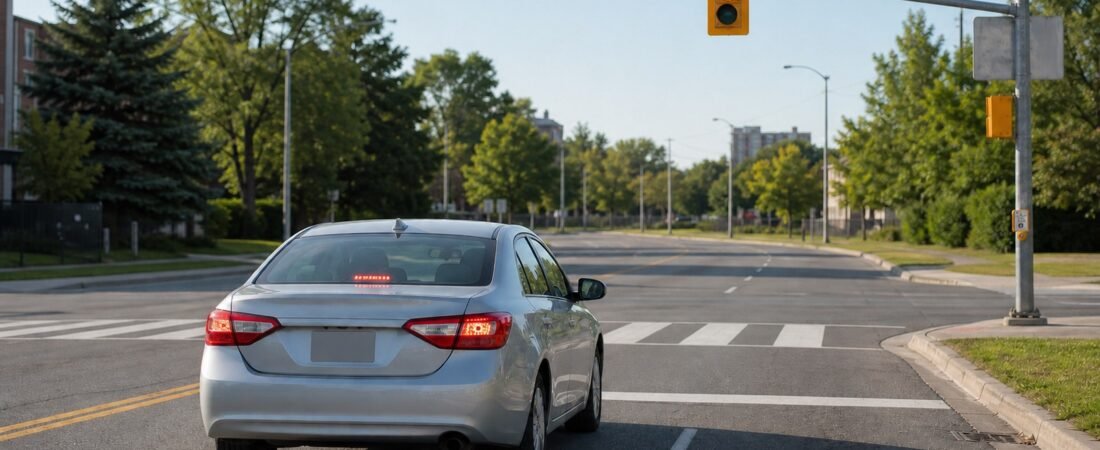
A yellow traffic light creates a short decision, but the rule is straightforward: stop if you can do so safely; otherwise continue through with caution. The hard part for a new driver is recognizing the signal early enough to make that decision calmly. On busy Scarborough roads, good scanning, following space and speed control make the difference between a smooth stop and a rushed reaction.
What a solid yellow light means in Ontario
The Official MTO Driver’s Handbook traffic-light guide, updated March 31, 2026, says a yellow—or amber—light means the red light is about to appear. You must stop if you can do so safely. If you cannot stop safely, continue with caution.
A yellow light is not permission to accelerate and “beat” the red. It is also not an instruction to make an emergency stop regardless of the traffic behind you. Your decision should be based on what the vehicle can do safely at that moment, using the road, weather, speed and traffic conditions you actually face.
Once you decide, be predictable. Brake smoothly toward a stop or continue steadily while scanning the intersection. Hesitating between the two choices—braking hard, releasing the brake, then accelerating—makes your movement harder for other road users to understand.
Treat a stale green as an early warning
A “stale green” is simply a green light that has been visible for a while. You do not know exactly when it will change, so it should remind you to prepare rather than guess.
The MTO’s driving-through-intersections guidance tells drivers to be prepared to stop when a light has been green for a while. If you are already so close that you cannot stop safely when it changes, drive through with caution.
As you approach a stale green:
- look well ahead and identify the stop line and crosswalk;
- check the sidewalks, turning lanes and vehicles waiting on the cross street;
- glance in the rear-view mirror so you know what is behind you;
- keep a useful gap from the vehicle ahead; and
- be ready to move your right foot smoothly from the accelerator to the brake.
This is preparation, not automatic slowing at every green light. Maintain a legal, appropriate speed while creating enough attention and space to respond smoothly.
Make the stop-or-continue decision before panic takes over
There is no single fixed distance that answers every yellow-light situation. A car on dry level pavement at a modest speed does not stop the same way as a vehicle travelling faster, going downhill or driving in rain. Tire condition, following traffic and the distance to the stop line also matter.
Ask one practical question: Can I stop smoothly before the correct stopping position without creating a new danger? If yes, check the mirror and brake firmly and evenly. If no, do not slam on the brakes or speed up. Hold a controlled path, continue cautiously and keep scanning for pedestrians, cyclists and turning traffic.
Better following distance gives you more options. If you are too close to the vehicle ahead, you may not see the signal early and may copy that driver’s choice without having the same amount of space.
Stop at the correct place
If you stop for the yellow, aim to finish before the marked stop line. The MTO’s official stopping guidance explains the order when a red-light stop is required: stop at the stop line; if there is none, stop at the crosswalk; if neither is present, stop at the sidewalk edge or, where there is no sidewalk, at the edge of the intersection.
Do not roll across the stop line while deciding. Start braking early enough to finish smoothly, keep the wheels straight and hold the brake once stopped. If you have already passed the line before stopping, do not reverse into a crosswalk. Stay stopped and avoid creating a second conflict.
Review SparkOn’s Ontario pavement-marking guide if stop lines, crosswalks and lane arrows still blend together when you approach an intersection.
If you are already in the intersection, clear it safely
A driver already lawfully inside the intersection may see the light change while completing a turn. The MTO handbook says that if the light turns red while you are in the intersection waiting to turn left, complete the turn when it is safe.
Do not rush across the path of an oncoming vehicle because the signal changed. Watch for opposing traffic that may continue through the yellow, then finish the turn calmly once the path is clear. Also recheck the crosswalk before entering it.
This situation is different from approaching the stop line after the signal has changed. SparkOn’s guide to unprotected left turns in Scarborough explains waiting position, gap selection and pedestrian checks in more detail.
Know the difference between a yellow circle, arrow and flashing light
These yellow signals do not all give the same instruction:
- Solid circular yellow: the red signal is about to appear; stop if you can do so safely, otherwise proceed cautiously.
- Solid yellow arrow: the protected turn phase is ending. Do not begin the protected turn; stop if you can safely do so, or complete the movement cautiously if you are already committed.
- Flashing yellow: proceed with caution. It is a warning signal, not the same sequence as a solid yellow changing to red.
Look at the signal controlling your lane. On wider Scarborough intersections, a left-turn signal may change while through traffic still faces a different indication. Lane arrows and signal placement help show which movement each light controls.
Adjust the decision for Scarborough conditions
On a multi-lane arterial, scan far enough ahead to see the signal before the vehicle in front blocks it. Near plazas and bus stops, expect pedestrians to approach the crosswalk late and vehicles to turn from driveways. On downhill approaches, manage speed early rather than depending on a sharp final brake application.
Rain changes the decision too. Reduce speed, increase following space and begin observations sooner because traction and visibility may be worse. SparkOn’s heavy-rain driving guide covers visibility, hydroplaning and smoother control.
At night, signal distance can be harder to judge and glare may hide pedestrians or lane markings. Keep the windshield clear, avoid staring directly at bright lights and use the same early scanning routine.
Avoid these common yellow-light mistakes
- Accelerating automatically: speed removes stopping options and shortens observation time.
- Braking without a mirror check: you still need awareness of following traffic, even when stopping is the correct choice.
- Copying the vehicle ahead: its distance, speed and visibility are not identical to yours.
- Watching only the signal: intersections also contain pedestrians, cyclists and turning vehicles.
- Changing lanes to avoid stopping: a sudden lane change near an intersection adds blind-spot and side-conflict risk.
- Entering a blocked intersection: a green or yellow light does not create space on the far side.
- Rushing a left turn: the signal change does not remove the need to yield to oncoming traffic and people crossing.
Your yellow-light practice checklist
During a supervised lesson, use this short routine at every signalized intersection:
- Identify the signal and stop line early.
- Decide whether the green is fresh or has been visible for a while.
- Scan left, ahead and right for developing conflicts.
- Check the rear-view mirror before planned braking.
- Keep enough following space to see and respond independently.
- If yellow appears, choose a smooth stop or cautious continuation—never a race.
- Keep scanning through the intersection until you are fully clear.
Ask your accompanying driver or instructor to discuss the decision after the intersection, not while you are making it. Calm feedback helps you understand what you saw without distracting you during the highest-workload moment.
Practise calm intersection decisions in Scarborough
Yellow-light judgement improves when you combine early scanning, stable speed and smooth braking. A SparkOn instructor can help you recognize stale greens, choose the correct stopping point and practise busy-intersection observation without inventing shortcuts or memorizing a road-test route.
Explore driving lessons in Scarborough or contact SparkOn Driving Academy to book focused G1, G2 or G preparation.