
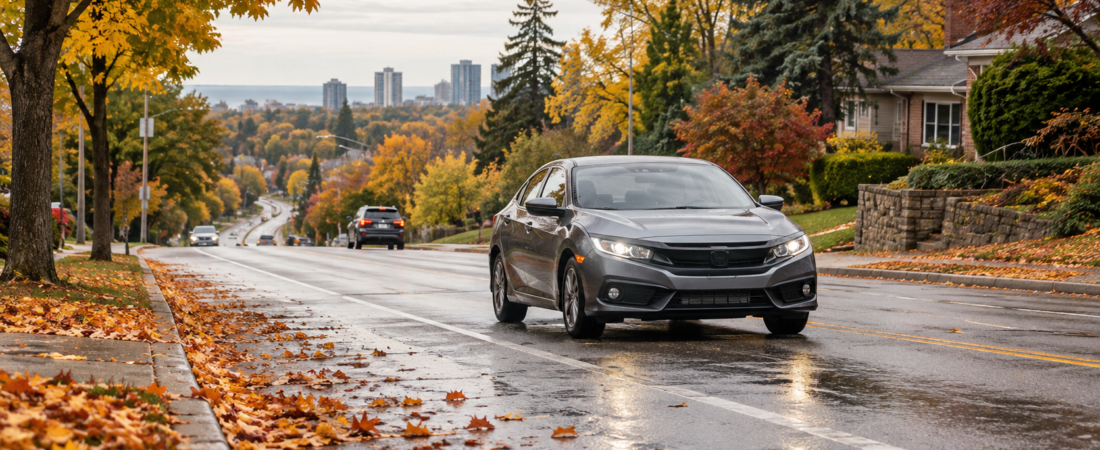
Fall driving in Scarborough can look easy: clear skies, dry-looking pavement and a familiar route. Then a shaded corner, a pile of wet leaves and a quick brake change the picture. Leaves are not a special driving “rule” in Ontario, but they can hide a slippery surface and reduce the grip you are counting on. The safest response is simple: see the change early, slow before it, and keep your steering, braking and acceleration smooth.
Why wet leaves deserve your attention
A thin layer of leaves can hold water against the pavement and cover markings, potholes or a change in road texture. The Official MTO Driver’s Handbook explains that wet roads reduce tire contact and that skids are often linked to driving too fast for the conditions. The handbook’s practical advice applies here: reduce speed, look ahead and use the controls gently.
In Scarborough, you may meet leaf cover beside a curb on a tree-lined residential street, at the bottom of a hill near a ravine, or where runoff collects at an intersection. You do not need to panic or swerve around every leaf. You do need to treat a broad, shiny patch as a reason to create more time and space.
Spot the change before you arrive
Good scanning gives you options. Look well beyond the vehicle in front of you and check the lane surface as you approach a bend, stop line or crosswalk. A dark, glossy patch, a fan of leaves pushed toward the gutter, or a line of standing water is a useful warning. The City of Toronto notes that leaves on roads and sidewalks can create safety hazards and contribute to localized flooding, so leaf buildup is a real road-condition issue, not just a cosmetic one.
On a route such as Kingston Road or a busy stretch near the Scarborough Bluffs, traffic may prevent you from choosing a perfect line. That is fine. Your job is to reduce speed early, hold a steady lane position and avoid making a last-second move around the patch.
Brake before the slippery section
One common student mistake is waiting until the front tires are on the leaves and then pressing the brake hard. That asks the tires to slow the car while they are already managing reduced grip. Instead, check your mirrors, ease off the accelerator and do most of your speed adjustment on the clearer pavement before the leaf cover.
Keep a comfortable following gap so you can brake progressively. If the car ahead stops suddenly, you want time to respond without a panic input. The MTO handbook also recommends leaving more space in wet conditions and avoiding cruise control on wet or slippery roads. These are official safe-driving recommendations; the exact speed you choose remains a judgment based on visibility, traffic and the road surface.
Keep steering quiet through a leaf patch
New drivers sometimes make a sharp steering correction because they want to put every tire on bare pavement. That can be more dangerous than driving smoothly over a narrow patch. Keep both hands steady, look where you want the vehicle to go and make only a gentle adjustment when you have a clear, legal path.
Do not cross into an oncoming lane, bike lane or shoulder just to avoid leaves. If the clear path is not available, slow down and stay predictable. A predictable car gives the driver behind you and nearby cyclists a better chance to read what you are doing.
Take extra care on hills and curves
Gravity and a change of direction both use tire grip. On a downhill curve, set your speed before the turn, then use light, steady steering. Avoid braking hard in the middle of the bend. On an uphill approach, do not rush the throttle when the road surface changes; a smooth input keeps the car balanced.
This is especially useful on Scarborough’s rolling residential streets. A familiar hill can feel harmless in summer, but a wet leaf layer near the bottom can hide a puddle or drain. Look through the turn, check for pedestrians and parked-car doors, and leave yourself room to stop.
Paint, metal and leaves can change the feel
Wet leaves often collect beside painted lane lines, crosswalk bars and metal utility covers. These surfaces can feel different from clean asphalt when wet. Do not accelerate, brake or turn sharply while crossing them. Line up the vehicle early, keep your input smooth and continue scanning after the patch rather than staring at it.
If visibility is poor, turn on the appropriate lights and make sure your windshield stays clear. The MTO’s vehicle-maintenance guidance says drivers should keep lighting, windows and tires in safe condition. Before a fall lesson, check that the wipers clean without streaking and that the tires have usable tread and correct pressure according to the vehicle maker.
Common student mistakes I correct in lessons
- Looking only at the car ahead: Scan the surface and the next decision point, not just the bumper in front of you.
- Braking late: Lift off early and build your stop before the leaf cover.
- Over-correcting the wheel: Stay in your lane and make small, deliberate inputs.
- Following too closely: Add space so a normal stop does not become an emergency stop.
- Using cruise control in slippery conditions: Keep direct control of the accelerator.
- Ignoring the curb side: Leaves can hide puddles, drainage grates, debris or a person stepping out between parked cars.
A simple wet-leaf routine
- See it: Look for shiny pavement, leaf fans, puddles and covered markings.
- Set the speed: Ease off early and brake while the tires are on the clearer surface.
- Choose a line: Stay in your lane; avoid a sudden swerve.
- Stay smooth: Gentle steering, braking and acceleration through the patch.
- Re-check: After the patch, look for pedestrians, cyclists, parked cars and the next change in surface.
When a skid starts
If the car begins to slide, do not freeze or jerk the wheel. Ease off the accelerator and brake, look in the direction you want to travel and steer gently that way. The MTO handbook explains that oversteering can make a skid worse and that control should be regained before braking as needed. If a skid feels beyond your control, prioritize staying in your lane and avoiding other road users.
This is a skill to practise with an instructor in a safe setting, not something to test beside traffic. My smooth and emergency braking lesson approach is to build the habit of looking ahead and applying the brake firmly but progressively when the road and situation require it.
Use fall conditions as a learning opportunity
You do not need to avoid driving until every leaf is gone. You need a plan that matches the conditions. Before leaving, check the forecast, allow more time and make sure the windshield, lights and tires are ready. During the drive, reduce speed when visibility or grip changes, and remember that a posted limit is a maximum for ideal conditions—not a target you must maintain.
If you are preparing for a G2 or G road test, an examiner is looking for controlled, legal decisions. Wet leaves are a chance to demonstrate observation, speed management, lane discipline and smooth control—not to prove that you can squeeze through a tight gap.
Practise this in Scarborough
During a Scarborough driving lesson, we can work on the exact sequence: scan the surface, choose a safe speed, manage the turn and check for people near parked cars. We can also connect it to your usual route, whether you are leaving a residential street for a busier arterial or approaching a hill near the Bluffs.
For more seasonal preparation, review our winter tire and washer-fluid checklist before temperatures drop. When you are ready to practise fall traction and braking with calm, practical coaching, contact SparkOn Driving Academy to book a lesson in Scarborough.
Official references
For the rule-based foundation, read the MTO section on bad weather and skids, the MTO vehicle-maintenance section, and the City of Toronto leaf-maintenance information. Always follow current signs, the Highway Traffic Act and the conditions you can actually see.