
Last verified: October 2, 2026.
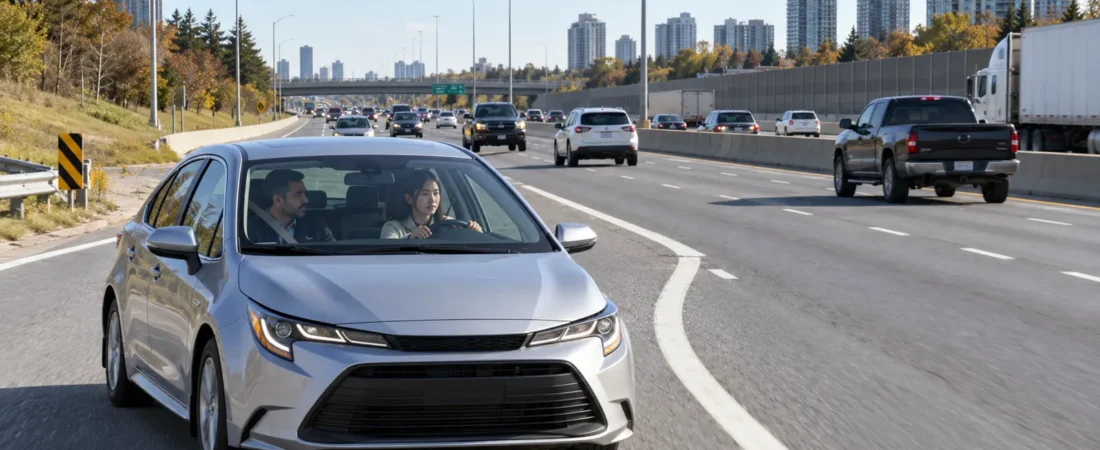
The Ontario G road test is where you show that your everyday driving habits still hold together on major roads and an expressway. The goal is not to impress an examiner with aggressive confidence. It is to make safe, timely decisions while traffic, speed and directions change around you.
If you are preparing in Scarborough, that means becoming comfortable with busy multi-lane roads as well as freeway entries and exits. This guide explains the official test scope, then turns it into a practical practice plan. It does not describe or promise a test route. Routes, examiner directions, traffic, construction and test procedures can change.
What the Ontario G road test currently covers
Ontario’s Official MTO Driver’s Handbook calls this the Level Two road test. It assesses advanced skills that normally come with experience. The current handbook says the G test still includes major-road and expressway driving, including merging on and off, speed and space management and signalling. It also includes turns, curves, lane changes, intersections and business areas.
Ontario also says that, until further notice, the G test does not include parallel parking, a roadside stop, a three-point turn or driving in residential neighbourhoods because those elements are covered on the G2 test. That is a current test-format note, not a reason to stop practising those skills for normal driving. Always recheck the official page before your appointment because the temporary format can change.
You will receive directions from the examiner. Your job is to follow when it is safe and legal. Missing a direction is not a reason to make a sudden or unsafe move. Continue safely and listen for the next instruction.
The highway-experience declaration matters
Before the expressway portion, the official handbook says you must complete and sign a Declaration of Highway Driving Experience. It asks how many times during the previous three months you have driven on a freeway and/or a highway with a speed limit of at least 80 km/h, and the average length of those trips.
Freeways listed by Ontario include Highway 401 and the Don Valley Parkway, along with other 400-series highways and named expressways. Give accurate information. If you do not have enough highway-driving experience, the handbook says the examiner must declare the test out of order and cancel it, with 50 per cent of the prepaid road-test fee lost.
Practical advice: do not treat two last-minute freeway trips as complete preparation. Build experience across lighter and busier traffic, while keeping every practice drive within the conditions of your licence. If you still need a structured starting point, use our Highway 401 merging guide before supervised practice.
Highway entry: prepare before the lane runs out
The MTO separates a freeway entry into the ramp, acceleration lane and merge. On the ramp, control the curve and look ahead. Once you can see freeway traffic, divide your attention between the road ahead, mirrors and the blind spot. In the acceleration lane, increase speed to match the traffic flow, signal where freeway drivers can see you, choose a usable gap and merge gradually into the centre of the nearest lane.
A common student mistake is looking over the shoulder for too long. The vehicle then drifts or gets too close to the car ahead. Make the blind-spot check brief, return your eyes forward, and repeat it if the situation changes. Another mistake is arriving at the end of the acceleration lane far below traffic speed. That makes the gap harder to use. Build speed progressively when road, weather and traffic conditions allow.
The signal communicates your plan; it does not create a right-of-way. Do not force another driver to brake. At the same time, avoid stopping in the acceleration lane unless traffic or an emergency leaves no safe alternative. Good merging is a planned blend, not a last-second lane change.
Highway driving: make observation visible and useful
Once you are on the expressway, settle at an appropriate legal speed, maintain space and continue scanning. The official test guide tells drivers to check mirrors every five to ten seconds, look 12 to 15 seconds ahead and keep at least a two- to three-second following distance. Increase space when weather, visibility or traffic calls for it.
Do not perform mirror checks as a head-moving routine while missing what the mirrors show. Each check should answer a question: Is someone closing behind me? Is a vehicle beside me? Is the gap changing? A smooth G-test drive comes from noticing changes early, before they require hard braking or abrupt steering.
Keep out of other vehicles’ blind spots when practical. Avoid sitting directly behind a large truck that blocks your view. If traffic compresses, ease off early and create room instead of repeatedly accelerating and braking. For a focused refresher, review our Ontario lane-change routine.
Lane changes without hesitation or rushing
A G-test lane change should show a clear sequence: assess the lane ahead, check the rearview and side mirror, signal, confirm the blind spot, move smoothly, centre the vehicle and cancel the signal. Keep a steady speed unless conditions require an adjustment.
Two opposite errors are common. Some learners move immediately after signalling, before confirming the space. Others wait so long that the original gap disappears and surrounding drivers no longer understand the plan. Practise recognizing a safe gap before the examiner asks for a lane change. Then the instruction becomes a normal decision, not an emergency.
If the lane is not safe, do not move. Keep control, leave the signal on only while the intention remains clear, and complete the change when a suitable space develops. Safety comes before satisfying a direction immediately.
Exiting: keep freeway speed until you are in the exit lane
The official handbook says to move into the exit lane at its beginning with a smooth, gradual movement. Signal before reaching it and check traffic, mirrors and the right blind spot where needed. Do not slow down before you are completely in the exit lane. Once you are in it, reduce speed progressively and follow the ramp’s curve and posted signs.
Students sometimes see the exit and brake while still in the through lane. That surprises traffic behind and wastes the purpose of the deceleration lane. Others enter the ramp too fast and then brake sharply in the curve. The better pattern is simple: freeway speed in the freeway lane, controlled deceleration in the exit lane, then a suitable speed for the ramp.
Major roads, turns and intersections still count
The G test is not only a highway test. On business and major roads, the MTO expects observation around entrances, businesses, pedestrian areas and intersections. Choose a safe through lane, follow lane markings, maintain an appropriate speed and leave space.
For turns, reduce speed smoothly, enter from the correct lane and finish in the corresponding lane. Before entering an intersection, scan left, ahead and right. When waiting to turn left, keep the wheels straight until you begin the turn. These familiar actions often weaken when a student is concentrating too hard on the upcoming expressway.
In Scarborough, practise reading busy multi-lane situations without memorizing a sequence of streets. Commercial entrances, buses, pedestrians and turning traffic can change from one minute to the next. The useful skill is early recognition, not route memory.
A practical G-test preparation checklist
- Confirm that you are eligible and book only through official DriveTest channels.
- Build truthful, recent experience on eligible highways before signing the declaration.
- Practise acceleration-lane speed matching, gap selection and brief blind-spot checks.
- Hold a steady lane position while checking mirrors regularly.
- Complete lane changes without rushing, drifting or losing speed unnecessarily.
- Enter the exit lane before reducing freeway speed.
- Keep major-road turns, intersections, following distance and observation consistent.
- Check the vehicle in advance using our Ontario road-test car checklist.
- Bring the items in our G2 and G test-day checklist.
- Check the official test page again shortly before your appointment for format changes.
How to know whether you are ready
You are getting close when you can enter, drive on and leave an expressway without step-by-step prompting; when your mirror and blind-spot checks do not disturb lane position; and when you can accept that a gap is unsuitable without panicking. You should also be able to recover calmly from a missed direction and continue driving safely.
If an instructor still has to remind you to scan, build speed, create space or cancel a signal, treat that as a practice need rather than a test-day gamble. A mock G road test in Scarborough can reveal whether those habits remain consistent when the coaching stops.
Prepare for the skills, not a rumoured route
No online route can guarantee what an examiner will ask you to do. Routes and directions can change because of traffic, construction, closures or operational decisions. Practising only a remembered path may make you less adaptable when the real drive differs.
SparkOn Driving Academy offers focused G-test preparation for Scarborough drivers, including highway merging, lane changes, major-road judgment and mock-test feedback. Book a Scarborough driving lesson when you want practical coaching on the skills that transfer to any safe, legal route.