
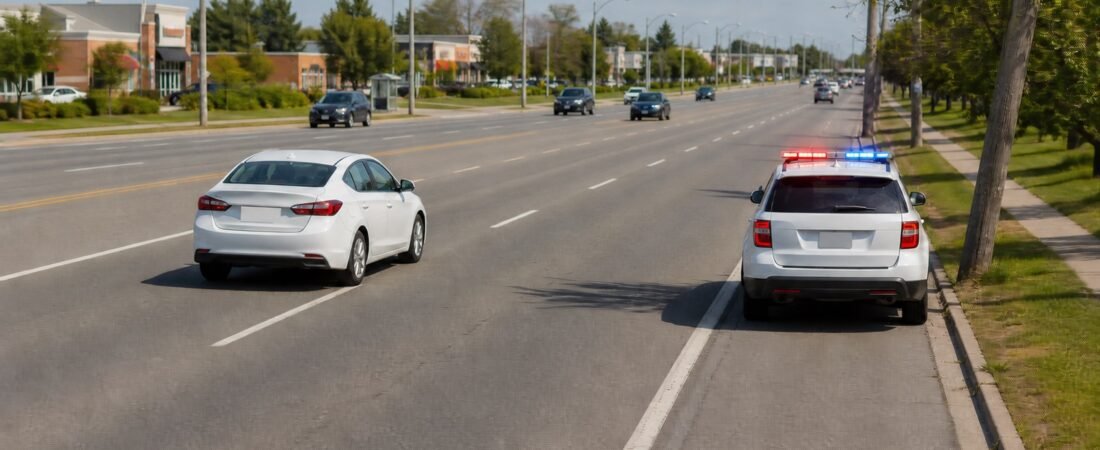
Flashing lights can make a new driver react too quickly or freeze in place. The safest response starts with identifying which situation you are facing: an emergency vehicle approaching through traffic, or an emergency vehicle or tow truck already stopped at the roadside. Ontario has different rules for each.
Two Situations, Two Different Responses
The words pull over and move over sound similar, but they describe different driving decisions.
- Approaching emergency vehicle: a police vehicle, fire truck, ambulance or public-utility emergency vehicle is coming toward or behind you with its siren, bell or required flashing lights. You must make room and stop.
- Stopped emergency vehicle or tow truck: the vehicle is stationary on your side of the road with qualifying lights flashing. You must slow down and pass cautiously; on a multi-lane road, move away from it if you can do so safely.
Keeping that distinction clear is useful on Scarborough’s busy arterial roads, where a driver may hear a siren before seeing its source or encounter a roadside response beyond a line of traffic.
When an Emergency Vehicle Is Approaching
Ontario’s Highway Traffic Act and the province’s emergency-vehicle guidance require drivers to bring their vehicle to a standstill when a qualifying emergency vehicle approaches with its lights or siren operating.
On a typical two-way Scarborough road, use this sequence:
- Look and listen. Check your mirrors and scan ahead and to both sides to find the emergency vehicle.
- Signal early. Show other drivers that you intend to move toward the right.
- Adjust speed smoothly. Avoid a panic stop. Other drivers may still be locating the emergency vehicle.
- Move near the right curb or edge. Keep the vehicle parallel to the road and clear of the intersection.
- Stop and wait. Stay stopped until the emergency vehicle passes, then check for another responder before signalling back into traffic.
On a one-way road with more than two lanes, Ontario’s rule allows the nearest curb or edge. The safest choice depends on your lane and the route the emergency vehicle is using. Do not weave across several lanes to reach the right if the nearer edge gives the responder a clear path.
What If You Are Already in an Intersection?
Do not stop where you block the intersection. The official MTO Driver’s Handbook says that a driver preparing to turn should abandon the turn, proceed straight when safe, clear the intersection and then pull right and stop.
This matters when traffic is queued at a Scarborough signal. If the light permits you to move and the way ahead is clear, create a predictable path out of the intersection. Do not turn suddenly across the likely route of the ambulance, fire truck or police vehicle. If you are still behind the stop line, remain out of the intersection and make space without entering against a red light.
Keep Highway Shoulders Clear
On Highway 401 or another high-speed road, move as close to the right side as practical but do not drive onto or block the shoulder. Emergency vehicles may use the shoulder when regular lanes are congested. Check mirrors, signal and reduce speed progressively so the driver behind has time to respond.
After the first emergency vehicle passes, wait a moment and look again. Police, fire and paramedic vehicles often respond to the same event. Ontario law also prohibits following within 150 metres of a fire department vehicle responding to an alarm, so never use the opening behind it as a way through traffic.
When the Emergency Vehicle or Tow Truck Is Stopped
The current Ontario move-over rule applies when you approach, on the same side of the highway, a stopped emergency vehicle with red or red-and-blue lights flashing or a stopped tow truck with amber lights flashing.
You must slow down and proceed with caution, taking traffic, road conditions and weather into account. When there are two or more lanes travelling in your direction, a driver in the stopped vehicle’s lane or the adjacent lane must move into another lane if the move can be made safely.
The words if it can be made safely matter. Do not force your way into an occupied lane or make a sudden swerve. Begin scanning well ahead, check your mirrors, signal, shoulder-check and move over early when a safe gap is available. SparkOn’s guide to calm Ontario lane changes gives a repeatable routine.
If traffic prevents a safe lane change, reduce speed gradually, leave as much space as practical and pass with exceptional care. Watch for responders, tow operators, a disabled vehicle, equipment or debris near the lane edge. Avoid staring at the scene; keep scanning the road ahead.
A Simple Scarborough Move-Over Routine
- Spot the lights early. Look far enough ahead to distinguish a stopped response from an approaching vehicle.
- Check behind. Know how closely the next driver is following before you slow.
- Ease off and signal. Make your speed and lane intentions clear.
- Create a full lane of clearance when safe. Complete the lane change rather than straddling a line.
- Pass slowly and attentively. Expect people or equipment close to traffic.
- Return only when useful and safe. Do not cut back immediately beside the stopped vehicle.
Good following distance makes every step easier. A driver who leaves space has more time to recognize the lights, check traffic and brake smoothly. Review the two-second following rule before your next practice drive.
What Changes on January 1, 2027?
Ontario has proclaimed an amendment to take effect on January 1, 2027. The revised rule will add defined work-related vehicles with flashing amber lights to the vehicles for which drivers must slow down and, where applicable, move over. The legislation includes an exception for certain construction-zone situations.
This is a future change, not the rule in force as of this article’s July 2026 publication date. The official Ontario Order in Council 1119/2026 sets the effective date, while the Working for Workers Six Act, 2024 contains the amended wording. Drivers should check Ontario’s current guidance as the effective date approaches.
Common Mistakes to Avoid
- Braking hard before checking what is behind you.
- Stopping inside an intersection.
- Turning across the path of an approaching emergency vehicle.
- Blocking a highway shoulder that responders may need.
- Assuming one emergency vehicle is the only one coming.
- Forcing an unsafe lane change beside a stopped vehicle.
- Passing at normal speed because you cannot move over.
- Following closely behind a fire vehicle through traffic.
Road-Test Practice Without Guessing at a Route
You do not need a supposed test route to practise these decisions. Work on mirror checks, smooth braking, clear signals, shoulder checks and leaving intersections open during regular lessons. These habits support both everyday safety and the observation skills expected during G2 road-test preparation.
Ask your accompanying driver or instructor to give you a safe verbal scenario while parked: Where would you stop if a siren appeared behind you? Which lane would you choose beside a stopped tow truck? Talking through the decision first makes the real response calmer.
Practise Calm Emergency-Vehicle Decisions in Scarborough
SparkOn’s one-on-one driving lessons in Scarborough help G1, G2 and G drivers build the scanning, spacing and lane-control habits needed on busy local roads.
Book a Scarborough driving lesson and tell us which traffic situations you want to practise.