
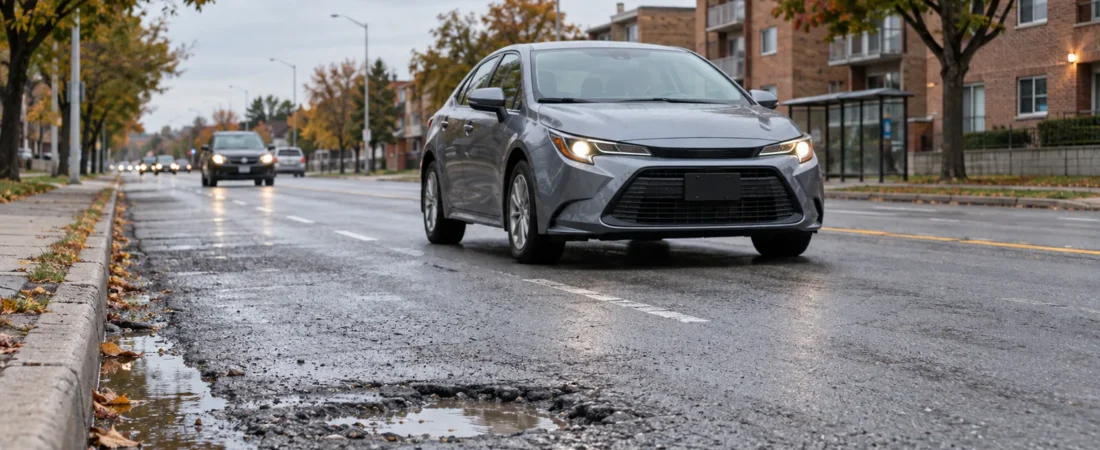
A pothole rarely gives you much time to think. One moment the road looks clear; the next, you notice a dark patch or broken edge directly in your path. For a new driver, the first reaction is often to grab the wheel and move away quickly. That reaction can turn a road-surface problem into a lane-control problem.
The safer approach starts earlier: scan farther ahead, keep useful space around the car and make one controlled decision. Here is how to practise that routine on Scarborough roads without treating every rough patch like an emergency.
What the official guidance says
The Official MTO Driver’s Handbook tells drivers to keep a cushion of space, look well ahead and steer smoothly and precisely. Its bad-weather guidance specifically warns that a puddle may hide a pothole large enough to damage a vehicle, its suspension or a tire. The handbook recommends planning movements early and using smooth steering, braking and acceleration.
The City of Toronto’s pothole page explains that water can enter cracks in asphalt, freeze and expand, and help break the pavement apart under traffic. It also provides the official way to report a pothole on a City road, expressway or bike lane through Toronto 311.
Those are the official sources. The driving routine below is practical instructor guidance for applying them; it is not a special road-test rule or a claim that you must always steer around every pothole.
Why looking farther ahead matters
If you see the hazard only when it disappears under the hood, your choices are already limited. Looking farther up the road gives you time to check traffic, ease off the accelerator and decide whether a small change in position is safe.
On a dry road, clues include broken edges, loose gravel, patched asphalt and vehicles ahead moving slightly around the same spot. After rain, the surface can be harder to read. A puddle may be shallow, or it may fill a deep hole. Treat water that you cannot see through as an unknown hazard rather than aiming a wheel through it.
Scarborough’s wider arterials can make a learner feel there is plenty of room, but adjacent lanes may be occupied by faster traffic. Residential roads create a different problem: parked cars, cyclists, pedestrians and narrow travel space can remove the easy escape route. The habit is the same in both places—see the surface early, then check the full traffic picture before moving sideways.
Use a calm decision order
When you spot damaged pavement ahead, work through these steps:
- Look where you want the car to go. Do not stare only at the hole. Keep your eyes moving between the safe path and surrounding traffic.
- Check mirrors and the nearby lane. Know whether a cyclist, motorcycle or vehicle is beside you before changing your position.
- Reduce speed smoothly if needed. Ease off early. Avoid a sharp brake application that surprises the driver behind.
- Choose the smallest safe adjustment. If there is room inside your lane, a gentle change in position may be enough.
- Hold a steady path over or past the rough section. Avoid braking hard or making a second sudden steering input at the obstacle.
- Re-centre gradually. Check the space again and return to a normal lane position without snapping the wheel back.
Sometimes the safest choice is to drive straight over a smaller defect at a reduced, controlled speed. Swerving into another vehicle, cyclist, curb or oncoming lane is a much greater risk than accepting a firm bump. You cannot decide safely without knowing what is beside you.
Stay in your lane unless a lane change is truly needed
A slight position change within your own lane is not the same as a lane change. Once your tires cross a lane marking, however, you are entering another driver’s space. That requires the normal mirror, signal and blind-spot routine described in our Ontario lane-change guide.
Do not drift over a centre line to avoid rough pavement unless the movement is legal and you have confirmed the opposing side is completely clear. Oncoming traffic can close the distance faster than a nervous learner expects. Near a bike lane, assume a cyclist may need extra space to avoid the same pothole. The MTO handbook recognizes that cyclists may move away from the curb to avoid potholes, debris and sewer grates, so leave a generous buffer rather than trying to squeeze past. Our guide to driving near cyclists in Scarborough covers that situation in more detail.
Common mistakes I want learners to correct
Fixating on the pothole. When your eyes lock onto one object, the steering often follows. Identify the hazard, then move your vision to the safe path beyond it.
Swerving first and checking second. A mirror check after you move is too late. Build the habit of checking space whenever the road surface ahead looks uncertain.
Following too closely. The vehicle ahead can hide a pothole until it is almost under your tires. A larger following gap improves both visibility and decision time. Review the Ontario following-distance routine if your view is regularly blocked.
Braking hard while turning. Sudden braking and steering place more demand on the tires at the same time. When possible, slow before the hazard, then steer smoothly.
Copying the car ahead. That driver may move at the last moment or may have more clearance than your vehicle. Use their movement as a clue, not as a command.
Assuming every puddle is harmless. If you cannot judge its depth, create space and avoid it when that can be done safely. Our heavy-rain driving guide explains why standing water requires extra caution.
If you hit a pothole
A hard impact does not automatically mean the car is damaged, but do not ignore a new vibration, pulling sensation, unusual steering, tire-pressure warning or visible tire problem. Keep control of the car and find a safe place off the travelled road before inspecting anything.
Do not stop in a live lane to look at the wheel. If the tire is losing air or the steering feels unsafe, arrange professional help rather than continuing. The MTO’s vehicle-maintenance guidance says drivers should watch for tire condition, warning lights and unusual vehicle behaviour, and consider inspection or repair when a concern appears.
A practical Scarborough pothole checklist
Before and during a drive:
- check that the tires are properly inflated according to the vehicle manufacturer’s label;
- keep enough following space to see the pavement ahead;
- scan beyond the car directly in front of you;
- treat puddles and broken pavement as possible hazards;
- check mirrors before changing lane position;
- slow early and steer smoothly;
- give cyclists room to avoid damaged pavement;
- pull over safely if an impact changes how the car feels.
Once you are safely parked, you can use the City’s online form or contact 311 to report a pothole. Note the road name, direction of travel, nearest intersection and which lane is affected. Do not try to photograph, type or submit the report while driving.
Practise the observation, not the swerve
The goal of a lesson is not to hunt for potholes. It is to improve the skills that make road hazards manageable: looking farther ahead, keeping space, checking beside the car and making smooth steering decisions. Those habits also help with debris, uneven repairs, construction plates and unexpected stopped traffic.
If rough roads make you tense or you tend to react late, SparkOn offers driving lessons in Scarborough with focused practice for observation, lane position and controlled braking. Book a Scarborough lesson and tell us you want to work on seeing road hazards earlier and responding without sudden swerves.